

Rahul Guleria
SEO Executive
Creative,
Branding
& Growth
in the Global
Digital Ecosystem

Write Something....
The ecommerce industry is evolving faster than ever in 2026. From AI-powered recommendations to immersive AR shopping experiences, brands are redefining how customers discover, compare, and purchase products online. Consumers now expect highly personalized shopping journeys, seamless mobile experiences, instant customer support, and faster deliveries — all powered by modern ecommerce technologies.
The biggest ecommerce trends in 2026 include AI personalization, voice commerce, AR/VR shopping, social commerce, ecommerce automation, and mobile-first customer experiences.
Businesses investing in modern ecommerce website development guide strategies are focusing heavily on AI-powered shopping experiences and automation. Companies that adapt early to these ecommerce industry trends are gaining a major competitive advantage in customer engagement, retention, and conversions.
To implement these technologies effectively, many brands are also investing in professional ecommerce website development services.
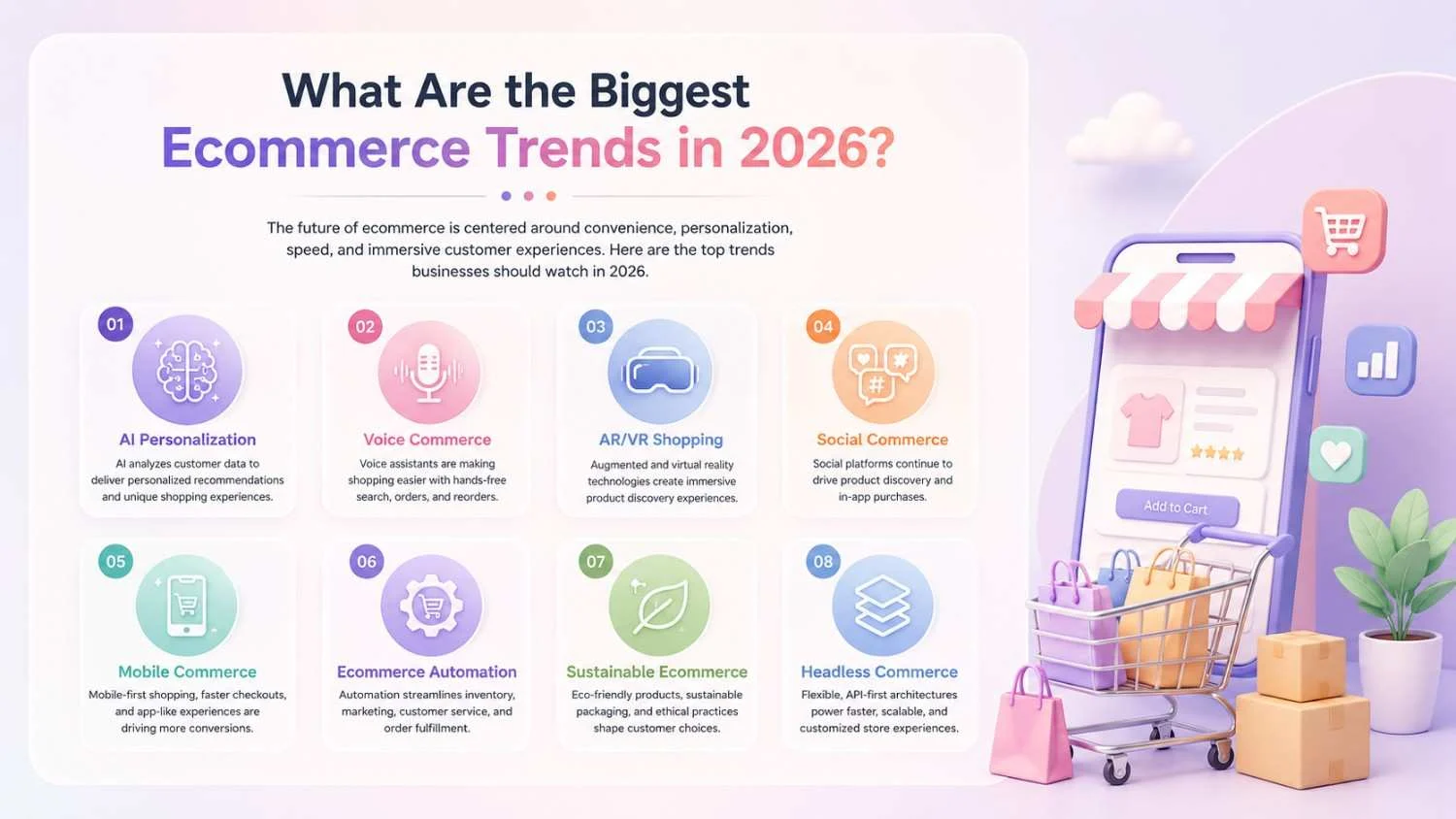
The future of ecommerce is centered around convenience, personalization, speed, and immersive customer experiences. Some of the most important ecommerce trends 2026 businesses should watch include:
Modern businesses are upgrading their stores through scalable ecommerce website development strategies to stay competitive in the rapidly evolving digital marketplace.
AI in e-commerce is transforming the way online stores interact with customers. Machine learning algorithms analyze customer behavior, purchase history, browsing patterns, and preferences to deliver highly relevant shopping experiences.
Today’s consumers expect brands to understand their needs instantly. AI makes this possible through smart recommendations, dynamic pricing, automated customer support, and predictive search experiences.
AI personalization improves customer satisfaction while increasing conversions and average order value. Some key benefits include:
AI recommendations perform best when integrated with advanced ecommerce website features.
Popular AI tools in e-commerce include:
Search visibility also depends on implementing a strong ecommerce SEO guide strategy.
Businesses often combine AI technology with professional ecommerce website design services to improve user experience.
Predictive shopping allows ecommerce platforms to recommend products before customers even search for them. AI can predict customer intent based on browsing history, demographics, and shopping habits, helping brands improve conversions and reduce cart abandonment.
Voice commerce allows consumers to shop online using voice assistants like Alexa, Siri, and Google Assistant. Customers can search for products, reorder items, and complete purchases using simple voice commands.
Voice commerce is becoming one of the fastest-growing online shopping trends 2026 due to the increasing use of smart devices.
Consumers are becoming more comfortable using voice assistants for everyday shopping tasks. Smart assistant shopping provides convenience, speed, and hands-free browsing.
As voice commerce grows, brands must optimize product pages for conversational search queries and long-tail keywords.
To improve voice search performance, brands should follow modern ecommerce website design best practices.
AI-powered chatbots and messaging apps are becoming essential for conversational shopping. Customers now expect instant responses, personalized recommendations, and real-time support across multiple channels.
To improve voice search performance, brands should follow modern ecommerce website design best practices.
Voice-first experiences work best with mobile-optimized web design services.
AR/VR ecommerce uses augmented reality and virtual reality technologies to create immersive shopping experiences online.
Customers can virtually try on clothes, eyewear, makeup, and accessories before making a purchase. This reduces returns and improves buyer confidence.
3D product models allow shoppers to view products from multiple angles and interact with them digitally.
Interactive shopping experiences are becoming essential ecommerce website features in 2026.
Virtual showrooms and metaverse shopping experiences are becoming increasingly popular among younger consumers.
AR/VR functionality often requires scalable ecommerce website development services.
Mobile commerce trends continue to dominate ecommerce growth in 2026. Most consumers now prefer shopping directly from smartphones and tablets.
Fast checkout experiences reduce friction and improve conversion rates significantly.
PWAs provide app-like experiences without requiring users to download native applications. They improve speed, responsiveness, and mobile usability.
Poor responsiveness remains one of the most common ecommerce website mistakes.
Mobile-friendly design, faster loading speeds, and simplified navigation are essential for improving user experience.
A responsive layout is critical for successful ecommerce website design.
Mobile-first optimization is now a core part of modern ecommerce website design services.
Social commerce allows users to discover and purchase products directly through social media platforms.
Platforms like Instagram now offer integrated shopping experiences that reduce the gap between product discovery and purchase.
Live shopping events are growing rapidly because they combine entertainment, product demonstrations, and instant buying opportunities.
Influencers continue to shape purchasing decisions through product recommendations, reviews, and live promotions.
Social commerce is becoming an important part of the overall ecommerce development process.
Many brands use scalable Shopify development services to launch social commerce stores quickly.
Automation tools help businesses manage stock levels, prevent overselling, and improve supply chain efficiency.
AI-powered customer support systems can handle common queries instantly while reducing operational costs.
Automated fulfillment systems improve shipping accuracy and delivery speed.
Email automation, retargeting campaigns, and customer segmentation tools improve marketing performance significantly.
Automation tools are commonly integrated during the build ecommerce website process.
Businesses should also evaluate overall ecommerce website development cost in India before implementing advanced automation.
Automation integration becomes easier with professional ecommerce website development services.
Consumers increasingly prefer brands using recyclable and sustainable packaging materials.
Many ecommerce brands are investing in carbon-neutral delivery methods to reduce environmental impact.
Modern consumers value ethical sourcing, transparency, and sustainability when choosing brands.
Sustainable brands are increasingly investing in scalable ecommerce website development services.
Headless commerce separates the frontend presentation layer from the backend ecommerce infrastructure.
API-driven systems provide flexibility and allow brands to deliver seamless omnichannel experiences.
Customers expect consistent experiences across websites, mobile apps, social platforms, and physical stores.
Headless architecture improves website speed, flexibility, and scalability.
Businesses comparing platforms should understand the differences between Shopify vs WooCommerce vs Custom ecommerce solutions.
Headless commerce often requires advanced custom ecommerce development services.
AI may soon create fully automated storefront designs personalized for individual users.
Predictive analytics will continue improving customer targeting and purchase forecasting.
Autonomous drone delivery systems could reduce shipping times dramatically.
Virtual stores and digital experiences will become increasingly mainstream.
Blockchain-based payment systems may improve transaction security and transparency.
Future-ready businesses are investing in scalable ecommerce website development services to support AI-powered commerce.
Mobile-first shopping experiences are no longer optional.
Fast-loading websites improve SEO rankings and customer satisfaction.
Security should be prioritized during the build ecommerce website process.
Businesses should also follow strong ecommerce website security practices.
AI-powered tools can improve customer engagement, personalization, and automation.
Voice search optimization will become increasingly important for ecommerce visibility.
Choosing the right payment solution is critical for customer trust and conversions.
payment gateway integration ecommerce
Long-term growth also depends on reliable ecommerce SEO services.
The latest ecommerce trends in 2026 include AI personalization, voice commerce, AR/VR shopping, ecommerce automation, mobile-first experiences, and social commerce.
AI improves ecommerce through personalized recommendations, predictive analytics, automated support, and smarter customer experiences.
Voice commerce allows customers to search and buy products using voice assistants like Alexa, Siri, and Google Assistant.
Mobile commerce is growing because consumers increasingly prefer shopping through smartphones for convenience and speed.
The future of ecommerce includes immersive shopping experiences, AI-driven personalization, automation, and omnichannel commerce.