

Rahul Guleria
SEO Executive
Creative,
Branding
& Growth
in the Global
Digital Ecosystem

The most common e-commerce website mistakes include poor website design, slow loading speed, lack of mobile optimization, weak SEO, complicated checkout processes, and missing trust signals. These issues can significantly reduce conversions, traffic, and customer trust.
Launching an online store is easier than ever, but building a successful ecommerce business is far more challenging. Many brands invest heavily in products and marketing but still struggle with low traffic, poor conversions, and abandoned carts. In most cases, the problem comes down to avoidable ecommerce website mistakes.
From poor user experience and weak SEO to technical performance issues, even small errors can damage your online store’s growth potential. Customers expect fast, intuitive, and trustworthy shopping experiences. If your website fails to meet those expectations, users leave quickly — often without making a purchase.
Avoiding common ecommerce website errors is essential for improving search rankings, increasing conversions, and maximizing revenue. Whether you're launching a new store or optimizing an existing one, understanding these mistakes can help you build a high-performing ecommerce platform in 2026.
For a complete foundation, check out our ecommerce website development guide.
User experience (UX) directly impacts how customers interact with your online store. Poor usability frustrates visitors and increases bounce rates.
Complex menus and unclear categories make it difficult for users to find products. Customers should be able to locate products within a few clicks.
Common problems include:
● Too many menu categories
● Confusing navigation labels
● Missing search functionality
● Poor filtering options
Product pages should provide clear information, high-quality images, pricing, and benefits. Many ecommerce website mistakes happen when pages are cluttered or incomplete.
Weak or hidden call-to-action buttons reduce conversions significantly. Every product page should guide users toward the next action.
Examples:
● Add to Cart
● Buy Now
● Checkout Securely
Long checkout forms and unnecessary steps are major conversion killers.
● 70% of users abandon carts due to poor UX
● Mobile shoppers expect checkout in under 2 minutes
● Simple navigation improves engagement and retention
To improve usability, explore essential e-commerce website features.
Many ecommerce stores fail to generate organic traffic because of critical ecommerce SEO mistakes.
Without proper keyword optimization, search engines cannot understand your pages.
Important areas for keywords:
● Product titles
● Meta descriptions
● Product descriptions
● Image alt text
● URLs
Duplicate product descriptions are common across ecommerce websites and can harm rankings.
Missing or poorly written title tags and meta descriptions reduce click-through rates from search results.
Messy URLs hurt both SEO and user experience.
Bad URL Example: website.com/product?id=12345
Good URL Example: website.com/mens-running-shoes
● Optimize page titles
● Write unique meta descriptions
● Use schema markup
● Improve internal linking
● Add keyword-rich product descriptions
● Optimize image alt text
Technical performance plays a huge role in ecommerce success. Slow or unstable websites reduce customer trust instantly.
Website speed directly affects conversions and SEO rankings.
● 1-second delay → 7% conversion drop
Common causes:
● Unoptimized images
● Heavy scripts
● Poor hosting
● Too many plugins
Mobile commerce continues to dominate online shopping. Non-responsive websites lose both rankings and sales.
Broken pages create poor user experiences and negatively impact SEO.
Cheap hosting solutions often result in downtime, slow loading times, and security issues.
Even with good traffic, conversion-related ecommerce website errors can reduce revenue significantly.
Customers hesitate to buy from websites that look unsafe.
Examples of trust signals:
● SSL certificates
● Secure payment badges
● Verified reviews
● Money-back guarantees
Offering only one payment method creates friction during checkout.
Recommended options:
● Credit/Debit Cards
● UPI
● PayPal
● Wallets
● Buy Now Pay Later
Unexpected shipping or taxes during checkout increase cart abandonment.
Generic descriptions fail to persuade users. Focus on benefits, features, and customer pain points.
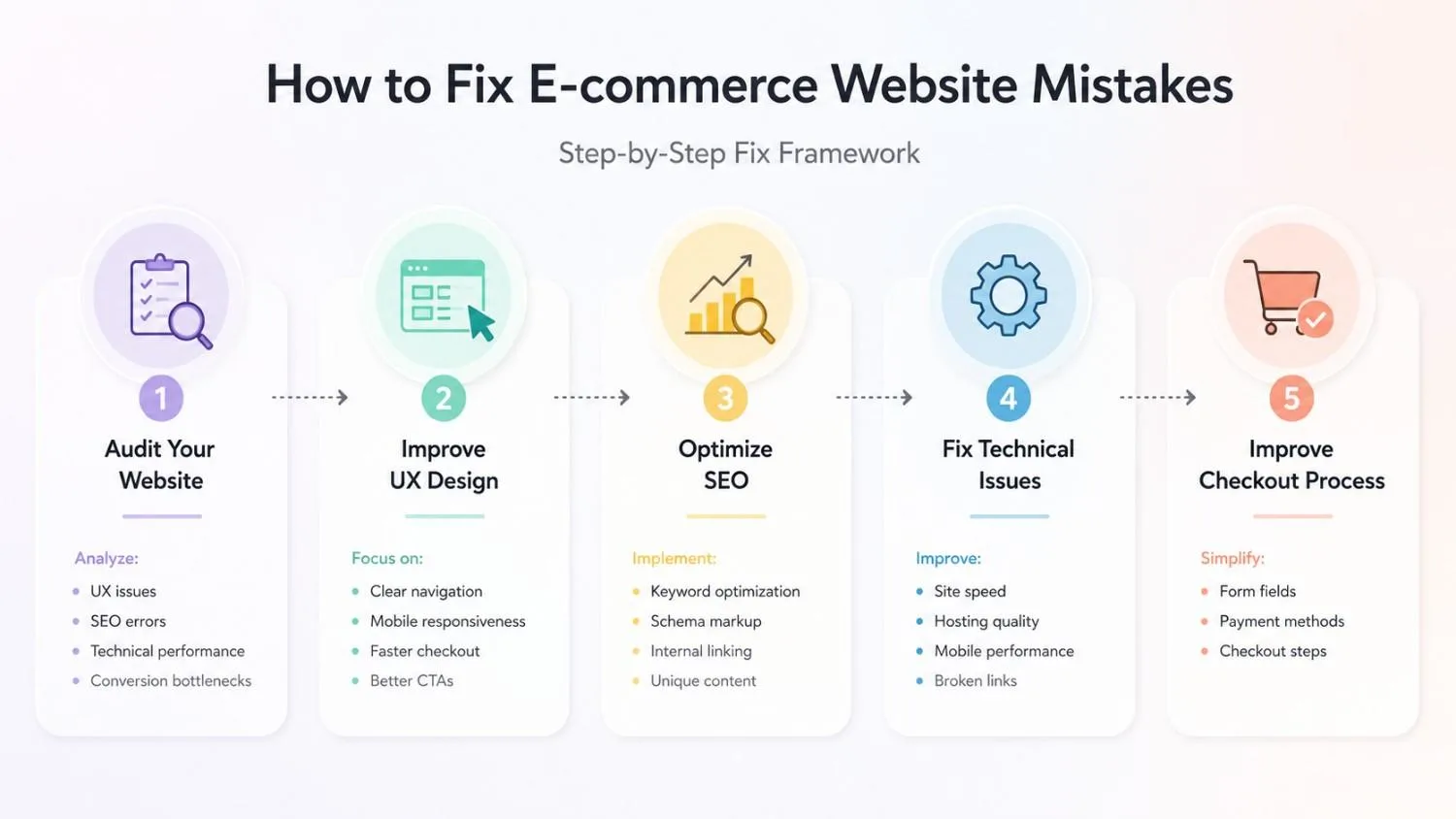
Fixing ecommerce website mistakes requires a structured optimization strategy.
Analyze:
● UX issues
● SEO errors
● Technical performance
● Conversion bottlenecks
Focus on:
● Clear navigation
● Mobile responsiveness
● Faster checkout
● Better CTAs
Implement:
● Keyword optimization
● Schema markup
● Internal linking
● Unique content
Improve:
● Site speed
● Hosting quality
● Mobile performance
● Broken links
Simplify:
● Form fields
● Payment methods
● Checkout steps
Area | What to Fix |
|---|---|
UX | Navigation, CTAs, checkout |
SEO | Keywords, meta tags, URLs |
Technical | Speed, mobile responsiveness |
Conversion | Trust badges, payment options |
Content | Product descriptions, images |
You can also learn how to build ecommerce website strategies that avoid these issues from the start.
Ignoring ecommerce website mistakes can severely impact business growth.
Poor UX and slow speed push users away before they engage with products.
Even small checkout problems can reduce completed purchases.
Technical SEO issues and weak content reduce visibility on search engines.
Every usability or performance issue directly affects sales and customer retention.
Many ecommerce businesses fail not because of poor products, but because of avoidable ecommerce website mistakes. Problems like weak SEO, poor UX, slow loading speed, and complicated checkout experiences can drastically reduce traffic and conversions.
The good news is that most ecommerce website errors can be fixed with proper optimization and regular audits. By focusing on user experience, technical performance, SEO, and trust-building strategies, you can create a faster, more reliable, and higher-converting online store.
Continuous improvement is essential in ecommerce. The more you optimize your website, the better your chances of increasing rankings, customer satisfaction, and long-term revenue.
For deeper insights, explore our complete complete ecommerce website development guide.
The biggest ecommerce website mistakes include poor navigation, slow loading speed, weak SEO, complicated checkout processes, missing trust signals, and poor mobile optimization.
These mistakes reduce conversions, increase bounce rates, lower customer trust, and negatively impact search rankings, ultimately reducing revenue.
The most common UX mistake is a complicated checkout process that creates friction and leads to cart abandonment.
You can fix ecommerce SEO mistakes by optimizing keywords, improving meta tags, using schema markup, creating unique content, and strengthening internal linking.
Website speed affects user experience, SEO rankings, and conversions. Slow websites increase bounce rates and reduce customer satisfaction.