
Rahul Guleria
SEO Executive
Creative,
Branding
& Growth
in the Global
Digital Ecosystem
A performance marketing funnel is the measurable customer journey that moves a potential buyer from an advertisement or other acquisition channel to a conversion and, ultimately, revenue. It connects audience targeting, ad creative, landing pages, conversion optimization, follow-up, retargeting, and analytics so marketers can identify where prospects drop off and continuously improve campaign performance.
A performance marketing funnel is a structured journey that moves a prospect from initial brand or product discovery through engagement, consideration, conversion, and eventually customer retention. Unlike a traditional funnel that may focus primarily on awareness and purchase, a performance marketing funnel connects each stage to measurable actions, costs, conversions, and revenue.
The purpose is not simply to generate traffic or clicks. It is to build a measurable system where marketers can understand:
In simple terms:
Audience → Ad/Traffic → Landing Page → Engagement → Conversion → Customer → Retention → Revenue → Optimization
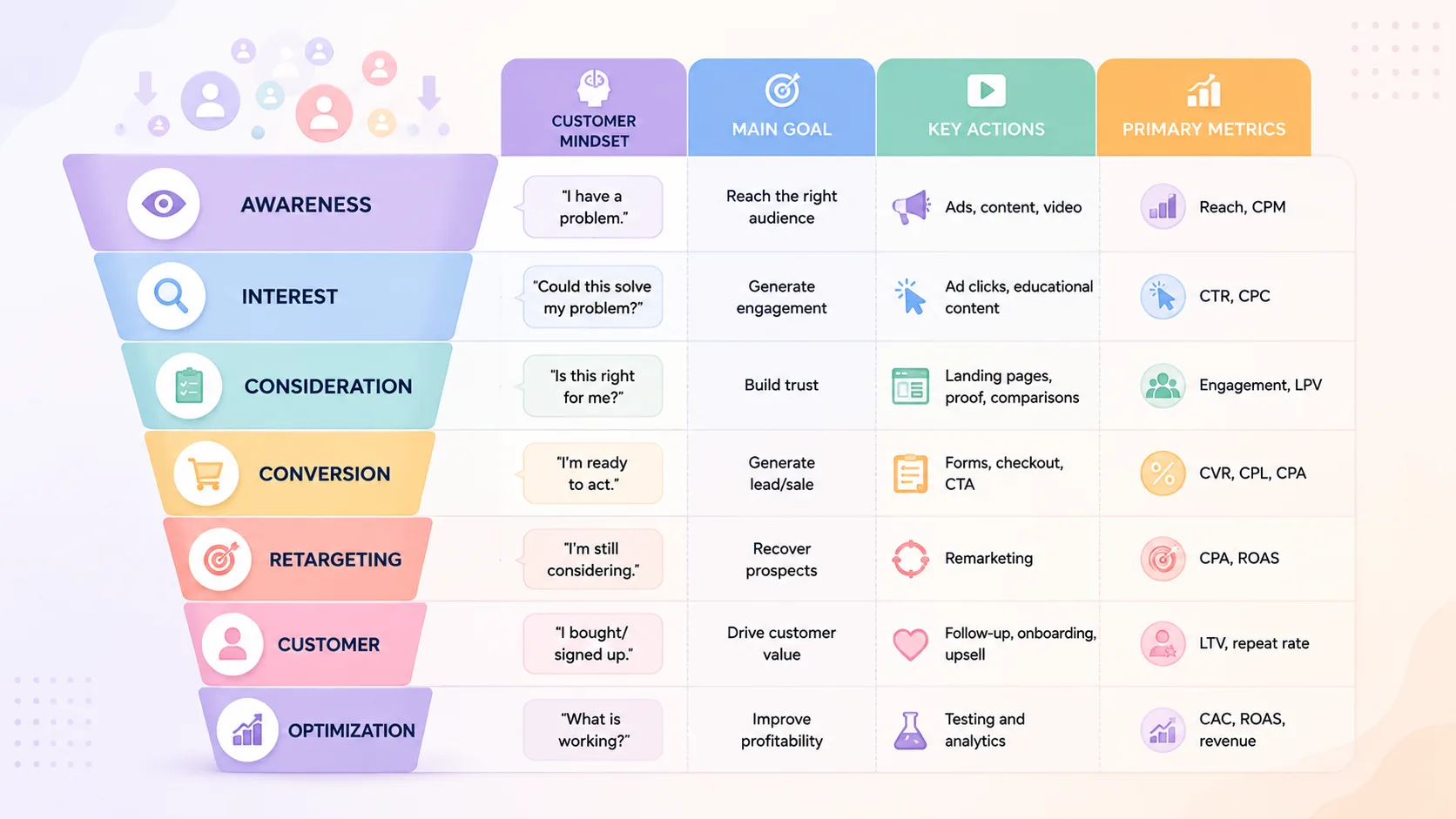
Funnel Stage | Customer Mindset | Main Goal | Key Actions | Primary Metrics |
|---|---|---|---|---|
Awareness | “I have a problem” | Reach the right audience | Ads, content, video | Reach, CPM |
Interest | “Could this solve my problem?” | Generate engagement | Ad clicks, educational content | CTR, CPC |
Consideration | “Is this right for me?” | Build trust | Landing pages, proof, comparisons | Engagement, LPV |
Conversion | “I’m ready to act” | Generate lead/sale | Forms, checkout, CTA | CVR, CPL, CPA |
Retargeting | “I’m still considering” | Recover prospects | Remarketing | CPA, ROAS |
Customer | “I bought/signed up” | Drive customer value | Follow-up, onboarding, upsell | LTV, repeat rate |
Optimization | “What is working?” | Improve profitability | Testing and analytics | CAC, ROAS, revenue |
This framework makes the funnel easier to understand because every stage has a defined objective and measurable outcome.
A performance marketing funnel generally follows this journey:
Ad/Traffic → Landing Page → Engagement → Conversion → Qualification/Purchase → Customer → Retention → Revenue → Optimization
However, the journey is rarely completely linear.
A prospect may see an advertisement, click through to a website, leave without converting, encounter a retargeting ad several days later, search for the brand on Google, return to the website, and then complete a purchase or submit an enquiry.
For example:
Ad impression↓Website visit↓No conversion↓Retargeting ad↓Google search↓Website return↓Conversion↓Customer
This is why performance marketing should not be evaluated only by the number of initial clicks. A campaign can generate inexpensive traffic but still perform poorly if those visitors do not become qualified leads or customers.
The real objective is to understand the complete customer journey and optimize the points where users are most likely to drop off.
The main stages of a performance marketing funnel are audience acquisition, traffic generation, consideration, conversion, retargeting, customer development, and optimization.
A performance marketing funnel starts with the right audience.
Reaching thousands of people is not necessarily valuable if those users have little interest in the product, service, or offer. Audience selection should therefore be based on factors such as customer needs, search intent, demographics, behaviour, location, and available first-party data.
Key activities can include:
A performance marketing funnel should target people who have a relevant need, intent, problem, or buying opportunity that the business can address.
For B2B campaigns, this could mean targeting decision-makers or accounts that match the company's ideal customer profile. For e-commerce, targeting can focus on users showing relevant product or purchase intent. For local businesses, location and service-related intent can be especially important.
For deeper audience analysis, businesses can use audience intelligence to better understand customer segments, behaviours, and opportunities.
The goal of paid advertising should not be to generate the maximum possible number of clicks.
The objective is to attract relevant clicks from users who have a realistic chance of converting.
An effective ad connects:
Audience need + relevant message + compelling offer + clear CTA
Important factors include:
For example, an ad targeting someone searching for a specific product should lead with a message relevant to that product rather than a generic brand statement.
Common metrics at this stage include:
A high CTR is useful, but it does not automatically mean a campaign is profitable. The quality of the traffic matters just as much as the volume.
Once someone clicks an ad, the landing page becomes one of the most important parts of the funnel.
The landing page should continue the promise made in the advertisement and make it easy for the visitor to understand what to do next.
Important elements include:
For example, if an advertisement promotes a specific service, the visitor should land on a page that clearly explains that service instead of being redirected to a generic homepage.
A well-designed landing experience can influence conversion rates, lead generation costs, and overall campaign efficiency.
Businesses can also learn more about landing page conversions and review common CRO mistakes that can create unnecessary conversion friction.
The conversion stage depends on the business model.
Different businesses may define a conversion differently.
Add to Cart → Checkout → Purchase
The goal is to move the shopper from product evaluation to completed purchase while reducing checkout friction.
Lead Form → MQL → SQL → Sales Call → Customer
A B2B conversion may begin with a form submission but requires additional qualification before becoming revenue.
Landing Page → Free Trial → Activation → Paid Account
For SaaS companies, the first conversion may be a free trial or demo, while the ultimate business outcome is a paid account.
Landing Page → Enquiry → Call/WhatsApp → Booking
For service businesses, a phone call, enquiry, WhatsApp conversation, or booking can be the key conversion event.
The important principle is to define the conversion that matters to the business rather than treating every click or form submission as the final outcome.
A click does not equal a conversion.
After clicking an advertisement, the visitor still needs to evaluate the landing page, understand the offer, establish trust, decide whether the solution is relevant, and complete the desired action.
The post-click journey can include:
Consider this illustrative example:
10,000 ad impressions → 500 clicks → 100 landing-page leads → 30 qualified leads → 8 customers
The most important question is not simply how many clicks the campaign generated. It is where prospects are being lost and why.
For example:
This approach turns the funnel into a diagnostic framework rather than simply a reporting model.
Generating more clicks is only one part of performance marketing. The bigger opportunity is to make more of those relevant clicks move through the funnel.
The ad promise should match the landing page promise.
If an ad promotes a particular product, service, discount, feature, or solution, the landing page should immediately reinforce that same message.
This reduces confusion and helps visitors understand that they have reached the right destination.
Even a small improvement in conversion rate can increase the number of leads or sales generated from the same amount of traffic.
Ways to improve conversion rate include:
Conversion optimization should be based on user behaviour and data rather than assumptions.
Conversion friction refers to anything that makes it unnecessarily difficult for a visitor to complete the desired action.
Common examples include:
Removing unnecessary friction can make it easier for qualified visitors to take action.
Many prospects do not convert during their first visit.
Retargeting gives marketers another opportunity to reconnect with users who have already demonstrated interest.
Potential retargeting audiences include:
The message can also become more specific as the prospect moves further down the funnel.
For B2B and service businesses, the number of leads alone can be misleading.
A campaign producing 1,000 low-quality leads may be less valuable than a campaign generating 100 highly qualified leads.
Businesses should therefore track:
Lead → Qualified Lead → Opportunity → Customer
This helps connect marketing activity with actual commercial outcomes.
Performance marketing should go beyond:
Clicks → Leads
A stronger measurement framework is:
Clicks → Leads → Customers → Revenue
This makes it possible to identify campaigns that may have a higher cost per lead but ultimately produce better customers and stronger revenue.
Retargeting helps bring back prospects who interacted with a business but did not convert during their first interaction.
A typical retargeting journey can look like this:
Cold Audience↓First Ad↓Website Visit↓No Conversion↓Retargeting Ad↓Landing/Product Page↓Conversion↓Customer
Retargeting can be used for different stages of consideration.
For example, an e-commerce business may show a product reminder to someone who viewed a product but did not purchase. A B2B company may show additional proof, case studies, or service information to someone who visited a landing page but did not submit a form.
Retargeting is particularly useful within paid media advertising because it allows campaigns to reconnect with audiences based on previous interactions rather than treating every user as a completely new prospect.
The metrics you track should correspond to the stage of the funnel and the business outcome you are trying to achieve.
Funnel Stage | Metrics |
|---|---|
Awareness | Impressions, Reach, CPM |
Traffic | CTR, CPC |
Engagement | Engagement rate, Landing Page Views |
Conversion | Conversion Rate, CPL, CPA |
Customer Acquisition | CAC |
Revenue | ROAS, Revenue |
Retention | Repeat Purchases, LTV |
Overall | Profitability, Contribution Margin |
Click-through rate (CTR) measures the percentage of users who click an advertisement after seeing it.
A strong CTR can indicate that the ad is relevant to the audience, although CTR alone does not prove that the traffic will convert.
Cost per click (CPC) shows how much is being paid, on average, for each click.
Lower CPC can be useful, but cheap clicks are not necessarily valuable if they produce poor-quality traffic.
Conversion rate measures the percentage of visitors or users who complete a desired conversion action.
For example:
100 landing-page visitors → 10 leads = 10% conversion rate
Cost per lead (CPL) measures the average advertising cost required to generate a lead.
It is particularly useful for lead-generation campaigns, but should be evaluated alongside lead quality.
Cost per acquisition (CPA) measures the cost of acquiring a defined conversion or customer, depending on how the campaign is configured.
Customer acquisition cost (CAC) measures the broader cost of acquiring a customer. Depending on the business, this can include marketing and sales costs rather than advertising spend alone.
Return on ad spend (ROAS) compares revenue attributed to advertising with the advertising spend.
For example:
₹2,00,000 attributed revenue ÷ ₹50,000 ad spend = 4× ROAS
ROAS should be interpreted in the context of margins, customer quality, and other business costs.
Customer lifetime value (LTV) estimates the value a customer generates over the duration of the relationship.
A campaign that acquires customers with strong long-term value may be more attractive than one that generates short-term purchases at a lower acquisition cost.
A performance marketing funnel can be built systematically by connecting business objectives, audience strategy, acquisition channels, conversion experiences, tracking, and optimization.
Start with a measurable business outcome.
Examples include:
Identify who is most likely to need and purchase the product or service.
Consider:
Choose channels based on where your target audience is most likely to discover and evaluate your offering.
Potential channels include:
Develop an offer that gives the target audience a clear reason to take action.
The offer could be:
Create a landing page or conversion experience that matches the campaign message and makes the next action clear.
Track meaningful actions such as:
Launch campaigns with defined audiences, creatives, offers, budgets, and conversion objectives.
Build appropriate audiences for users who interacted with your campaigns or website but did not complete the desired action.
Review performance stage by stage.
Look for gaps such as:
High traffic + low conversion
or
High leads + low qualification
or
High customer acquisition + low profitability
Test variables such as:
Once a funnel demonstrates consistent performance, scale the campaigns, audiences, offers, or creative combinations that contribute to profitable growth.
An e-commerce funnel can connect advertising with product discovery, purchase, and repeat buying.
Meta/Google Ad↓Product Landing Page↓Product View↓Add to Cart↓Checkout↓Purchase↓Retargeting / Email↓Repeat Purchase
An illustrative funnel might look like this:
Stage | Example Volume |
|---|---|
Impressions | 100,000 |
Clicks | 3,000 |
Product Views | 2,700 |
Add to Cart | 400 |
Checkout | 180 |
Purchases | 90 |
Repeat Purchases | 20 |
Note: These are illustrative numbers, not industry benchmarks.
This example shows why every stage matters. If 3,000 people click the advertisement but only 90 purchase, the business needs to understand what happens between the click and the purchase.
For example, optimization could focus on product-page messaging, pricing, trust signals, checkout friction, shipping information, or retargeting.
A B2B performance marketing funnel generally has more qualification and sales activity between the initial conversion and customer acquisition.
A typical journey can be:
Ad↓Landing Page↓Lead Form↓MQL↓SQL↓Sales Call↓Proposal↓Customer↓Revenue
In B2B marketing, a form submission should not automatically be treated as a successful business outcome.
For example, a campaign may generate many leads but fewer qualified opportunities. The marketing team should therefore connect campaign data with CRM and sales outcomes to understand which sources are actually producing revenue.
This becomes especially important when the sales cycle is long or the average customer value is high.
Performance marketing brings qualified traffic into the funnel, while conversion rate optimization (CRO) helps more of that traffic take the desired action.
CRO can improve different parts of the customer journey, including:
Common CRO activities include:
Compare different versions of a page element or experience to determine which performs better.
Test CTA wording, placement, visibility, and surrounding content.
A stronger headline can make the value proposition easier to understand immediately.
Reducing unnecessary fields and simplifying the form experience can reduce friction.
Improve navigation, page structure, readability, mobile experience, and overall usability.
For e-commerce, reducing unnecessary steps and making costs, delivery information, and payment options clear can improve the purchase experience.
Where appropriate, experiences can be adapted based on audience characteristics, behaviour, or funnel stage.
Businesses looking to improve this part of the funnel can explore Conversion Rate Optimisation and learn how to improve landing page conversions.
Clicks are an input, not the final business outcome. A campaign needs to be evaluated based on conversions, customer quality, and revenue.
A generic homepage may not provide the relevance or context required by someone responding to a specific advertisement.
When the ad and landing page communicate different messages, users may become confused or leave.
A low CPL can look attractive while producing leads that have little commercial value.
Without connecting leads to sales outcomes, marketers may not know which campaigns actually generate revenue.
Not every prospect converts on the first visit. Retargeting can help reconnect with interested users.
Even well-designed landing pages can have opportunities for improvement. Testing helps identify which changes actually improve performance.
Increasing budgets before understanding funnel economics can amplify inefficiencies instead of profitable growth.
Short-term ROAS does not always capture the full value of customers, particularly when repeat purchases or long-term relationships are important.
Data transforms the performance marketing funnel from a collection of campaigns into a measurable growth system.
A useful optimization cycle is:
Data Collection → Attribution → Analysis → Insight → Experiment → Optimization
Relevant data can come from:
For example, an advertising platform may show that one campaign produces a low cost per lead. CRM data may later reveal that another campaign produces fewer but significantly more qualified opportunities.
Without connecting marketing data with downstream business outcomes, it can be difficult to determine which campaign is genuinely more valuable.
Businesses can strengthen this measurement layer through data analytics and relevant technology and platform integrations.
Both traditional and performance marketing funnels can follow the broad journey from awareness to purchase, but performance marketing places greater emphasis on measurable actions, attribution, conversion data, and continuous optimization.
Traditional Funnel | Performance Funnel |
|---|---|
Awareness | Awareness |
Interest | Click/Engagement |
Consideration | Landing Experience |
Purchase | Conversion |
— | Retargeting |
— | Revenue Tracking |
— | Continuous Optimization |
A traditional advertising approach may focus heavily on reach and awareness, while a performance approach connects marketing activity to measurable outcomes and uses data to improve results over time.
For a broader comparison, see performance marketing vs traditional advertising.
AI is changing how people discover information, evaluate brands, interact with advertising, and make purchase decisions.
Ad → Click → Website → Conversion
Search/AI Answer → Brand Discovery → Website/Ad → Conversion
AI-assisted discovery can add new interactions before a user reaches a company's website.
Examples include:
The funnel does not disappear because AI changes discovery. Instead, the customer journey and measurement environment become more complex.
A prospect might discover a brand through an AI-generated answer, search for the company independently, see a paid advertisement later, visit the website, and then convert through another channel.
This means marketers increasingly need to think about both visibility and measurable conversion journeys.
A performance marketing article can also be structured so that search engines and AI-powered answer systems can understand and extract key information easily.
Useful practices include:
The goal is not to add keywords unnecessarily. Instead, information should be organized in a way that makes important concepts easy to understand, retrieve, and connect.
Answer-first formatting, clear headings, concise definitions, tables, and contextual internal links can make the content easier for both users and answer engines to interpret.
A performance marketing funnel is a measurable customer journey that moves prospects from acquisition and engagement to conversion, customer acquisition, retention, and revenue.
The main stages include awareness, interest, consideration, conversion, retargeting, customer development, and optimization.
It turns clicks into customers by connecting relevant advertising with targeted landing pages, clear offers, conversion optimization, follow-up, retargeting, lead qualification, and revenue tracking.
A marketing funnel describes the broader customer journey, while a performance marketing funnel emphasizes measurable actions, conversion data, acquisition costs, revenue, and continuous optimization.
Important metrics include CTR, CPC, conversion rate, CPL, CPA, CAC, ROAS, revenue, repeat purchase rate, and customer lifetime value.
Clicks may not lead to customers because of poor audience targeting, weak message match, ineffective landing pages, conversion friction, low-quality leads, pricing issues, or problems later in the sales process.
Retargeting reconnects with users who have previously interacted with a website, advertisement, product, or form but did not convert.
CRO improves performance marketing by helping a higher percentage of relevant visitors complete desired actions through better landing pages, CTAs, forms, UX, offers, and checkout experiences.
Landing pages provide the post-click experience where visitors evaluate the offer and decide whether to take the desired action. Their relevance, clarity, trust signals, and usability can significantly influence conversion performance.
Businesses can optimize their funnel by analyzing each stage, identifying drop-offs, improving audience targeting, testing ads and landing pages, using retargeting, improving lead quality, connecting marketing with revenue data, and scaling profitable campaigns.
A successful performance marketing funnel does more than generate clicks. It connects the right audience with the right message, landing experience, conversion path, follow-up, and measurement system.
The real objective is to turn relevant traffic into qualified leads or customers and continuously improve the economics of acquisition.
By tracking the complete journey—from the first interaction to conversion, customer acquisition, retention, and revenue—businesses can identify where opportunities exist and make more informed decisions about their marketing investment.
The strongest performance marketing funnels are not built around one campaign or one metric. They are built around a continuous process of targeting, testing, measuring, learning, and optimizing.
For businesses looking to build a more measurable digital growth strategy, PulsePlay Digital can help connect audience intelligence, paid media, conversion optimization, and data analytics into a performance-focused marketing approach.