
Rahul Guleria
SEO Executive
Creative,
Branding
& Growth
in the Global
Digital Ecosystem

Meta Ads can be used as a performance marketing channel by combining audience targeting, relevant creative, conversion-focused landing pages, tracking and continuous campaign optimization to drive measurable actions such as leads, purchases, registrations or bookings. The objective is not simply to generate impressions or clicks, but to connect advertising activity with meaningful business outcomes.
Meta Ads are paid advertising campaigns delivered across Meta's advertising ecosystem, including Facebook and Instagram. For performance marketing, they become one part of a broader system that connects media buying, audience strategy, creative, landing pages, conversion tracking, analytics and optimization.
A campaign may generate thousands of impressions, but impressions alone do not tell a business whether the campaign is creating customers or revenue. A performance-focused approach therefore connects:
Audience → Creative → Click → Landing Page → Conversion → Customer → Revenue → Optimization
Businesses can combine Meta Ads with broader performance marketing services to build a measurable acquisition and conversion system.
Meta Ads are paid social advertisements that businesses use to reach audiences across Meta platforms such as Facebook and Instagram. Advertisers can define campaign objectives, audiences, budgets, placements, creative formats and conversion goals to support different stages of the customer journey.
The Meta Ads ecosystem includes:
For example, an e-commerce business can use Meta Ads to introduce a product to new audiences, bring interested visitors to a product page, retarget people who viewed the product and ultimately optimize campaigns around purchases.
The same principle can apply to service businesses, SaaS companies, local businesses, B2B organizations and D2C brands, although the conversion event may be different.
A performance marketing approach connects the ad platform with the rest of the customer journey rather than treating advertising as an isolated activity.
A simple Meta Ads performance marketing process can be represented as:
Audience → Campaign Objective → Ad Creative → Ad Delivery → Landing Page → Conversion → Measurement → Optimization
The campaign begins by identifying who should see the advertisement. Depending on the campaign, this can include new prospects, website visitors, existing customers, engaged users or other defined audience groups.
The campaign objective should reflect the business outcome being pursued, such as awareness, traffic, leads or sales.
Creative communicates the offer to the selected audience through images, videos, carousels, Reels, copy and calls to action.
Meta's advertising system delivers ads to eligible users according to campaign settings, audience signals, placements, budget and optimization requirements.
The destination after the click should support the same message and objective as the advertisement.
The desired action could be a purchase, lead submission, booking, registration, app action or another measurable business event.
Tracking systems collect campaign and conversion data so marketers can understand what happened after the ad interaction.
The campaign can then be refined using audience, creative, landing-page, budget and conversion data.
This is the key distinction between Meta Ads and performance marketing.
Meta Ads are an acquisition channel.
Performance marketing is the broader measurable framework connecting:
Media → Audience → Creative → Website → Conversion → Revenue → Optimization
PulsePlay Digital's broader performance marketing approach also emphasizes campaign design, media buying and optimization, social media, analytics and technology capabilities.
Meta Ads | Performance Marketing |
|---|---|
Advertising platform and channel | Broader marketing approach |
Primarily Facebook and Instagram ecosystem | Multiple digital channels and touchpoints |
Audience targeting within the platform | Audience and channel strategy |
Ad creative | Creative plus landing-page and conversion experience |
Campaign-level metrics | Funnel and business metrics |
Paid social acquisition | Acquisition, conversion and optimization |
Platform-level reporting | Cross-funnel business measurement |
Meta campaign management | End-to-end measurable marketing |
Meta Ads can therefore be part of a performance marketing strategy, but the two terms should not be treated as interchangeable.
Campaign objectives should be connected to the actual business outcome rather than simply maximizing low-value engagement.
Awareness campaigns can support:
They are generally useful when the immediate goal is to introduce a brand, product or message to an audience.
Traffic campaigns can support:
Traffic can be useful when the business needs to bring users to a digital destination, but the value of that traffic should ultimately be assessed against downstream actions.
Engagement-focused campaigns can support:
Engagement can provide useful signals, but high engagement does not automatically mean high commercial value.
Lead-focused campaigns can support:
For B2B and service businesses, lead quality should be considered alongside lead volume.
Sales-focused campaigns can support:
For e-commerce businesses, the campaign can be connected to product discovery, product-page visits, add-to-cart activity and purchases.
App-focused campaigns can support:
The objective should be connected to what happens after installation rather than treating an install as the only meaningful outcome.
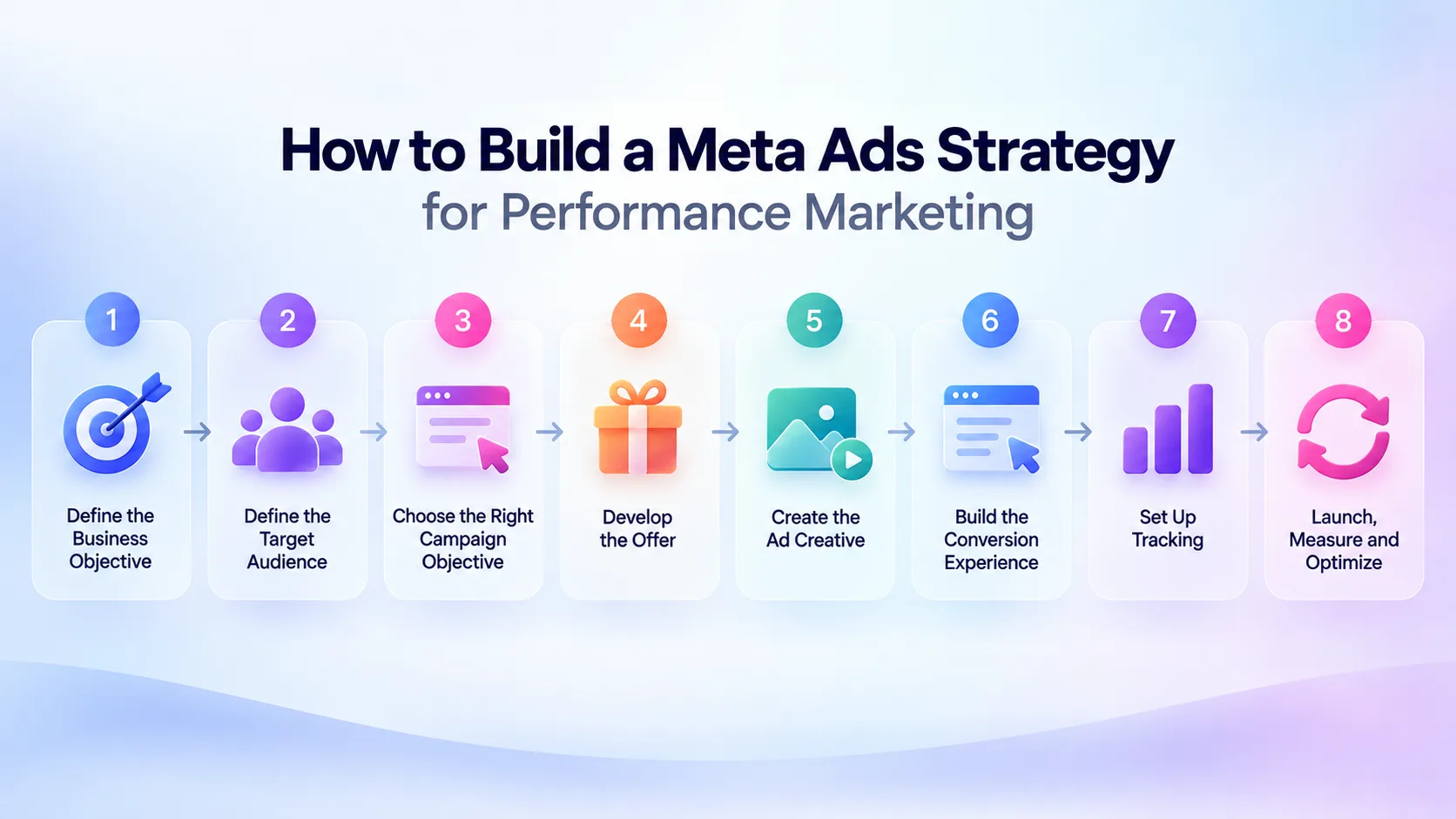
A strong Meta Ads strategy starts with the business outcome and works backward toward audience, creative, landing page and measurement.
Start by identifying what the campaign needs to achieve.
Examples include:
A clearly defined objective makes it easier to select an appropriate campaign structure and measurement framework.
Audience definition should go beyond basic demographics.
Consider:
Audience research can become particularly useful when campaign strategy is informed by audience intelligence, which can help businesses understand customer interests, behaviours and motivations.
The objective should correspond with the action you want the audience to take.
For example:
Business goal → Desired action → Campaign objective → Conversion event
A campaign designed to generate sales should be evaluated differently from one designed primarily for awareness.
The offer gives the audience a reason to act.
Depending on the business, this could be:
The offer should be relevant to the audience's level of awareness and position in the customer journey.
A useful creative framework is:
Audience Insight → Message → Creative → CTA
The creative should communicate why the offer is relevant and what the user should do next.
The ad should lead to a relevant destination.
Depending on the objective, this could be:
Tracking should connect advertising activity with the desired business action.
Important elements can include:
The more complete the measurement system, the easier it becomes to understand the commercial impact of campaigns.
Meta Ads should be treated as an iterative process.
The basic cycle is:
Launch → Measure → Analyze → Test → Optimize → Scale
The objective is not to make every campaign decision based on one metric. Instead, marketers should examine the relationship between audience, creative, cost, conversion rate, customer quality and revenue.
Targeting is one of the most important parts of a Meta Ads strategy because the same creative and offer can perform differently across audience groups.
Broad targeting can be useful when there is sufficient conversion data and the campaign needs room to identify potential customers within a larger audience.
Instead of manually restricting the audience too heavily, marketers can allow the platform to use available signals to identify people who may be relevant to the campaign objective.
Broad targeting should still be evaluated against actual business outcomes.
Interest-based targeting can help advertisers reach people associated with particular interests or categories.
It can be useful when:
Interest targeting should be tested rather than assumed to be the final audience structure.
Custom audiences can be created from first-party or platform engagement signals, depending on the available setup.
Examples include:
These audiences can support both retargeting and customer-specific campaigns.
Lookalike audiences are designed to help advertisers reach new people who share characteristics or signals with an existing source audience.
The quality of the source audience matters.
For example, a lookalike based on actual customers can represent a different marketing signal from one based on all website visitors.
Retargeting focuses on people who have already interacted with a business.
Examples include:
The messaging should change based on what the audience has already done.
Geographic targeting can support:
For example, a local service business may focus advertising around specific cities or service areas, while an e-commerce brand may run campaigns across multiple regions.
A useful creative framework is:
Hook → Problem → Value Proposition → Proof → CTA
The purpose is to make the message relevant quickly and provide a clear reason for the audience to continue.
The first part of the creative should capture attention and establish relevance.
The hook can focus on:
Whenever possible, demonstrate what the user receives or what outcome the product or service can help create.
For e-commerce, this may mean showing the product in use.
For SaaS, it could mean showing the interface or workflow.
For services, it could mean communicating the transformation, process or business result.
A cold audience may need education or problem awareness.
A warm audience may need proof, differentiation or a stronger offer.
A retargeting audience may need a reminder, objection handling or a conversion-focused message.
Meta Ads can use different creative formats, including:
The appropriate format depends on the product, audience, message and campaign objective.
Businesses can also connect paid campaigns with broader social media marketing strategies covering social creative, engagement, paid social and audience insights.
Examples include:
Creative testing helps identify which message resonates with specific audiences.
Ad gets the click → Landing page earns the conversion.
A successful Meta Ads campaign can still underperform if the landing page creates friction or does not match the advertisement.
Important landing-page factors include:
The landing page should continue the promise made in the advertisement.
If an advertisement promotes a particular offer but the landing page forces the user to search for that offer, conversion friction can increase.
The headline should make the value proposition easy to understand.
The next step should be obvious.
Examples include:
Because Meta Ads frequently reach users on mobile devices, mobile usability should be part of the conversion experience.
Depending on the business, trust can be supported by:
Lead-generation pages should collect the information necessary for qualification without creating unnecessary friction.
For e-commerce, the journey from product page to checkout should be clear and easy to navigate.
Businesses looking to improve this part of the funnel can explore conversion rate optimisation as part of a broader performance strategy.
Retargeting is based on the principle that users who have already interacted with a brand may require a different message from completely new prospects.
A basic structure is:
Prospecting → Retargeting → Conversion
Reach users who visited relevant website pages but did not complete the desired action.
Show relevant product messaging to people who viewed specific products.
Reconnect with users who added products to their cart but did not complete checkout.
Users who interacted with a lead form but did not complete it may receive a different message from completely new prospects.
Users who interacted with videos, posts or other content can become potential retargeting audiences.
Existing customers may receive campaigns designed around:
The messaging should reflect the audience's previous relationship with the brand.
A Meta Ads performance marketing funnel can be represented as:
Cold Audience
↓
Meta Ad
↓
Landing Page / Product Page
↓
Engagement
↓
Lead / Add to Cart
↓
Retargeting
↓
Conversion
↓
Customer
↓
Repeat Purchase / Retention
This connects Meta Ads with the broader performance marketing funnel, where audience targeting, ads, landing pages, CRO, follow-up, retargeting and analytics work together.
A performance funnel should therefore not stop at the click or lead. The more useful measurement chain is:
Click → Lead → Customer → Revenue
Optimization should happen across multiple parts of the funnel.
Test:
The objective is to understand which audience groups produce meaningful business outcomes.
Test:
Creative fatigue should also be monitored when performance declines after prolonged use of the same creative.
Test:
Budget allocation should be based on campaign performance, testing requirements and business objectives.
A campaign producing a low cost per click is not automatically the campaign that should receive the most budget if it produces fewer valuable conversions or customers.
Businesses can combine Meta Ads with broader paid media advertising, where media buying involves spend allocation, monitoring, pacing, bid considerations and performance campaigns.
Different metrics answer different questions.
Metric | What It Measures |
|---|---|
Impressions | Ad delivery |
Reach | Unique users reached |
CPM | Cost per 1,000 impressions |
CTR | Click-through rate |
CPC | Cost per click |
Landing Page Views | Users reaching the landing page |
Conversion Rate | Percentage completing the desired action |
CPL | Cost per lead |
CPA | Cost per acquisition |
ROAS | Revenue generated relative to ad spend |
CAC | Customer acquisition cost |
LTV | Customer value over time |
The most useful metric depends on the campaign's actual objective.
For example, a lead-generation campaign may focus heavily on lead quality and cost per qualified lead, while an e-commerce campaign may place more emphasis on purchases, revenue, CPA and ROAS.
For a broader framework, see PulsePlay's performance marketing KPIs, which covers performance metrics used to evaluate marketing activity.
A useful financial framework is:
Budget → Spend → Conversions → Revenue → ROAS → Profitability
Budget decisions should consider:
There is no single Meta Ads budget that is appropriate for every business.
A campaign should have enough budget to generate useful data, but the required amount depends on factors such as audience size, conversion rate, sales cycle, target CPA, average order value and customer economics.
Similarly, ROAS should be interpreted in context.
A higher ROAS does not automatically mean greater business value if the campaign produces low-quality customers, limited scale or low-margin sales.
For a broader view of planning, businesses can also review PulsePlay's performance marketing budget and ROAS vs ROI resources.
A performance marketing system should turn campaign data into actionable decisions.
The basic process is:
Campaign Data → Analysis → Insight → Test → Optimization
Important areas include:
For example, a campaign may show a strong click-through rate but a weak conversion rate. This can indicate that the issue may not be the advertisement itself but the landing page, offer, audience intent or conversion experience.
Similarly, a campaign with a higher cost per lead may produce better-qualified customers and more revenue.
Connecting campaign data with broader data analytics capabilities can help businesses analyze performance beyond individual platform metrics.
Meta Ads can also connect with marketing automation systems after the initial conversion.
Automation can support:
For example:
Meta Ad → Lead → CRM → Automated Follow-Up → Sales → Customer
This helps prevent marketing performance from being measured only at the moment a form is submitted.
Businesses can connect campaign activity with broader marketing automation workflows to improve follow-up and customer journeys.
A more complete performance marketing system can connect:
Meta Ads → Website → Analytics → CRM → Sales → Revenue
Technology integration can support:
For example, an e-commerce business may connect advertising data with website behaviour, purchase information, customer records and revenue reporting.
This makes it possible to evaluate campaigns based on business outcomes rather than isolated platform metrics.
Businesses with complex marketing technology requirements can explore technology and platform integration as part of their broader digital infrastructure.
Meta Ads can support different business models, but the conversion journey and measurement framework should change according to the business.
A typical e-commerce journey is:
Ad → Product Page → Add to Cart → Checkout → Purchase
Important metrics may include:
For businesses that need support across their digital commerce infrastructure, e-commerce and websites can form part of the broader acquisition and conversion system.
A B2B funnel may look like:
Ad → Lead Form → MQL → SQL → Sales → Customer
B2B campaigns may require more time between the initial ad interaction and revenue.
Lead volume should therefore be considered alongside:
A SaaS funnel can look like:
Ad → Landing Page → Demo/Trial → Activation → Paid Account
The campaign should not necessarily be evaluated only on clicks or sign-ups.
Activation and paid conversion can provide additional context.
A local business funnel may be:
Ad → Landing Page → Enquiry → Call → Booking
Relevant conversions may include:
A D2C funnel may look like:
Ad → Product Discovery → Product Page → Purchase → Retargeting → Repeat Purchase
This connects acquisition with retention and customer lifetime value.
Clicks can indicate traffic generation, but they do not necessarily represent customers or revenue.
Overly restrictive targeting can limit delivery and reduce the available audience pool.
Audience response can change over time, making creative testing important.
The homepage may not always be the most relevant destination for a specific advertisement.
A strong advertisement cannot compensate indefinitely for a weak or confusing conversion experience.
Lead volume alone may hide differences in lead quality and customer value.
Increasing spend before understanding the relationship between audience, creative, conversion and revenue can make inefficiencies more expensive.
CTR, CPC, CPL, CPA and ROAS each provide different information. A campaign should be evaluated using metrics appropriate to the business objective.
Meta Ads are a paid social advertising channel that can be used within a broader performance marketing strategy to generate measurable actions such as leads, purchases, registrations, bookings or other conversions.
Meta Ads work by connecting audience targeting, campaign objectives, creative, ad delivery, landing pages, conversion tracking and optimization to measurable business outcomes.
A performance-focused Meta Ads strategy begins with a clear business objective and connects audience selection, campaign objective, creative, landing page, tracking, measurement and continuous optimization.
Audience targeting can include broad audiences, interest-based audiences, custom audiences, lookalike audiences, website visitors, engaged users, existing customers and geographic segments. The appropriate structure depends on the business, campaign objective and available data.
Meta Ads retargeting is the process of advertising to people who have previously interacted with a business, such as website visitors, product viewers, engaged users, leads or cart abandoners.
Common metrics include impressions, reach, CPM, CTR, CPC, landing page views, conversion rate, CPL, CPA, ROAS, CAC and LTV. The appropriate metrics depend on the campaign objective and business model.
Meta Ads campaigns can be optimized by testing audience segments, creative, offers, landing pages, conversion events and budget allocation while evaluating performance against meaningful business outcomes.
There is no universal ROAS benchmark that applies to every business. An acceptable ROAS depends on factors such as profit margins, customer acquisition cost, average order value, repeat purchase behaviour, customer lifetime value and business model.
Meta Ads budgets depend on business economics, conversion rates, target CPA or CAC, audience size, sales cycle and testing requirements. Instead of using an arbitrary universal budget, businesses should determine spending based on their ability to generate useful data and achieve commercially meaningful outcomes.
Meta Ads can be used for e-commerce product discovery, acquisition, retargeting and sales campaigns. Performance should be evaluated using metrics such as purchases, CPA, revenue, ROAS and customer value.
Meta Ads can be used by B2B businesses for awareness, lead generation, remarketing and other acquisition activities. Because B2B sales cycles can be longer, lead quality, qualification and downstream sales outcomes are important measurements.
Meta Ads are primarily paid social advertising across Meta's ecosystem, while Google Ads includes advertising formats across Google's search and other advertising properties. The audience intent, targeting approach, creative requirements and campaign objectives can differ between the two channels.
Meta Ads can become an effective part of a performance marketing system when advertising is connected to the complete customer journey.
The core framework is:
Meta Ads → Right Audience → Right Creative → Right Offer → Right Landing Page → Tracking → Optimization → Business Outcome
The objective is not simply to generate more impressions, clicks or engagement. A performance marketing approach connects media activity with conversions, customers, revenue and ongoing optimization.
For businesses looking to build a broader acquisition and measurement framework, explore performance marketing services from PulsePlay Digital.