

Rahul Guleria
SEO Executive
Creative,
Branding
& Growth
in the Global
Digital Ecosystem

ROAS and ROI are two of the most important metrics used to evaluate marketing performance, but they answer different questions.
ROAS (Return on Ad Spend) measures the revenue generated from advertising spend, while ROI (Return on Investment) measures the overall profitability of an investment. In performance marketing, ROAS is mainly used to evaluate advertising efficiency, whereas ROI provides a broader view of whether an investment is profitable.
Businesses using performance marketing need to track both revenue efficiency and profitability to understand the true impact of their campaigns.
The distinction matters because a campaign can generate impressive revenue while still producing limited profit once product costs, shipping, discounts, operations, and other expenses are considered.
So, what is the difference between ROAS and ROI, and which metric should you use?
Let's break it down.
ROAS measures how much revenue advertising generates for every unit of ad spend, while ROI measures the profit generated relative to the total investment.
Factor | ROAS | ROI |
|---|---|---|
Full Form | Return on Ad Spend | Return on Investment |
Measures | Advertising revenue efficiency | Overall profitability |
Formula | Revenue ÷ Ad Spend | Net Profit ÷ Investment × 100 |
Scope | Advertising | Overall investment |
Best For | Campaign optimization | Business profitability |
Usually Shown As | 2x, 4x, 5x | Percentage |
In simple terms:
ROAS asks: "How much revenue did my advertising generate?"
ROI asks: "How profitable was my investment?"
Both are valuable, but they should not be treated as interchangeable.
ROAS, or Return on Ad Spend, measures the revenue generated for every unit of money spent on advertising.
It is primarily an advertising efficiency metric. Marketers can use it to evaluate campaigns, channels, audiences, and creative performance.
ROAS = Attributed Revenue ÷ Advertising Spend
For example, suppose a business spends ₹50,000 on advertising and generates ₹2,00,000 in attributed revenue.
ROAS = ₹2,00,000 ÷ ₹50,000 = 4x
A 4x ROAS means the campaign generated ₹4 in attributed revenue for every ₹1 spent on advertising.
ROAS can help marketers understand:
ROAS is particularly useful when evaluating paid media advertising campaigns and deciding where to increase or reduce advertising spend.
However, ROAS only considers advertising spend and attributed revenue. It does not automatically account for all the costs involved in producing and delivering the product or service.
ROI, or Return on Investment, measures the profitability generated from an investment relative to its cost.
Unlike ROAS, ROI can incorporate a broader range of expenses and therefore gives businesses a more comprehensive view of financial performance.
ROI = (Net Profit ÷ Investment Cost) × 100
For example:
A 30% ROI means the investment generated a net return equal to 30% of the original investment.
This broader perspective makes ROI particularly useful for business leaders who need to determine whether a marketing initiative is actually contributing to profitability.
Accurate ROI measurement depends on reliable data analytics that connects campaign costs, conversions, revenue, and business outcomes.
The biggest difference is scope.
ROAS focuses specifically on advertising performance, while ROI looks at the profitability of the overall investment.
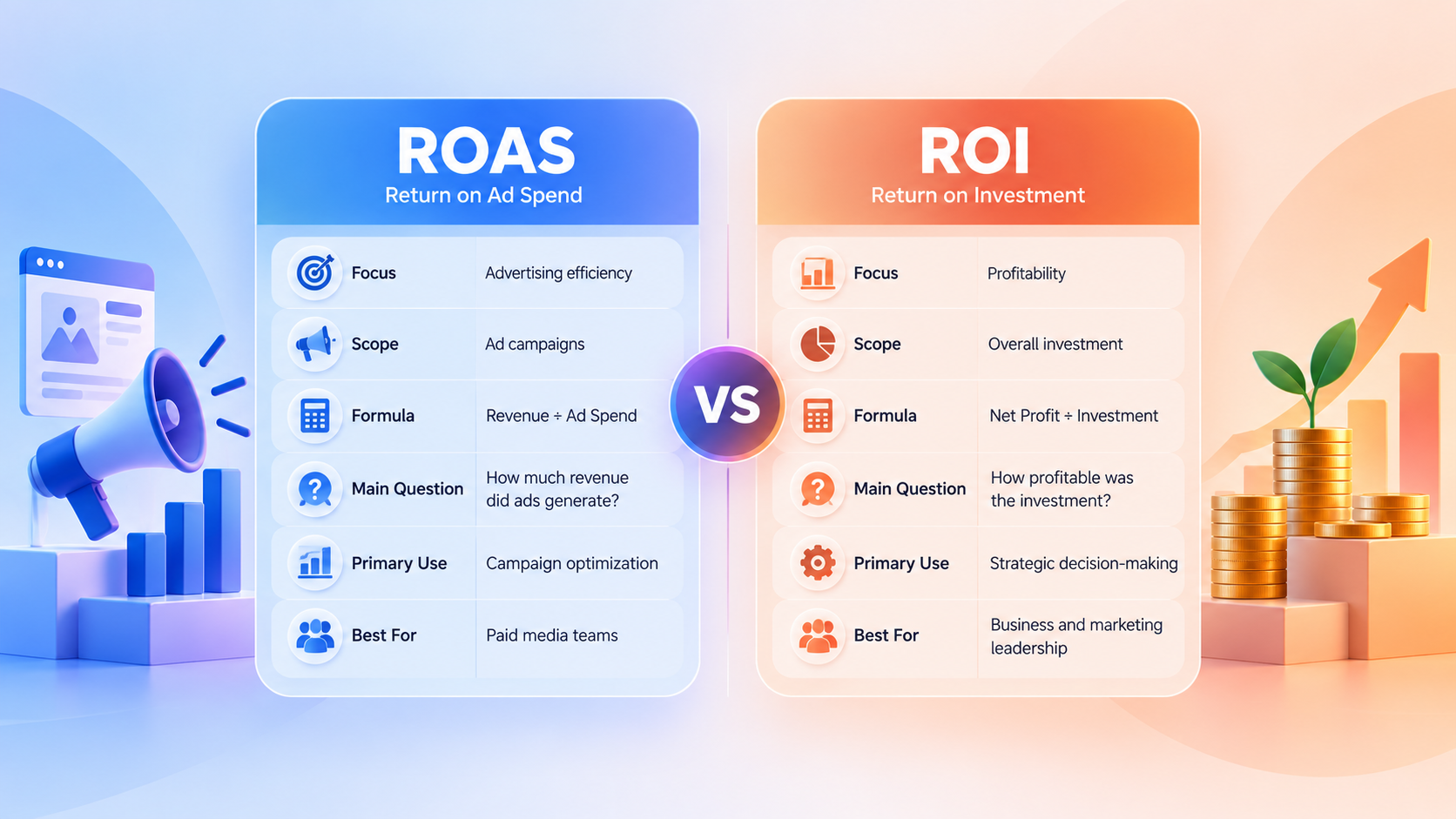
Difference | ROAS | ROI |
|---|---|---|
Focus | Advertising efficiency | Profitability |
Scope | Ad campaigns | Overall investment |
Formula | Revenue ÷ Ad Spend | Net Profit ÷ Investment |
Main Question | How much revenue did ads generate? | How profitable was the investment? |
Primary Use | Campaign optimization | Strategic decision-making |
Best For | Paid media teams | Business and marketing leadership |
ROAS answers:
"How much revenue did my advertising generate?"
This makes it especially useful for tactical campaign decisions. A marketer can compare the ROAS of different campaigns and identify where advertising budgets are generating more attributed revenue.
ROI answers:
"How much profit did my investment generate?"
Because ROI can include broader costs, it is more useful when evaluating the financial return of a complete marketing initiative or business investment.
Consider an e-commerce business that spends ₹1,00,000 on advertising and generates ₹5,00,000 in revenue.
Therefore:
ROAS = ₹5,00,000 ÷ ₹1,00,000 = 5x
At first glance, that may appear to be an excellent result.
But now consider the additional costs:
Total costs = ₹4,00,000
Revenue = ₹5,00,000
Profit = ₹1,00,000
The campaign has a 5x ROAS, but that does not mean it generated a 500% ROI.
This is one of the most important reasons marketers should avoid using ROAS as a direct substitute for profitability.
Improving conversion rate optimization can help businesses generate more conversions from existing advertising traffic and improve marketing efficiency.
The right metric depends on the question you are trying to answer.
ROAS is particularly useful for day-to-day paid media optimization.
ROI provides a wider financial perspective and is therefore more useful for strategic planning.
Yes.
A strong performance marketing measurement framework uses both metrics for different purposes:
ROAS → Campaign optimization
ROI → Business profitability
Using both helps marketing teams balance immediate advertising efficiency with longer-term financial performance.
No. A higher ROAS does not automatically mean higher profitability.
A campaign with a high ROAS may still produce weak profits if the business has high costs or low margins.
Factors that can influence profitability include:
For example, a business selling high-margin products may be profitable at a lower ROAS than a business operating on very thin margins.
Along with improving ROAS, businesses should focus on strategies that reduce customer acquisition cost while maintaining customer quality.
There is no universal "good ROAS" that applies to every business.
The right benchmark depends on factors such as:
Imagine two businesses.
Business A sells products with a 70% gross margin.
Business B sells products with a 20% gross margin.
The two businesses have very different economics. Business A may be able to remain profitable at a lower ROAS, while Business B may need significantly stronger advertising efficiency to cover its costs.
This is why ROAS should always be interpreted within the context of the company's unit economics.
ROAS and ROI are only two pieces of the performance marketing measurement puzzle.
Metric | What It Measures |
|---|---|
ROAS | Revenue from advertising spend |
ROI | Profitability of investment |
CAC | Cost to acquire a customer |
CPA | Cost per acquisition |
CPC | Cost per click |
CTR | Click-through rate |
LTV | Customer lifetime value |
Each metric answers a different question.
For example, CPC can tell you how much traffic costs, CTR can indicate how effectively an ad attracts clicks, conversion rate shows how effectively traffic converts, CAC measures the cost of acquiring customers, and LTV provides a view of customer value over time.
These metrics should be evaluated together as part of a full-funnel performance marketing strategy.
A useful way to understand the relationship is to look at the complete marketing funnel:
Ad Spend
↓
Traffic
↓
Leads / Visitors
↓
Conversions
↓
Revenue
↓
Costs
↓
Profit
ROAS sits primarily around the relationship between advertising spend and attributed revenue.
ROI extends the analysis further by considering investment, costs, and profit.
In other words:
ROAS = Revenue efficiency
ROI = Profitability
A business may therefore use ROAS to decide which campaign deserves more budget while using ROI to determine whether the overall marketing investment makes financial sense.
Improving marketing returns requires more than simply increasing advertising budgets. Businesses need to optimize targeting, creative, conversion, media spend, and measurement.
Better targeting can improve campaign efficiency by focusing advertising on audiences that are more likely to convert and generate long-term value.
Marketers can consider:
Better audience intelligence can help marketers identify high-value customer segments and improve targeting decisions.
Creative quality has a direct influence on how audiences respond to paid advertising.
Test and optimize:
Rather than relying on a single winning creative, businesses should continuously test different concepts and messages.
Getting more people to click an advertisement is only part of the equation. The landing page needs to convert that traffic efficiently.
Focus on:
Improving landing page conversions can help businesses generate more results from the same volume of paid traffic.
Businesses can improve advertising efficiency by continuously reviewing how budgets are distributed across campaigns, audiences, and channels.
Key areas include:
A strong approach to paid media campaigns can help businesses allocate spend toward the opportunities that generate stronger results.
Better decisions require reliable data.
Track and connect:
Businesses should look beyond surface-level campaign metrics and connect marketing performance with actual business outcomes.
Reliable marketing performance data makes it easier to understand which campaigns are genuinely contributing to growth.
ROAS is especially relevant to paid media because advertising platforms generate extensive campaign-level performance data.
Businesses may evaluate ROAS across:
However, comparing ROAS across channels requires context. Attribution models, audience intent, purchase journeys, margins, and campaign objectives can all influence reported performance.
The goal should not simply be to identify the channel with the highest ROAS. Instead, businesses should determine which combination of channels produces sustainable and profitable growth.
E-commerce businesses often rely heavily on ROAS because advertising directly influences online sales.
But e-commerce profitability depends on more than advertising revenue.
Businesses should consider:
For example, a business may have a strong first-purchase ROAS but struggle to generate profit if discounts are excessive or product margins are low.
Conversely, a business with a lower initial ROAS may have strong customer lifetime value because customers make repeat purchases.
This makes e-commerce marketing particularly dependent on understanding both short-term advertising efficiency and long-term customer economics.
Improving ROAS and ROI requires an integrated approach rather than optimizing one metric in isolation.
PulsePlay Digital brings together performance marketing, paid media advertising, audience intelligence, conversion rate optimization, and data analytics to help businesses build a more measurable growth engine.
Performance marketing services can help businesses build campaign strategies around measurable objectives. Paid media capabilities can support efficient media buying and campaign optimization, while audience intelligence can improve targeting decisions.
On the conversion side, conversion rate optimisation can help businesses get more value from existing traffic.
Finally, data analytics services can connect campaign activity with conversions, revenue, and broader business outcomes.
The result is a measurement approach that looks beyond clicks and impressions to understand what actually drives profitable growth.
No. ROAS measures revenue generated from advertising spend, while ROI measures profit generated relative to the overall investment.
Neither is universally better. ROAS is better for optimizing advertising campaigns, while ROI is better for evaluating overall profitability.
Yes. A campaign can generate high revenue relative to ad spend but still have low profitability after accounting for product, shipping, operational, discount, and other costs.
Use the formula:
5. ROAS = Attributed Revenue ÷ Advertising Spend
For example, ₹2,00,000 in attributed revenue from ₹50,000 in ad spend equals a 4x ROAS.
Use:
ROI = (Net Profit ÷ Investment Cost) × 100
If an investment generates ₹90,000 in net profit from ₹3,00,000 of investment, the ROI is 30%.
There is no universal benchmark. A good ROAS depends on margins, CAC, AOV, LTV, industry, business model, and campaign objectives.
Yes. Tracking both provides a more complete picture. ROAS helps optimize advertising efficiency, while ROI helps evaluate profitability.
No. A 5x ROAS means the campaign generated ₹5 in attributed revenue for every ₹1 spent on advertising. ROI requires profit and broader investment costs to be considered.
ROAS tells you how efficiently advertising generates revenue, while ROI tells you whether the overall investment generates profit.
For performance marketing, businesses should use ROAS to optimize campaigns and ROI to understand the broader financial impact of their marketing investment.
The strongest approach is not to choose between ROAS and ROI, but to use both. ROAS can guide tactical decisions around campaigns, channels, audiences, and budgets, while ROI provides the financial perspective needed for sustainable business growth.
When these metrics are supported by better targeting, creative testing, conversion optimization, paid media management, and reliable analytics, businesses can move beyond simply generating revenue and focus on generating profitable, sustainable growth.
Explore PulsePlay Digital's performance marketing solutions to build a more measurable and performance-driven marketing strategy.