
Rahul Guleria
SEO Executive
Creative,
Branding
& Growth
in the Global
Digital Ecosystem
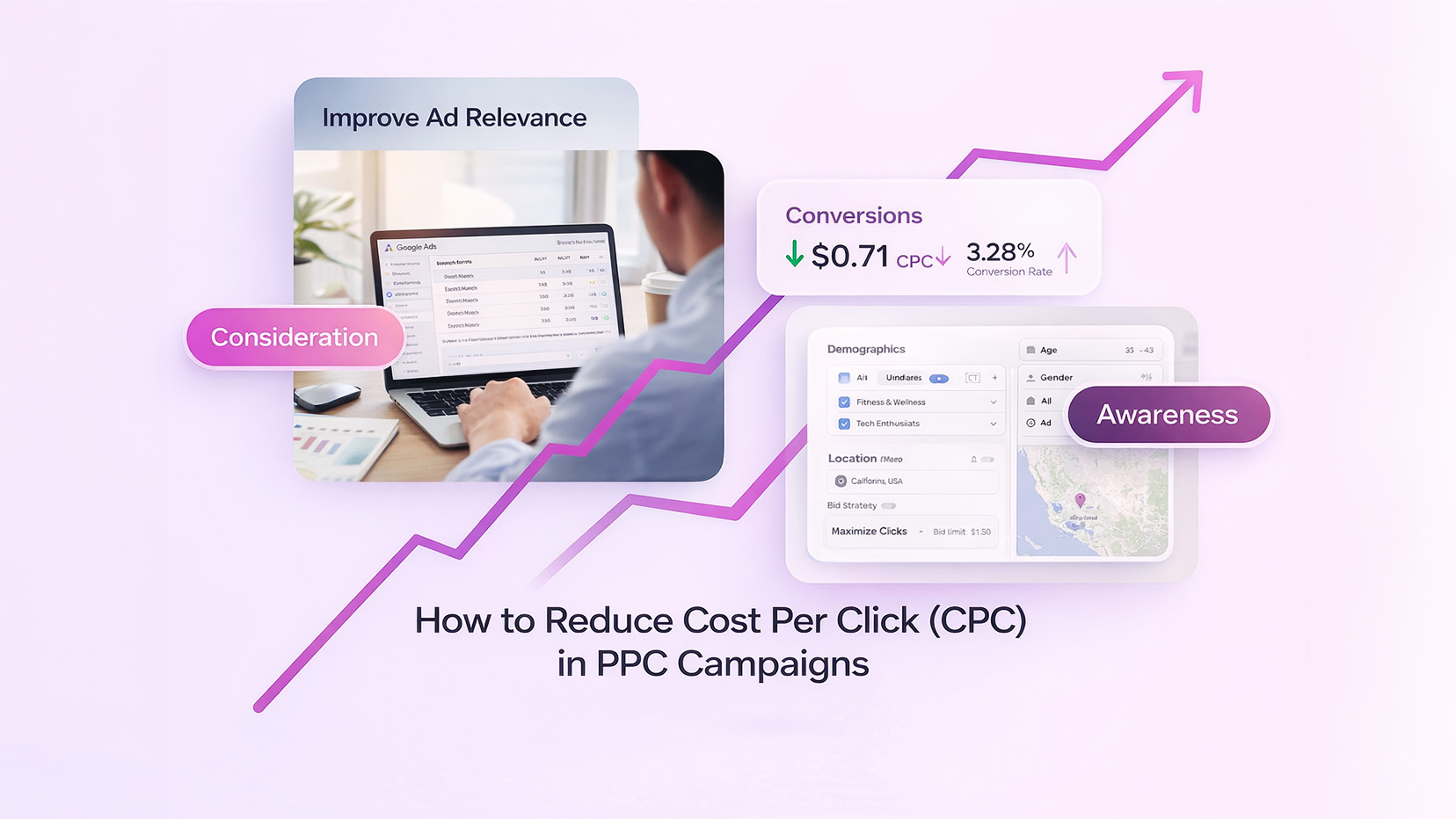
Cost per click, or CPC, is the amount you pay every time someone clicks your ad. Platforms like Google Ads and Meta Ads calculate it through a real-time auction. If your CPC keeps climbing, your ROI shrinks fast. Businesses using structured Paid Media Advertising Services can significantly reduce their CPC through strategic optimization.
Let’s break down how.
Cost Per Click (CPC) is the price advertisers pay for each click in a Pay-Per-Click campaign.
In simple terms:
You only pay when someone clicks.
If you're new to paid campaigns, read What is Paid Media Advertising? to understand the bigger picture.
The formula is straightforward:
CPC = Total Ad Spend ÷ Total Clicks
Example:
● $1,000 ad spend
● 500 clicks
CPC = $1,000 ÷ 500 = $2 per click
Seems simple. However, the calculation behind the scenes is far more complex.
Several factors push CPC higher:
● Low Quality Score
● Competitive keywords
● Poor click-through rate
● Weak landing pages
● Broad targeting
Think of it like an auction. If everyone wants the same keyword, prices rise.
Quality Score acts like a reputation score inside Google’s auction system.
Google evaluates:
● Expected CTR
● Ad relevance
● Landing page experience
Higher Quality Score often means lower CPC. We’ll unpack this shortly.
Many advertisers assume competition alone drives high costs. That’s rarely the full story.
Google rewards relevance. If your ads don’t align with keywords and landing pages, you’ll pay more.
Broad match keywords cast a wide net. Sometimes too wide.
You attract irrelevant clicks. Costs rise. Conversions don’t.
Low click-through rate signals weak engagement. Google sees that as poor user experience.
Result? Higher CPC.
If users bounce quickly, platforms interpret it as poor relevance.
You guessed it. Higher costs.
Some industries like legal or insurance naturally have higher CPC. However, smart targeting can still reduce costs.
Let’s move from theory to action.
Google’s auction system doesn’t just reward the highest bidder. It rewards relevance.
Ad Rank = Bid × Quality Score
Higher Quality Score means you can outrank competitors while paying less.
To improve it:
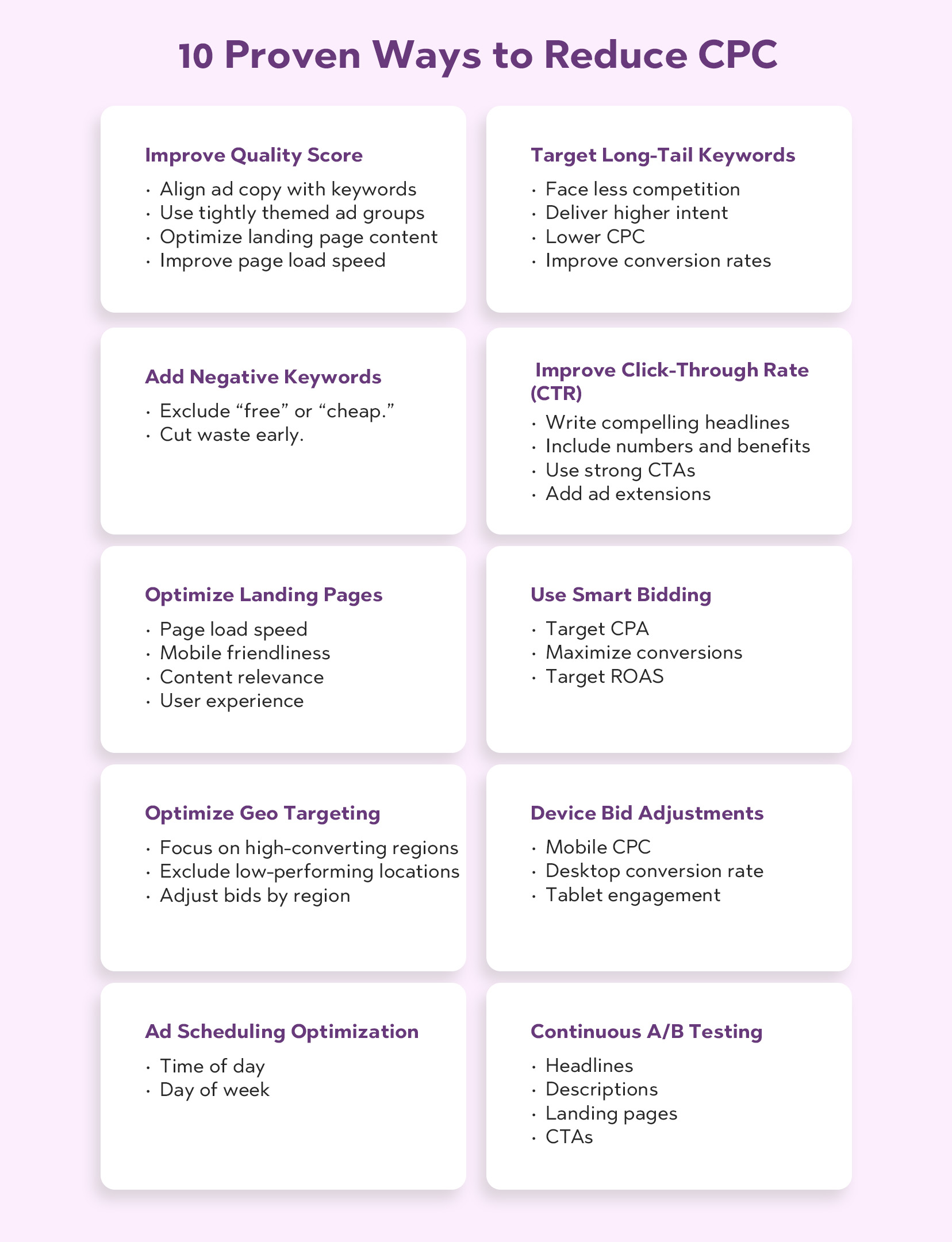
● Align ad copy with keywords
● Use tightly themed ad groups
● Optimize landing page content
● Improve page load speed
Even a jump from 5 to 7 can significantly reduce CPC.
Short keywords are expensive. Long-tail keywords are precise.
Instead of:
“Digital marketing”
Try:
“Affordable digital marketing agency for SaaS startups”
Long-tail terms:
● Face less competition
● Deliver higher intent
● Lower CPC
● Improve conversion rates
They may bring fewer clicks. Yet those clicks convert better.
Negative keywords prevent your ads from showing for irrelevant searches.
For example:
If you sell premium services, exclude “free” or “cheap.”
Review your search terms report weekly.
Cut waste early.
Higher CTR signals relevance.
To boost CTR:
● Write compelling headlines
● Include numbers and benefits
● Use strong CTAs
● Add ad extensions
Better CTR often lowers CPC because platforms reward engagement.
A relevant landing page can dramatically reduce CPC.
Google measures:
● Page load speed
● Mobile friendliness
● Content relevance
● User experience
If your page fails, your costs rise.
Businesses that implement a professional paid media strategy often see CPC drop within weeks because alignment improves across the funnel.
Manual bidding can work. However, Smart Bidding uses machine learning.
Strategies include:
● Target CPA
● Maximize conversions
● Target ROAS
Smart bidding analyzes thousands of signals in milliseconds.
Use it once you have sufficient conversion data.
Why pay for clicks outside your service area?
Refine targeting:
● Focus on high-converting regions
● Exclude low-performing locations
● Adjust bids by region
Sometimes narrowing reach lowers costs while increasing revenue.
Performance varies by device.
Analyze:
● Mobile CPC
● Desktop conversion rate
● Tablet engagement
If mobile drives cheap clicks but low conversions, adjust bids accordingly.
Precision saves money.
Not all hours perform equally.
Check performance by:
● Time of day
● Day of week
Pause or reduce bids during low-performing windows.
Let your budget work smarter.
Testing never stops.
Test:
● Headlines
● Descriptions
● Landing pages
● CTAs
Small improvements compound.
A 1% CTR increase may reduce CPC significantly over time.
Here’s the simplified relationship:
Ad Rank = Bid × Quality Score
Actual CPC = (Ad Rank of competitor below you ÷ Your Quality Score) + $0.01
You pay less than competitors with lower relevance.
You pay more even with higher bids.
Google prioritizes user experience. Relevance wins.
Lower CPC doesn’t just reduce costs. It improves profitability.
If you want a deeper dive into metrics, explore Measuring ROI in Paid Campaigns.
Let’s connect the dots.
Formula:
ROAS = Revenue ÷ Ad Spend
Lower CPC → More clicks → More conversions → Higher revenue per dollar spent.
If CPC drops while conversion rate stays stable, CPA decreases.
That means you acquire customers cheaper.
Better targeting improves both CPC and conversion rate.
It’s a double win.
Imagine paying $5 per click with 2% conversion.
Now imagine $3 per click with 4% conversion.
Same traffic volume. Dramatically different profit.
When comparing platforms, check Google Ads vs Meta Ads: Which is Better? for detailed insights.
Quick overview:
Factor | Google Ads | Meta Ads |
|---|---|---|
Intent | High search intent | Passive discovery |
CPC | Often higher | Often lower |
Conversion Rate | Typically higher | Depends on funnel |
Competition | Keyword-based | Audience-based |
Google captures demand.
Meta creates demand.
CPC may be lower on Meta. However, conversion intent often favors Google.
Your strategy should align with goals.
Even seasoned advertisers slip.
Too much freedom leads to irrelevant clicks.
This report shows exactly what users typed.
Review it weekly.
Misalignment increases bounce rates and CPC.
Without tracking, you optimize blindly.
Data guides decisions.
Reducing CPC requires:
● Better targeting
● Quality optimization
● Continuous testing
● Strategic bidding
There’s no magic button.
Instead, consistent refinement wins.
Lower CPC doesn’t mean chasing cheap clicks. It means paying less for qualified traffic. When you align keywords, ads, landing pages, and bidding strategies, costs fall naturally.
Think long term. Optimize systematically. Test relentlessly.
That’s how you truly decrease cost per click in PPC.
CPC is the amount you pay each time someone clicks your paid advertisement.
Common reasons include low Quality Score, broad match misuse, poor CTR, weak landing pages, and high competition keywords.
Improve Quality Score, use long-tail keywords, add negative keywords, and optimize bidding strategies.
Yes. Higher Quality Score typically lowers CPC because Google rewards relevance.
Absolutely. They face less competition and attract high-intent traffic.
Yes. Higher CTR signals relevance, which can reduce CPC in auction-based systems.
Smart bidding strategies like Target CPA or Target ROAS often reduce CPC once enough data exists.
Yes. Poor landing page experience lowers Quality Score, which increases CPC.
Meta Ads often have lower CPC. However, Google Ads may deliver higher intent traffic.
You may see improvements within 2–4 weeks with consistent optimization. Sustainable reduction requires ongoing testing and refinement.