
Rahul Guleria
SEO Executive
Creative,
Branding
& Growth
in the Global
Digital Ecosystem
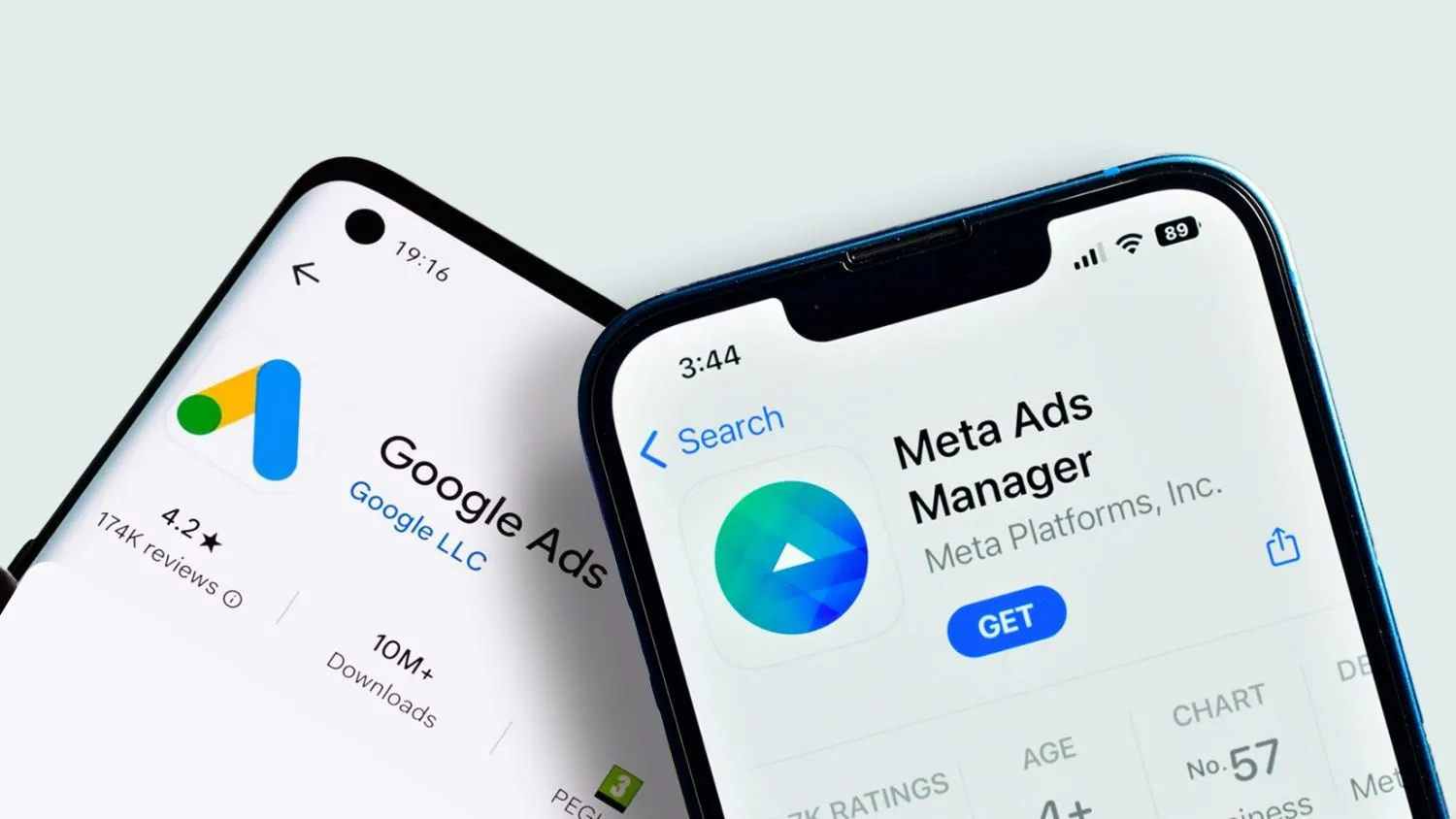
Google Ads and Meta Ads are usually the first two platforms that come up when you start exploring digital advertising. Both sit at the heart of modern paid media advertising and both can scale from a few hundred dollars a month to serious enterprise budgets. No wonder brands get stuck in the “Google Ads vs Meta Ads” debate and delay decisions. This guide breaks down costs, targeting, ROI, and when to use each channel so you can choose with confidence instead of guesswork.
Think of Google Ads as intent machines. People literally tell you what they want by typing it into the search box. Your job is to show up with the right offer at the right moment.
At its core, Google Ads is a pay-per-click platform that lets you show ads across:
● Search (text ads triggered by keywords)
● Shopping (product listing ads for e-commerce)
● Display Network (banner ads on partner sites and apps)
● YouTube (video ads before and during videos)
The magic of Google Ads comes from search intent:
● Someone searches “emergency plumber near me” or “best payroll software for small business”.
● You bid on those keywords.
● Your ad appears at the top of the results.
● You pay only when they click.
These are bottom-of-funnel or “ready-to-act” moments. That is why Google Ads usually drive high-intent leads. Benchmarks show average search CPC around $5.26 across industries with conversion rates hovering between 6–8% for well-optimized campaigns.
In plain language: you pay more per click than most social platforms yet a larger chunk of those clicks turn into leads or customers, especially for problem-aware audiences.
Google Ads are ideal when:
● People are already searching for your product or service
● You sell “urgent” solutions (plumbers, doctors, locksmiths, lawyers)
● You have clear offer pages like demos, quotes, or free trials
● You want measurable demand capture with strong intent signals
Meta Ads cover everything you run on Facebook and Instagram through the Meta Ads Manager, all owned by Meta. Instead of waiting for people to search, you push your message into the feeds where they already spend time.
Meta Ads are:
● Highly visual (images, reels, carousels, stories)
● Discovered rather than requested
● Fueled by interest, demographic, and behavior targeting
You typically build audiences using:
● Demographics (age, gender, location)
● Interests (fitness, travel, fintech, parenting)
● Behaviors (online shoppers, frequent travelers)
● Custom audiences (website visitors, email lists, app users)
● Lookalike audiences (people who “look like” your best customers)
Instead of “I need a dentist now”, Meta shines when you want to:
● Introduce a new brand or product
● Inspire impulse purchases
● Promote content, lead magnets, and webinars
● Retarget warm users with reminders and offers
Costs tend to be lower per click. Recent benchmarks put Facebook / Meta leads campaigns around $1.9–$2.0 CPC with conversion rates near 8.8–9.2% on average, though results swing by industry and objective.
Meta Ads are ideal when:
● You need scale and reach
● You want to build brand and demand at the same time
● Creative storytelling and visuals are your strength
● You want to nurture and retarget people over time
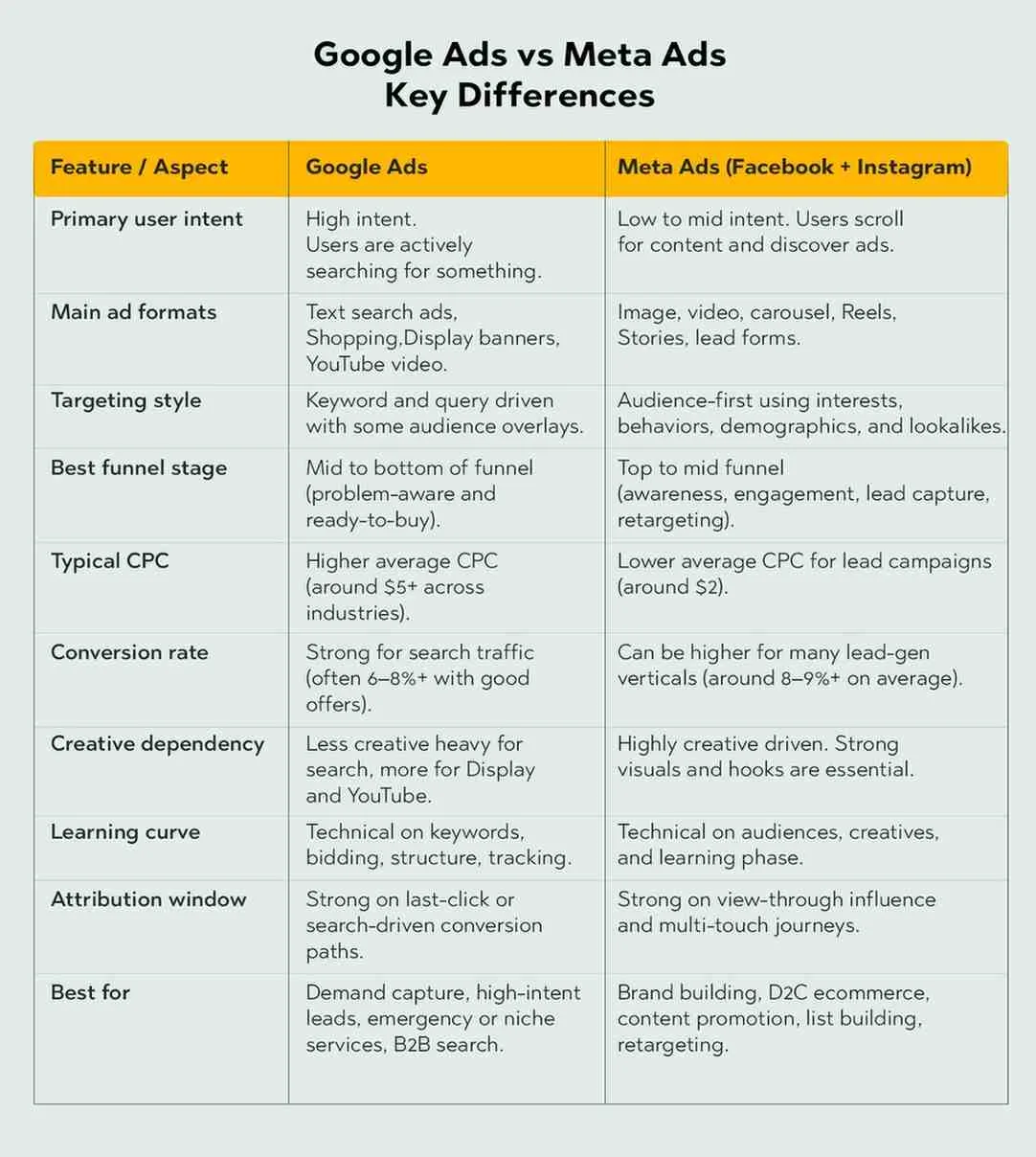
Here is a quick “at-a-glance” view of google ads vs meta ads so you can see where each shines.
Feature / Aspect | Google Ads | Meta Ads (Facebook + Instagram) |
|---|---|---|
Primary user intent | High intent. Users are actively searching for something. | Low to mid intent. Users scroll for content and discover ads. |
Main ad formats | Text search ads, Shopping, Display banners, YouTube video. | Image, video, carousel, Reels, Stories, lead forms. |
Targeting style | Keyword and query driven with some audience overlays. | Audience-first using interests, behaviors, demographics, and lookalikes. |
Best funnel stage | Mid to bottom of funnel (problem-aware and ready-to-buy). | Top to mid funnel (awareness, engagement, lead capture, retargeting). |
Typical CPC | Higher average CPC (around $5+ across industries). | Lower average CPC for lead campaigns (around $2). |
Conversion rate | Strong for search traffic (often 6–8%+ with good offers). | Can be higher for many lead-gen verticals (around 8–9%+ on average). |
Creative dependency | Less creative heavy for search, more for Display and YouTube. | Highly creative and driven. Strong visuals and hooks are essential. |
Learning curve | Technical on keywords, bidding, structure, and tracking. | Technical on audiences, creatives, and the learning phase. |
Attribution window | Strong on last-click or search-driven conversion paths. | Strong on view-through influence and multi-touch journeys. |
Best for | Demand capture, high-intent leads, emergency or niche services, B2B search. | Brand building, D2C ecommerce, content promotion, list building, retargeting. |
Keep this table in mind when deciding where to start. It will also help as you compare meta ads vs google ads later in the funnel.
Let’s talk numbers because that is usually where the “which is better, Google Ads or Meta Ads” debate gets heated.
Across industries, recent benchmarks show:
● Google Ads Search CPC averages around $5.26 for many markets.
● Meta / Facebook lead campaigns CPC sits closer to $1.9–$2.0.
● Google Ads CPM often ranges around $11+, depending on industry and format.
● Meta Ads CPM tends to sit in the $6–9 band on average, with variation by niche and season.
So at a surface level:
● Meta is usually cheaper per impression and per click
● Google is usually more expensive per click
That does not automatically make Meta more efficient. You must factor in conversion rate, lead quality, and customer value.
Benchmarks suggest:
● Google Ads search often converts around 6–8% on average when optimized.
● Meta / Facebook often reports 8–9%+ conversion rates for many lead campaigns, though definitions of “conversion” vary.
Even if Meta wins on paper with lower CPC and slightly higher conversion percentages, Google frequently wins on lead quality and purchase intent. Someone who types “best ERP software for manufacturing companies” is very different from someone who clicked a “10 tips for scaling operations” lead magnet in their feed.
So ROI depends on:
● Sales cycle length – High-ticket, long-cycle deals often favor Google Search and strong retargeting.
● Offer type – E-commerce impulse products love Meta. High-intent service searches love Google.
● Down-funnel performance – Qualification rate, show-up rate, close rate, LTV.
In many accounts, a common pattern emerges:
● Meta Ads deliver cheaper leads and build remarketing pools.
● Google Ads deliver fewer leads at a higher cost, yet more revenue per lead.
The right move is not chasing the cheapest CPC. It is balancing Cost per Acquisition (CPA) and Return on Ad Spend (ROAS) across both platforms.
Lead generation is where google ads vs facebook ads often feels like a true showdown.
Google Ads usually wins when:
● People search for what you sell
● Your offer solves an urgent or defined problem
● You have clear value propositions and strong landing pages
Great examples:
● “Best dentist in Dharamshala.”
●“HR software for Indian startups.s”
● “ISO certification consultant Dubai.”
●“Online MBA for working professionals.”
Here Google Search can send you leads that are comparison shopping or ready to talk to sales. You capture existing demand instead of creating it.
Meta Ads usually win when:
● You have a strong lead magnet (ebook, checklist, webinar, quiz, free sample)
● Your audience is broad or aspirational
● You want to grow your email list and warm up prospects
Examples:
● Free trials for apps and tools
● Webinars and workshops for coaches or B2B services
● WhatsApp lead forms for local salons, gyms, clinics
Lead form ads on Meta can generate a high volume of leads quickly at low CPL. The trade-off is that they often require strong lead qualification and nurturing.
The sweet spot for many businesses:
1. Use Meta to drive cheap leads into your ecosystem (newsletter, webinar, WhatsApp, community).
2. Use Google to capture high-intent searchers who are closer to a decision.
3. Retarget across both so people see your brand again while they research and compare.
If you want help designing that kind of integrated funnel, explore our Google Ads and Meta Ads services to plug a complete strategy into your growth plan.
Brand awareness sits at the top of the funnel. Here, the question “which is better, Google Ads or Meta Ads?” has a slightly different answer.
Meta Ads are built for reach, storytelling, and repetition.
● You can blanket your ideal audience with thumb-stopping creatives.
● You can sequence messages over time (ad 1 = story, ad 2 = proof, ad 3 = offer).
● You can use video and Reels to build familiarity at low CPMs.
For brand awareness, you measure:
● Impressions and reach
● Video views and completion rates
● Engaged users (saves, shares, comments)
● Growth in branded searches and direct traffic later
Meta is especially strong for:
● New brand or product launches
● D2C and ecommerce brands
● Lifestyle, fashion, beauty, fitness, F&B
● Any business that wins with visuals and stories
Google is not just about intent. You can build awareness with:
● YouTube Ads – For storytelling, product demos, and education.
● Display campaigns – For broad reach across relevant sites and apps.
● Discovery / Demand Gen campaigns – To reach people across YouTube, Gmail, and Discover.
These placements let you reach people before they search. Many advertisers use YouTube to introduce the brand, then rely on Search to close the deal when the user later types their brand name or category.
If you map it out:
● Top of funnel
○Heavily Meta Ads and YouTube for reach and story.
● Middle of funnel
○ Meta retargeting, YouTube retargeting, Google Display, and content promotion.
● Bottom of funnel
○ Google Search + Shopping; Meta direct response and retargeting.
So Meta might carry more weight for classic awareness. Yet a well-structured multi-channel funnel usually includes both.
Small businesses face a different challenge. Your budget is limited, so the “Google Ads vs meta ads” choice feels risky.
Here is a simple way to think about it.
Ask one question: “Do people actively search for what I sell?”
If the answer is yes (dentist, salon, lawyer, electrician, agency, clinic, IT service, course):
● Start with a tight Google Search campaign
● Target a small set of high-intent keywords
● Focus on your city or service area
● Use simple ad extensions (call, location, sitelinks)
● Optimize for calls or form submissions
If the answer is no or “not yet” (new product, niche D2C brand, lifestyle offer):
● Start with Meta Ads for awareness and leads
● Run one or two core campaigns:
○ Campaign 1: Awareness/traffic
○ Campaign 2: Leads or sales
● Keep your audience narrow and aligned with your ideal customer
● Test creative variations fast and kill losers quickly
With smaller budgets:
● Avoid spreading money thin across many campaigns.
● Pick one primary platform to start, then add the second once you have data.
● Spend enough per day for each campaign to exit the learning phase.
Roughly speaking:
● A local service might start around ₹500–₹1,500 per day on Google Search in a specific city.
● A small D2C brand might start at ₹500–₹1,500 per day on Meta, focusing on one or two hero products.
Once you see what works, you can layer in the second platform to plug gaps in the funnel.
Short answer: yes, whenever you can. The two platforms behave differently, and that is exactly why they play so well together.
When you use both platforms:
● Meta warms people up with stories, social proof, and offers.
● Google catches them later when they search your brand or category.
● Retargeting flows across searchers and site visitors in both directions.
A typical journey might look like this:
1. User sees your Instagram Reel ad and visits your site.
2. They leave without buying.
3. A few days later, they search your brand or solution on Google.
4. Your search ad shows u,p, and they click again.
5. This time, they buy or become a high-intent lead.
If you only look at last-click attribution, Google might seem like the hero. Yet Meta influenced the journey heavily. Multi-channel setups solve this blind spot.
Here is a simple starting framework:
1. Google Search
○ One or two core campaigns on brand and high-intent non-brand keywords.
2. Meta Prospecting
○ One campaign targeting your ideal audience with story-focused creative.
3. Cross-Channel Retargeting
○ Retarget website visitors on both Google Display / YouTube and Meta.
○ Emphasize testimonials, FAQs, and offers.
As budgets grow, you can add:
● YouTube for education and brand building
● Instagram Reels and Stories for viral-style content
● Advanced segmentation by funnel stage
If you prefer an expert team to design, test, and optimize this mix, our specialists can run Google Ads or Meta Ads campaigns for you as part of a full-funnel growth plan.
There is no one-size-fits-all winner in the Google Ads vs Meta Ads debate. Each platform solves a different part of your growth puzzle.
Use this as a quick decision guide:
● Choose Google Ads first if:
○ People already search for what you sell
○ You offer high-intent services or SaaS
○ You need serious lead quality and trackable demand capture
● Choose Meta Ads first if:
○ You need awareness and reach
○ You sell visually appealing products
○ You want to build a community, list, or following
● Use both together if:
○ You want scalable growth across the full funnel
○ You can invest in creative plus landing page optimization
○ You care about long-term brand equity and short-term revenue
What matters more than the platform is the strategy, execution, and ongoing optimization behind it. Campaign structure, creative, offers, tracking, and analytics will make or break your results on both platforms.
If you want a partner that treats your budget like their own, explore our paid media advertising services. PulsePlay Digital can help you plan, launch, and scale campaigns on both Google Ads and Meta Ads so you stop guessing and start growing.
The main difference lies in user intent.
● With Google Ads, people tell you what they want via search queries. You respond with relevant ads and catch them when they are problem-aware or ready to buy.
● With Meta Ads, people scroll social feeds for content and connection. You interrupt their attention with compelling visuals and copy that create or shape demand.
So Google is like a high-intent marketplace. Meta is like a discovery engine that finds the right people in a social context.
It depends on:
● Your industry and offer
● Your funnel and sales cycle
● How good your targeting and creative are
For high-intent services and B2B, Google often delivers stronger lead quality and revenue per lead, even if clicks cost more. For e-commerce and lifestyle brands, Meta can deliver exceptional ROAS when creative hits the right audience at the right time.
The best way to answer this for your business is to:
1. Test both with focused campaigns.
2. Track leads and sales all the way through your CRM or analytics.
3. Compare not just CPL or CPC but profit per channel.
In most benchmarks, yes, Meta Ads tend to have:
● Lower CPC
● Lower CPM
But cheaper does not always mean better. You must evaluate:
● Lead quality
● Sales conversion rate
● Average order value and LTV
A ₹200 lead that closes at 30% is more valuable than a ₹50 lead that closes at 2%. That is why it is dangerous to pick a platform only on media costs.
If your main goal is volume of leads, Meta often wins because you can run lead form campaigns at scale with low CPL. If your main goal is quality of leads that are closer to purchase, Google Search campaigns often win.
The best approach is usually a mix:
● Use Meta for top-of-funnel lead capture and nurturing.
● Use Google for high-intent demand capture and more sales-ready conversations.
Absolutely, and they should when the budget allows.
Using both lets you:
● Build awareness and desire with Meta.
● Capture high-intent searchers with Google.
● Retarget across both platforms for more touchpoints.
This cross-channel setup creates a smoother path from first impression to final purchase, and it reduces your reliance on a single platform’s algorithm or CPM swings.
There is no universal “best” platform. There is only the best mix for your specific business model, audience, and goals.
A good paid media partner will:
● Audit your market and competitors
● Map your buyer journey
● Recommend a blend of Google Ads and Meta Ads (plus other channels when relevant)
● Build testing roadmaps rather than guessing
If you want that level of strategic thinking and execution, consider working with a team that specializes in full-funnel paid media advertising services and understands how to balance search, social, and beyond for real business outcomes.