
Rahul Guleria
SEO Executive
Creative,
Branding
& Growth
in the Global
Digital Ecosystem
If you’re planning digital marketing budgets for 2026–2027, you’ve probably asked the same question as every founder and CMO:
“Which brings better ROI – SEO or SEM?”
Let’s break it down in plain English.
Both drive traffic from search engines, but they behave very differently in cost, speed, and return on investment (ROI). This guide walks through SEO vs SEM ROI, when to use each, and how to combine them for maximum growth.
New to SEO? Start with: What Is SEO & Why It Matters for Businesses
If you’re ready to plan and implement a strategy, check out our search engine optimisation services.
To keep this super digestible:
Core question:Businesses constantly ask, “SEO or SEM for business – which channel actually gives better ROI?”
The honest answer: it depends on your timeline, budget, and goals. Let’s compare them side by side.
Here’s a quick SEO SEM comparison to anchor everything else.
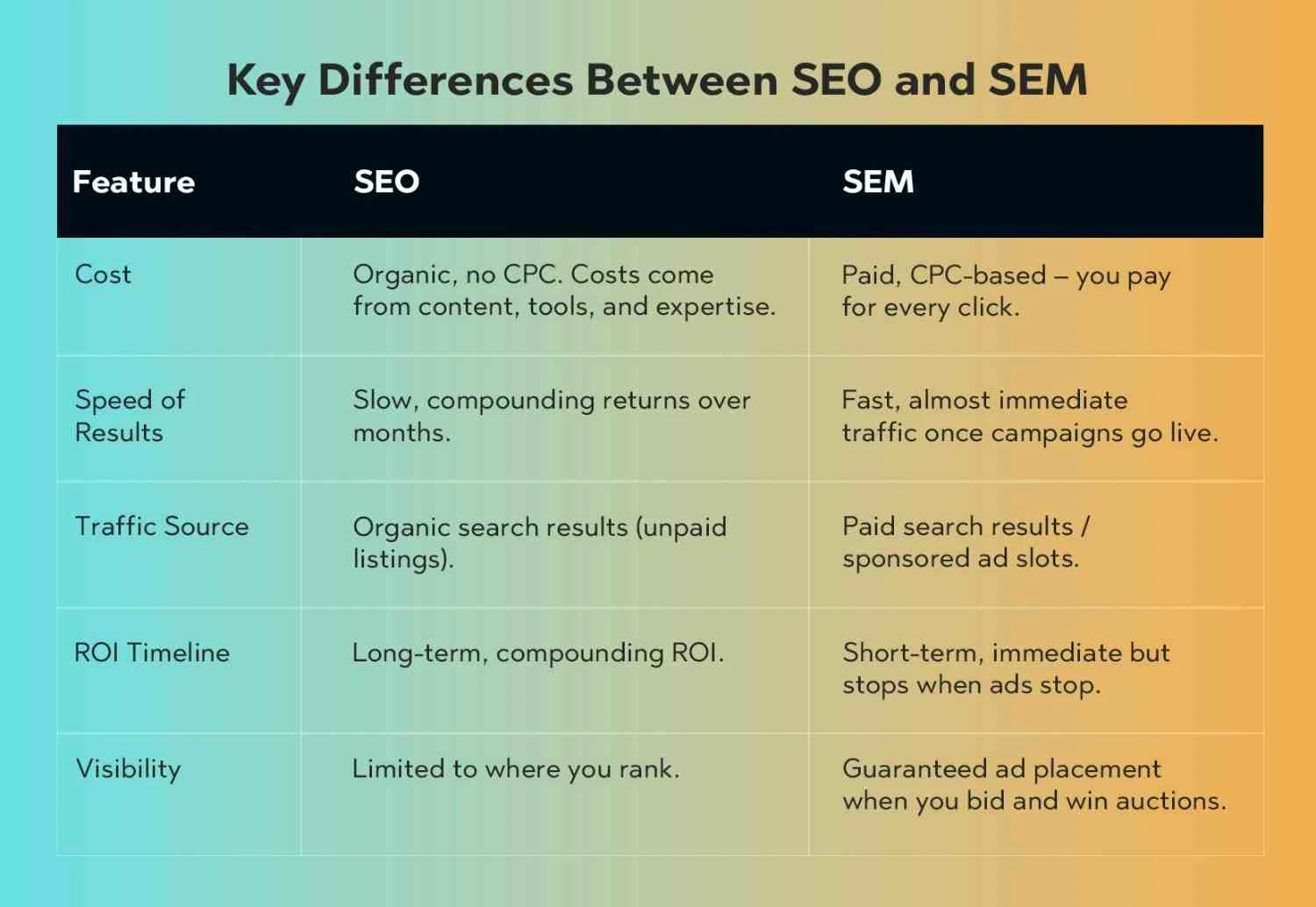
Feature | SEO | SEM |
|---|---|---|
Cost | Organic, no CPC. Costs come from content, tools, and expertise | Paid, CPC-based – you pay for every click. |
Speed of Results | Slow, compounding returns over months. | Fast, almost immediate traffic once campaigns go live. |
Traffic Source | Organic search results (unpaid listings). | Paid search results / sponsored ad slots. |
ROI Timeline | Long-term, compounding ROI | Short-term, immediate but stops when ads stop. |
Visibility | Limited to where you rank. | Guaranteed ad placement when you bid and win auctions. |
You can already see the pattern:
Now let’s look at the benefits of each.
If you’re playing the long game, SEO can become one of the most powerful growth engines your business has.
High-ranking pages can sit on page one for months or years if you maintain them. That means you:
Good SEO is like owning a prime shop location that keeps attracting foot traffic.
Yes, SEO isn’t free (we’ll talk about that myth later). You invest in:
But once a page ranks, the cost of each additional visitor trends towards almost zero. That’s why, over 12–24 months, SEO often beats paid search in ROI for core keywords.
Searchers often trust organic listings more than ads. Appearing in the top organic spots signals:
This credibility spills over into other channels – people are more likely to click your emails, ads, or social posts if they’ve “seen you around” on Google already.
In many industries, organic results still attract a significant share of total clicks, even though the top of the page is full of ads. For non-commercial or research-driven queries, organic can massively dominate.
If you earn those positions, you capture that click share without constant ad spend.
SEO rewards content that stays useful:
These assets can:
A single well-optimized article can outperform dozens of short-term ad campaigns over its lifetime.
Now the other side: paid search. Why do businesses pour billions into SEM each year? Because it works brilliantly when you use it right.
With SEM, you can:
This is unbeatable when:
SEO can’t match SEM on speed. It’s that simple.
With SEM platforms like Google Ads and Microsoft Ads, you control:
You can pause campaigns in seconds or scale them up during key months. That flexibility makes SEM friendlier for cash-flow-sensitive businesses.
SEM gives near real-time data:
Because the journey from click to conversion is easier to track, SEM often produces very clear ROI numbers – especially useful when you need board-level reporting.
You can laser-focus your spend on:
This precision means your budget goes toward people most likely to convert.
SEM shines for:
When you need a quick spike in traffic and leads, SEM is your best friend.
Now to the heart of it – SEO vs SEM ROI.
If your question is:
“How can I get leads this month and measure ROI quickly?”
Then SEM usually wins.
This short feedback loop makes SEM perfect for testing:
You can then feed that learning into other channels.
Over a 12–24 month horizon, SEO tends to produce better ROI for:
Once you’ve paid for the strategy, content, and technical work, the marginal cost of each visitor keeps falling while traffic often grows.
Meanwhile, SEM keeps charging you per click forever.
The smart play for most businesses:
That way:
Let’s talk money. Assume a business investing ₹1,000 at a time. Numbers will vary by niche, but this gives you a feel for how the two channels behave.
With SEO, your costs come from:
You might invest, say, ₹50,000–₹2,00,000 per month depending on scale and competition. But that investment is spread across many keywords and assets that keep bringing traffic.
With SEM, your costs include:
CPCs vary wildly:
This is a simplified model, not a forecast, but it illustrates the dynamic:
Scenario A – SEM only
Revenue from ₹1,000 SEM spend: ~₹2,000 ROAS: 2x
But to keep getting those conversions, you must keep spending every month.
Scenario B – SEO investment
Say you spend ₹1,00,000 over several months on SEO (content + technical + strategy). That might feel heavy upfront, but once your pages rank, you could be pulling in:
Revenue per month from organic: 90 × ₹2,000 = ₹1,80,000
Even if you factor in ongoing maintenance, SEO can quickly outstrip the initial investment, while SEM stays linearly tied to spend.
In reality, the right mix for you depends on your:
But the general pattern holds:
You should lean towards SEO-first if:
If you can’t sustain big monthly ad spends but can invest steadily over 6–12 months, SEO is ideal. You build assets instead of renting visibility.
SEO makes the most sense when:
Once your content ecosystem is in place, it becomes a growth engine.
If your strategy involves:
…then SEO is a natural fit. Search is often the biggest discovery channel for this type of content.
For a deeper dive on building that foundation, revisit: What Is SEO & Why It Matters for Businesses
On the other hand, you should prioritize SEM if:
SEO takes time. When you’re launching something new:
SEM gets eyes on your offer fast and reveals what resonates.
If cash flow, investors, or targets demand results this quarter:
It becomes a controllable lever you can pull when you need volume.
Seasonal sales, festival offers, limited-time bundles – these all rely on timing:
The real magic happens when you combine SEO and SEM instead of pitting them against each other.
This SEO + SEM combo usually gives the strongest ROI curve over time.
Let’s kill a few dangerous myths that confuse marketing decisions.
Nope.
Yes, you don’t pay per click. But you do pay for:
Think of SEO as capital expenditure in digital real estate, not a free tactic.
SEM guarantees traffic, not profit.
If:
…then you’ll pay for a lot of expensive clicks and see little to no return. SEM still needs strong strategy and optimization.
This one shows up every year and still isn’t true.
Search behavior continues to grow, and while formats change (featured snippets, AI overviews, etc.), people still use search engines at massive scale. Businesses that consistently create valuable content and optimize their sites still win.
What is dead is:
Real, user-focused SEO is very much alive.
Time for the verdict.
For most serious businesses, the answer to SEO vs SEM is:
Use both – just at different intensities and for different goals.
Start with SEM for instant learnings and pipeline. Invest in SEO alongside it so that over time, you rely less on paid clicks and more on organic, profitable traffic.
If you’d like strategic help deciding how to mix the two for your industry, you can explore our search engine optimisation solutions and see how a combined SEO + SEM approach could grow your business.
Learn more about how SEO and SEM can grow your business → Reach out to PulsePlay Digital for a tailored search strategy.
Both use search engines, but they differ in cost structure, speed, and how traffic is acquired.
The best choice depends on your time horizon and business goals.
Typically:
SEO is a long-term play. The ROI curve is slower at the beginning but usually steeper later.
SEM can generate traffic within hours or days of launching your campaigns:
This speed is why SEM is ideal for launches and urgent lead generation.
Absolutely. In fact, they’re strongest together.
Think of them as two sides of the same search strategy.
SEM can be expensive if:
However, with careful keyword selection, tight budgets, and strong tracking, small businesses can run profitable SEM campaigns—even on modest budgets. Start small, test, and scale only what works.
Yes, but the nature of the investment changes over time.
You don’t usually need to spend the same amount forever, but completely stopping SEO can cause your performance to slide over time.
SEO is generally better for long-term growth because:
That said, SEM remains valuable to complement SEO – especially for new products and highly competitive terms.
Not really.
SEM can generate traffic as long as you pay, but once you stop spending, the traffic disappears. SEO:
SEM can supplement or temporarily cover gaps in SEO, but it shouldn’t fully replace it if you care about sustainable growth.
For SEO:
For SEM:
Ideally, you should evaluate both channels together to understand how they support each other and where to allocate budget next.