

Rahul Guleria
SEO Executive
Creative,
Branding
& Growth
in the Global
Digital Ecosystem
Retail media is having a moment. Not a small blip—an industry-level shift. As shopping moves online and customer journeys zig‑zag between mobile, marketplaces, and apps, brands want ad channels that speak to real buying intent, not just passive scrolling. Enter retail media networks (RMNs)—the places where ads live inside digital stores and reach people while they’re actively browsing products.
In simple terms, retail media refers to advertising that appears on a retailer’s owned properties—its website, app, email, and even in-store screens—and increasingly across partner sites that the retailer syndicates. The big idea is proximity to purchase. Your message shows up when someone is comparing SKUs, reading reviews, and deciding what to add to cart. It’s the closest thing to a digital endcap.
Why is this the “next big thing” in paid media? Because it blends three superpowers:
If you’ve been wondering how to stretch performance in a privacy‑first world, RMNs provide a practical path forward. We’ll unpack everything you need to know—how retail media networks work, why they’re exploding, the benefits for brands and retailers, the challenges to watch, and a roadmap to get started.
Want a broader primer before we dive in? Read our explainer: What is paid media advertising?. When you’re ready to build, our paid media advertising service can help you put these ideas to work.
A retail media network is a retailer‑run advertising platform. It lets brand advertisers buy placements across that retailer’s ecosystem and reach shoppers using the retailer’s first‑party audiences. Think of it as a “mini‑Google” living inside Amazon, Walmart, Target, and dozens of others—but optimized for commerce instead of general browsing.
Here are India-based retail media networks (RMNs) you can actually buy on, grouped by category with quick notes on what they offer:
Retail media didn’t replace search and social; it completes the set. If search is the research phase and social is the discovery engine, retail media is the decisive nudge at the digital shelf.
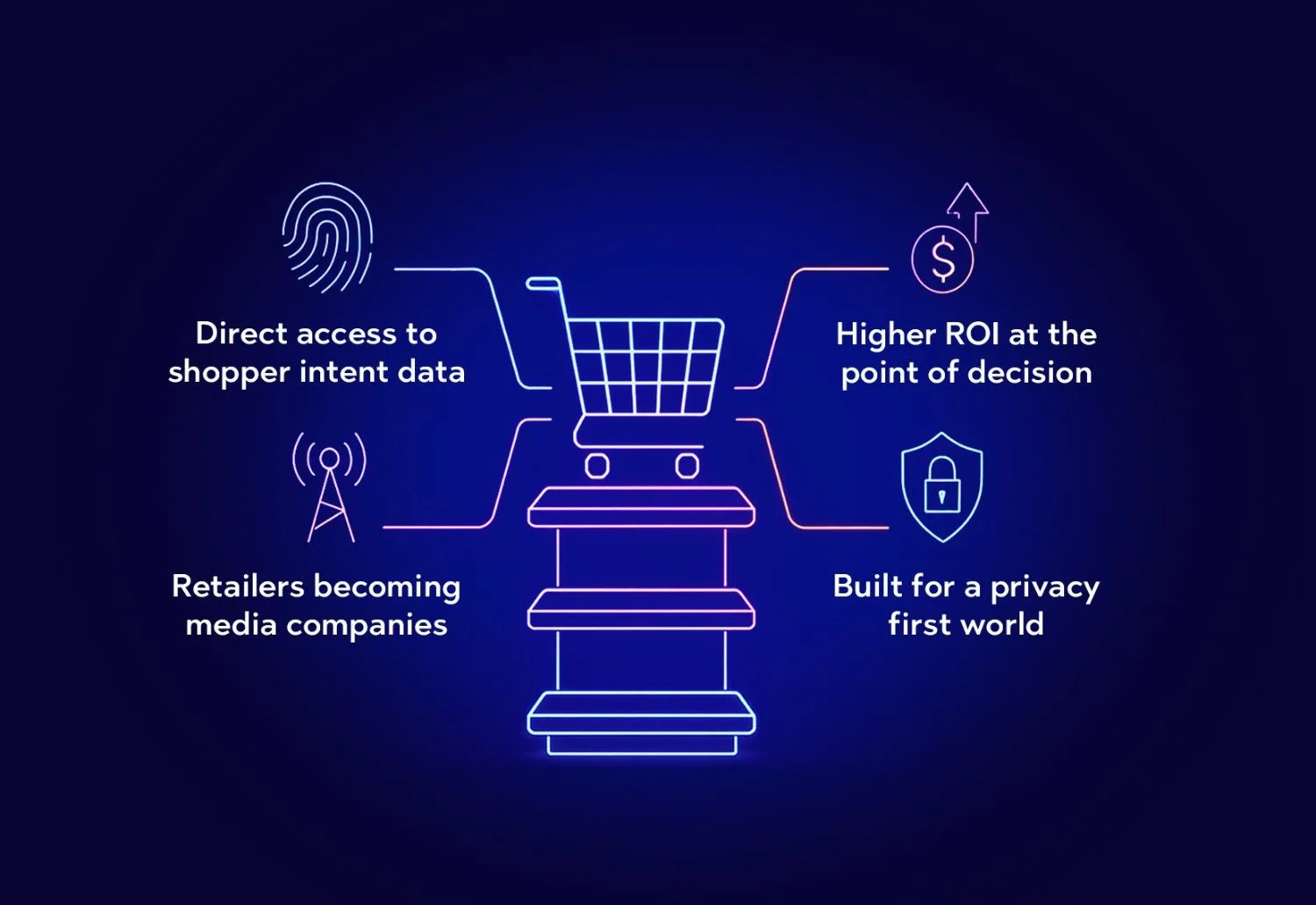
1) Direct access to shopper intent data RMNs leverage first‑party signals you can’t get anywhere else—recent category views, past purchases, basket size, brand affinity, and even store visits tied to loyalty programs. You’re not guessing who’s in the market. You’re speaking to people raising their hands.
2) Higher ROI at the point of decision Sponsored placements near the buy button tend to convert. You’re paying to win visibility where share of shelf equals share of sales. For many brands, retail media pulls double duty: it drives incremental units and protects your organic rank from competitors bidding on your branded terms.
3) Retailers becoming media companies Margins in retail are thin. Media is profitable. So retailers are packaging their audience data, inventory, and partner ecosystems into ad products. As they do, ad quality improves, formats diversify, and measurement gets richer.
4) Built for a privacy‑first world As third‑party cookies disappear and mobile identifiers tighten, retail media keeps working. It runs on opted‑in, first‑party data and increasingly uses clean rooms to match brand + retailer audiences without exposing raw PII. That makes RMN future‑proof and compliance‑friendly.
RMNs unlock value on both sides of the aisle.
The space moves quickly. Here are the shifts we’re watching.
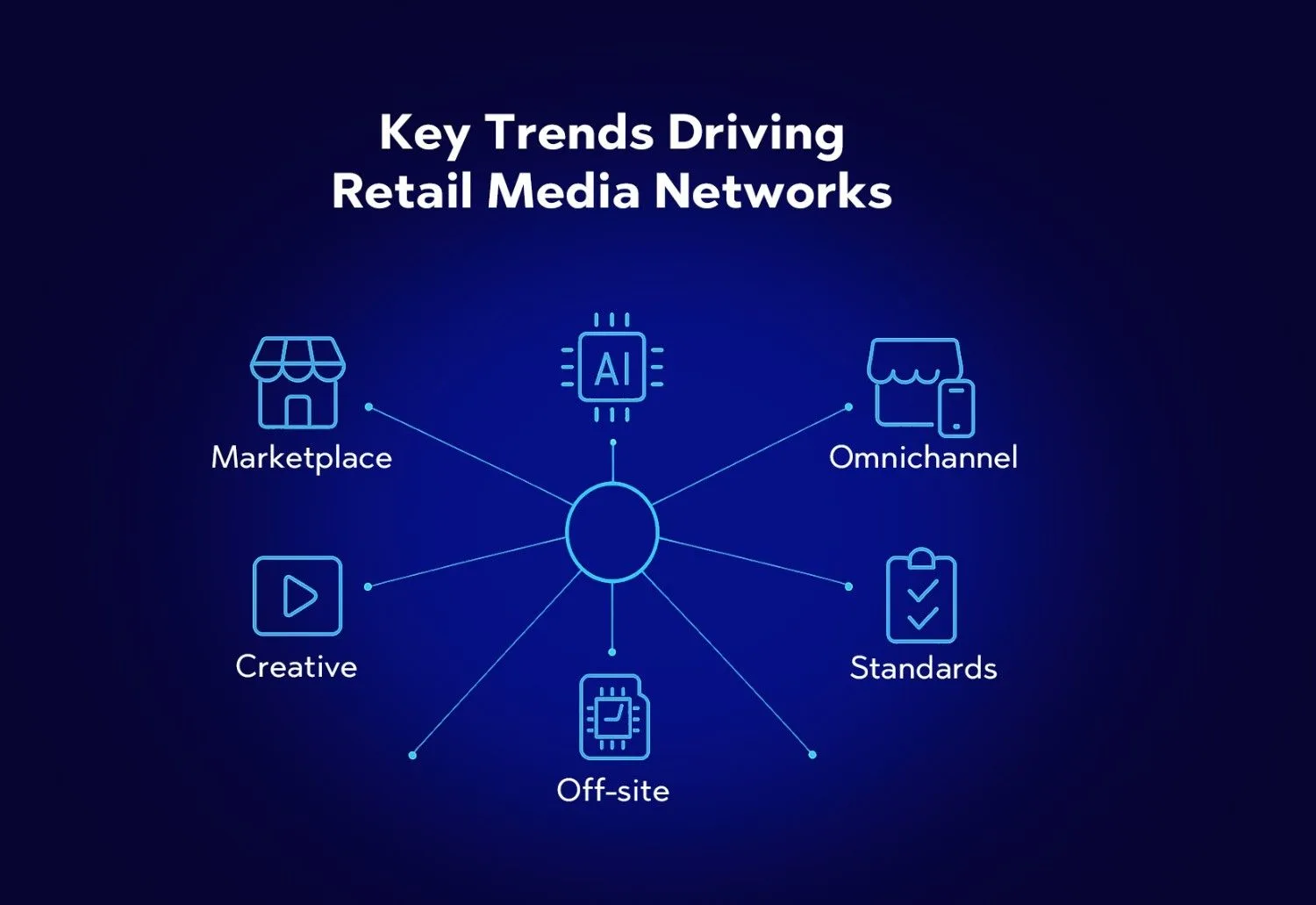
More retailers now operate marketplace models that host third‑party sellers. That increases assortment and search volume, which in turn makes sponsored search and paid placements more valuable.
RMNs don’t stop at the retailer’s domain anymore. Through DSPs and publisher partnerships, retailers extend their audiences across the open web and CTV while keeping measurement anchored to sales.
AI assists with keyword expansion, creative variants, bid optimization, and audience modeling. It also powers dynamic product ads that tailor SKU selection to each shopper.
Digital meets physical. Retailers connect online exposures to in‑store purchases using loyalty IDs and receipt matching. In‑store digital displays, smart carts, and self‑checkout screens become part of the media plan.
What began as text links now includes shoppable video, interactive comparison modules, and branded content hubs hosted by the retailer. Better creative lifts conversion and overall site UX.
Industry groups push for shared definitions—ROAS, incrementality, new‑to‑brand, and viewability—so brands can compare across networks with less friction.
No channel is perfect. Expect trade‑offs and plan for them.
Too many placements can clutter category pages and frustrate shoppers. Retailers need strict relevance rules and caps, and brands should balance paid with organic content improvements.
Each RMN holds its own data. Brands struggle to stitch performance across networks. Clean rooms and CDPs help, but you’ll still need a unified measurement plan.
Attribution varies widely by network. Some report on view‑through conversions, others don’t. Define success before launch and align with retailer reps on what’s feasible.
Retailers must protect the shopping experience. If ads feel spammy, conversion drops for everyone. Choose formats that help the shopper decide.
Retail media sits at the intersection of e-commerce, trade, and paid media. Many teams aren’t organized for that blend yet. Build cross‑functional pods or lean on specialist partners while you ramp up.
Use this practical playbook to go from zero to scaled.
For sponsored search:
For display/video:
Need hands‑on help? Our team designs, launches, and optimizes programs across major RMNs. Explore paid media advertising to get a custom rollout plan.
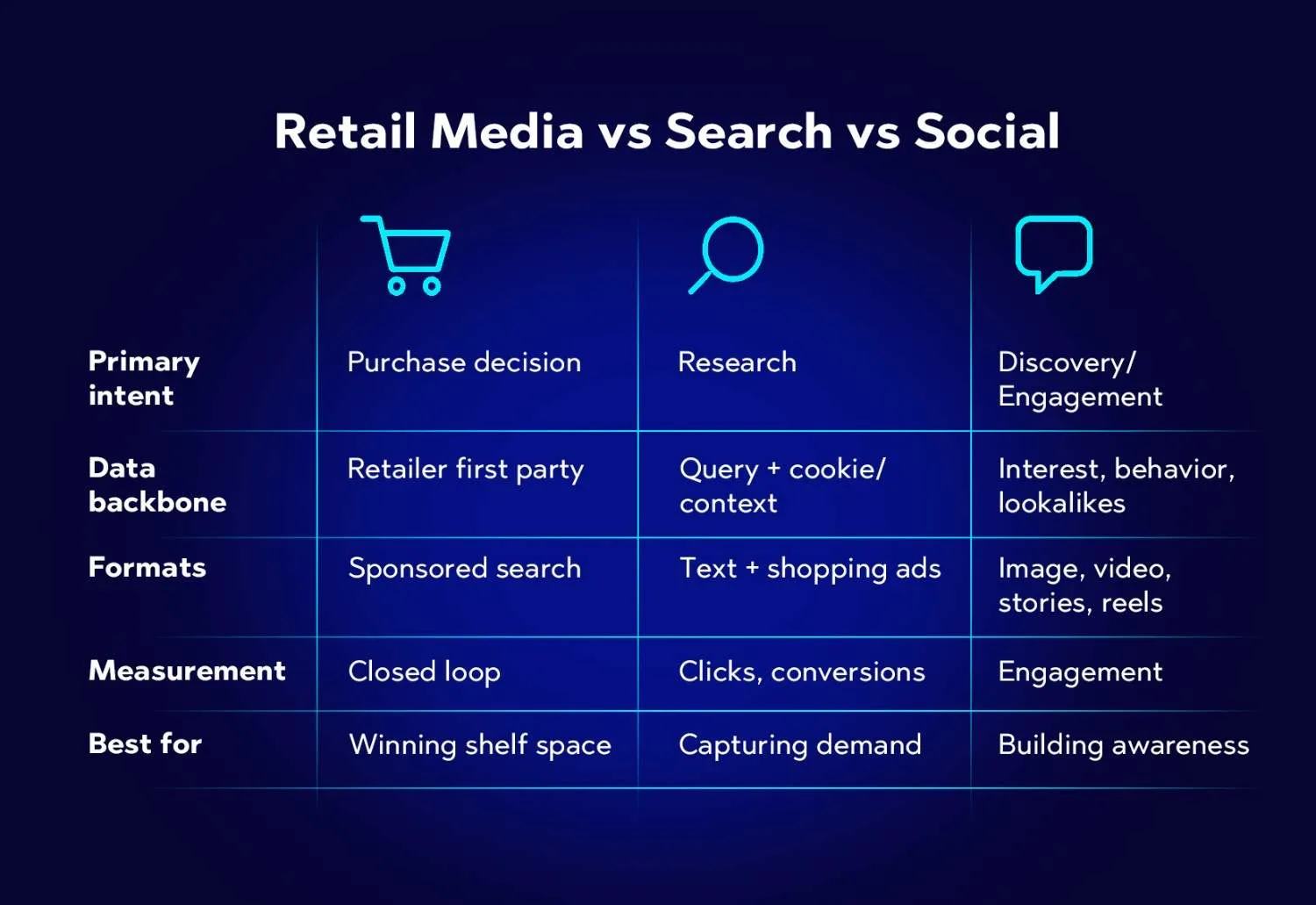
Dimension | Retail Media Networks | Search Ads | Social Ads |
|---|---|---|---|
Primary intent | Purchase decision | Research | Discovery/Engagement |
Data backbone | Retailer first‑party, loyalty, transaction data | Query + cookie/context | Interest, behavior, lookalikes |
Formats | Sponsored search, display, video, shoppable modules, in‑store DOOH | Text + shopping ads | Image, video, stories, reels |
Measurement | Closed‑loop to SKU‑level sales; emerging offline match | Clicks, conversions, store visits | Engagement, view‑throughs, conversions |
Best for | Winning shelf space, defending brand, driving units | Capturing demand, research‑heavy category | Building awareness, storytelling, and community |
Use all three. Let search harvest demand, social spark it, and retail media close the sale.
Great placements flop with weak creative. Keep these tips in your toolkit.
Retailers take privacy seriously because they’re customer‑first businesses. As a brand, mirror that mindset.
Where is this all going? Three big arcs are taking shape.
Search was the first wave. Social was the second. Retail media is the third—and it’s moving from “test budget” to “core line item.” Expect RMN planning to sit alongside trade and shopper marketing in annual brand plans.
CPG led the way, but other verticals are catching up. Pharmacies and health, travel marketplaces, ride‑share and delivery apps, financial services, B2B distributors—any platform with logged‑in users and transactions can build a media network.
Creative will get smarter, bidding will get cleaner, and targeting will keep learning. The magic trick isn’t AI alone; it’s pairing AI with strong first‑party data and clear business rules.
Retailers, brands, agencies, and ad‑tech platforms will work in shared environments—more data partnerships, more transparency, fewer frictions moving budgets across channels.
Retail media networks bring ads closer to the moment of truth. They connect brand storytelling with the final click (and often the in‑store scan) using privacy‑safe, first‑party data. That mix delivers performance and durability in a world where traditional tracking breaks.
If you sell through retailers—online, in store, or both—the question isn’t if you should invest. It’s how fast you can build a disciplined program that scales.
Start with your top retail partners, set clear goals, and test your way into a winning mix of sponsored search, display, and off‑site extensions. Keep your measurement honest. Keep your creative helpful. And keep the shopper experience sacred.
When you’re ready for a plan tailored to your category and margins, our team can help. Explore paid media advertising and let’s map the path from impression to aisle.
Retail media networks are retailer‑run ad platforms that let brands buy placements across the retailer’s website, app, email, in‑store media, and partner inventory. They use first‑party shopper data to reach people near the point of purchase.
Because they combine privacy‑safe data with purchase intent and closed‑loop sales reporting. Few channels can match that blend.
Higher conversion rates, precise targeting, measurable ROI, stronger digital shelf presence, and better alignment with trade promotion.
Media monetizes digital traffic and in‑store screens, strengthens brand partnerships, and finances better customer experiences.
Amazon Ads (India), Flipkart Ads, Myntra Ads, AJIO Ads (via JioAds), Nykaa Advertising, Tata CLiQ Ads, Meesho Ads, Snapdeal Ads, BigBasket Ads (bbnow), Blinkit Ads, Zepto Ads, Swiggy Ads, Zomato Ads, JioMart Ads (via JioAds), Reliance Retail / JioAds Commerce Media Network, Tata 1mg Advertising, PharmEasy Ads, Purplle Ads, FirstCry Ads, Netmeds Ads, and more.
Ad saturation, fragmented measurement, data silos, and the need for cross‑functional talent.
AI will assist with creative iteration, audience modeling, and bid optimization while clean rooms and privacy tech keep data safe.
They’re better for bottom‑funnel conversions and share‑of‑shelf wins. Social remains great for discovery, storytelling, and community. Most brands need both.
Ads generate sales that feed organic rank, while SEO improvements reduce your reliance on paid placements. The best programs combine both.
Absolutely. Start with sponsored search on your highest‑margin SKUs, protect your brand terms, and scale into display/video as you prove ROI.