
Rahul Guleria
SEO Executive
Creative,
Branding
& Growth
in the Global
Digital Ecosystem
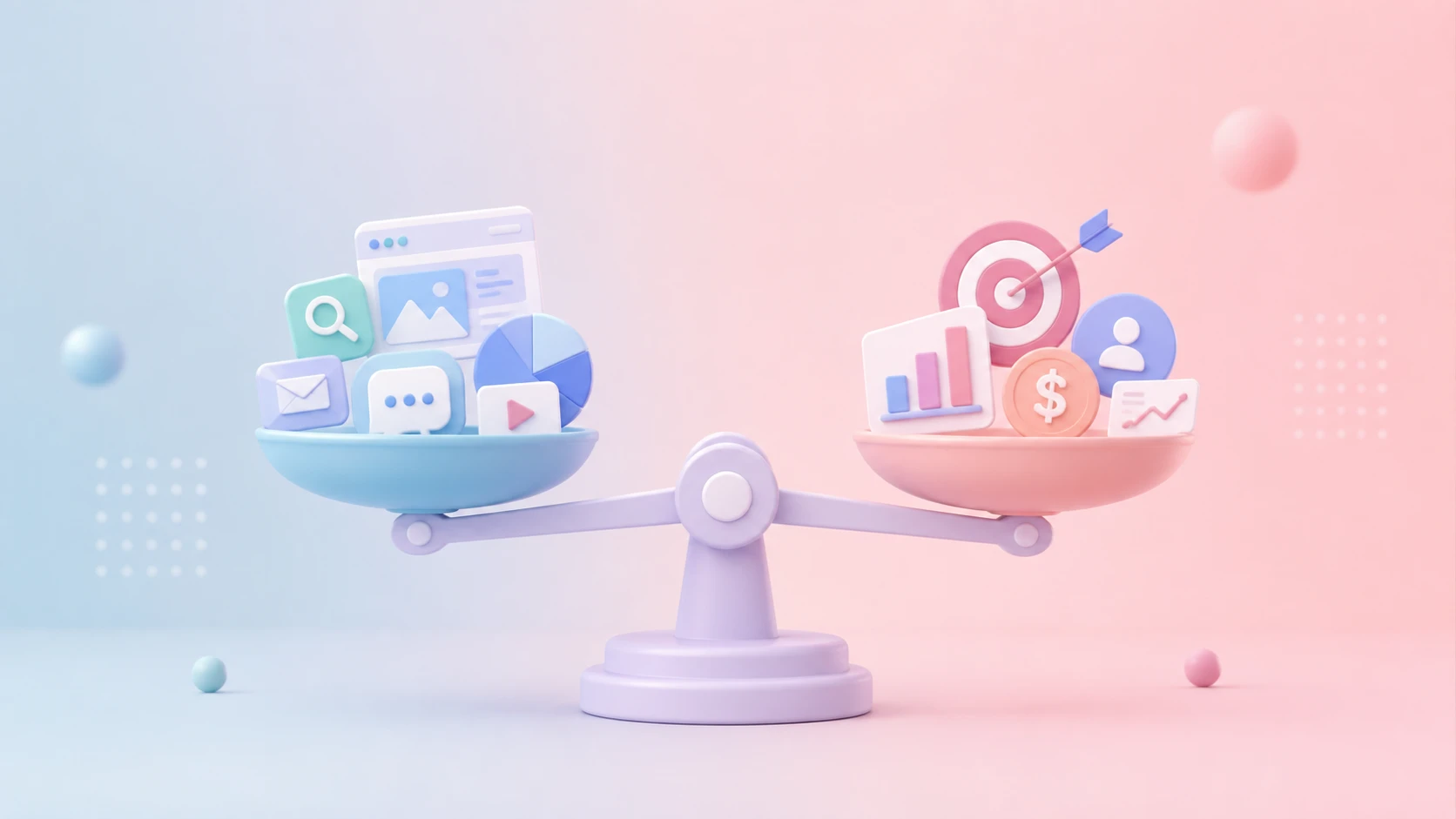
Performance marketing and digital marketing are closely related, but they are not the same. Digital marketing is the broader umbrella covering online channels and activities used to build awareness, engagement, traffic, leads, sales, and customer relationships. Performance marketing is a more outcome-focused approach within the digital ecosystem, where campaigns are planned, measured, and optimized around specific business results such as leads, purchases, conversions, or customer acquisition.
In simple terms, digital marketing focuses on the overall digital customer journey, while performance marketing puts greater emphasis on measurable business outcomes.
What is the difference between performance marketing and digital marketing?
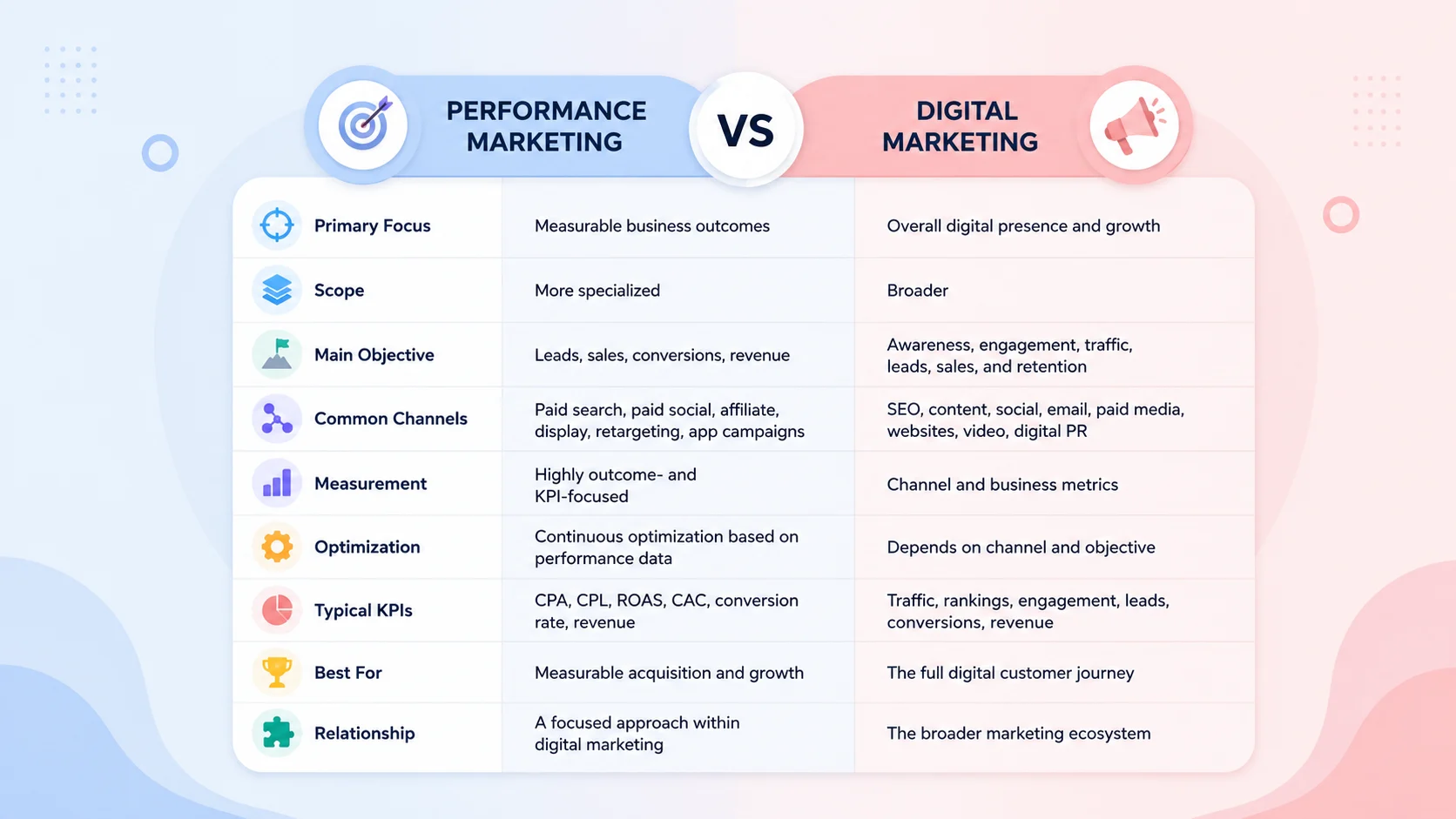
Factor | Performance Marketing | Digital Marketing |
|---|---|---|
Primary Focus | Measurable business outcomes | Overall digital presence and growth |
Scope | More specialized | Broader |
Main Objective | Leads, sales, conversions, revenue | Awareness, engagement, traffic, leads, sales, and retention |
Common Channels | Paid search, paid social, affiliate, display, retargeting, app campaigns | SEO, content, social, email, paid media, websites, video, digital PR |
Measurement | Highly outcome- and KPI-focused | Channel and business metrics |
Optimization | Continuous optimization based on performance data | Depends on channel and objective |
Typical KPIs | CPA, CPL, ROAS, CAC, conversion rate, revenue | Traffic, rankings, engagement, leads, conversions, revenue |
Best For | Measurable acquisition and growth | The full digital customer journey |
Relationship | A focused approach within digital marketing | The broader marketing ecosystem |
The key distinction: not all digital marketing is performance marketing. Digital marketing covers a much wider range of activities, including channels whose primary purpose may be awareness, authority, engagement, or long-term organic growth.
Performance marketing is an outcome-focused approach to digital marketing that emphasizes measurable actions and business results. Instead of evaluating a campaign primarily by visibility or reach, marketers focus on outcomes such as leads, purchases, conversions, customer acquisition, or revenue and use performance data to continuously improve results.
A typical performance marketing process can be summarized as:
Audience → Campaign → Landing Page → Conversion → Tracking → Analysis → Optimization
First, a business identifies a relevant audience and defines a measurable objective. Campaigns are then created to reach that audience and direct users toward a conversion point, such as a product page, lead form, booking page, or app store.
Tracking helps marketers understand what happens after the click. The resulting data can then be used to test audiences, creatives, offers, landing pages, and campaign settings.
The process becomes a continuous cycle:
Launch → Measure → Test → Optimize → Scale
Performance marketing can use a range of digital channels, including:
The exact payment model can vary. Despite the name, performance marketing does not necessarily mean a business pays only when a conversion happens. The defining characteristic is the emphasis on measurable performance and business outcomes.
Digital marketing is the broader ecosystem of marketing activities conducted through digital channels. It can include strategies designed to increase brand awareness, build authority, attract organic traffic, engage audiences, generate leads, drive sales, and retain customers.
For a broader introduction, see PulsePlay Digital's what is digital marketing guide.
Digital marketing can include:
This breadth is what separates digital marketing from performance marketing. A business may invest in SEO content to build organic authority, for example, without expecting every piece of content to generate an immediate conversion.
Likewise, social media activity may be designed to strengthen brand recognition and community engagement rather than directly generate a sale.
The easiest way to understand the difference is to look at scope, objectives, measurement, cost models, optimization, and the customer journey.
Digital marketing is the broader ecosystem.
It includes the digital channels and activities a business uses to build its online presence and engage customers.
Performance marketing is more specialized.
It concentrates on measurable actions and outcomes, often using paid media and conversion-focused campaigns.
A useful way to think about the relationship is:
Digital Marketing = Broad Ecosystem
Performance Marketing = Outcome-Focused Approach Within That Ecosystem
Digital marketing can support multiple objectives, including:
Performance marketing typically puts greater emphasis on measurable outcomes such as:
That does not mean performance marketing ignores awareness or consideration. Rather, its success is generally evaluated more directly against defined business outcomes.
Measurement is one of the clearest differences between the two approaches.
Performance marketing commonly tracks metrics such as:
Digital marketing can also measure these metrics, but its KPI framework can be broader. Depending on the strategy, it may include:
Data is therefore central to both disciplines, but performance marketing tends to place especially strong emphasis on connecting marketing activity with measurable commercial outcomes.
For a deeper look at how data supports marketing decisions, explore data analytics in digital marketing.
Performance marketing is commonly associated with measurable paid media outcomes and campaign economics.
However, it is important not to oversimplify this into the idea that performance marketing always means pay-per-conversion.
Different campaigns can use different pricing and buying models, including models based on impressions, clicks, leads, acquisitions, or other agreed objectives.
The important distinction is the measurement and optimization mindset: marketers monitor campaign performance against defined outcomes and use that information to make decisions.
Performance marketing typically follows a highly iterative process:
Launch → Measure → Test → Optimize → Scale
Marketers can test:
Digital marketing can also involve continuous optimization, but some digital activities are inherently longer-term.
SEO and content marketing, for example, may require sustained investment before their full impact becomes visible. Brand building and authority development can also take time and cannot always be evaluated through immediate conversion metrics.
Digital marketing can support the entire customer journey:
Awareness → Consideration → Engagement → Conversion → Retention
Performance marketing often places greater emphasis on the acquisition and conversion stages:
Target → Acquire → Convert → Measure → Optimize → Scale
In practice, the two journeys overlap. A user may first discover a brand through an organic search result, interact with its social content, see a retargeting advertisement, visit a landing page, and eventually become a customer.
That is why treating performance marketing and digital marketing as completely separate disciplines can create an incomplete picture.
Neither is universally better.
Digital marketing is best understood as the overall digital strategy or ecosystem, while performance marketing is particularly useful when specific measurable outcomes are a priority.
For example:
For most businesses, the question is not necessarily “Which one should we choose?” but rather “How should we use both to achieve our business objectives?”
Yes. In fact, they often work best together.
Consider a D2C brand trying to grow its online business.
The brand could use:
These activities help attract audiences, establish credibility, build visibility, and nurture potential customers.
↓
The brand could then use:
These activities can help capture demand and drive measurable actions.
↓
The business can monitor:
↓
The team can then test:
This creates a connected growth system rather than treating paid campaigns, organic channels, data, and conversion optimization as isolated activities.
Businesses looking to improve the effectiveness of their landing pages can explore conversion rate optimization.
Goal: Increase online sales.
Digital marketing may include:
Performance marketing may include:
The broader digital strategy helps create visibility and demand, while performance campaigns can be used to capture and optimize measurable purchase activity.
Goal: Generate qualified product demos.
Digital marketing may include:
Performance marketing may include:
Here, performance campaigns can be measured against leads and qualified opportunities, while digital marketing supports awareness and consideration.
Goal: Increase installs and active users.
Digital marketing may include:
Performance marketing may include:
The combination can help an app attract new audiences while measuring acquisition performance.
Performance marketing may be a strong choice when:
Performance marketing can be particularly valuable when the business has a clearly defined action that represents success, such as a purchase, qualified lead, booking, subscription, or app install.
Digital marketing is especially important when:
Digital marketing provides the broader framework in which individual channels can work together rather than operating as disconnected campaigns.
For businesses looking to strengthen organic visibility and search-focused growth, explore SEO, AEO & GEO services.
A simple decision framework can help:
Business Goal | Recommended Focus |
|---|---|
Brand awareness | Digital Marketing |
Organic visibility | Digital Marketing |
Generate leads quickly | Performance Marketing |
Increase online sales | Performance Marketing + Digital Marketing |
Build long-term authority | Digital Marketing |
Improve ROAS | Performance Marketing |
Launch a new product | Both |
Scale customer acquisition | Both |
A useful rule is:
If the question is “How do we grow our entire digital presence?” think digital marketing. If the question is “How do we generate and optimize measurable conversions?” think performance marketing.
Understanding the metrics behind performance campaigns is essential for evaluating their effectiveness.
CPA measures the cost associated with acquiring a desired customer or conversion.
It can help businesses understand whether acquisition costs are sustainable relative to the value generated.
CPL measures how much a business spends to generate a lead.
It is particularly relevant to businesses where the first conversion is an enquiry, registration, consultation, or other lead action.
CAC measures the cost of acquiring a new customer.
Unlike a channel-specific metric, CAC can provide a broader view of acquisition economics.
ROAS compares revenue generated from advertising with advertising spend.
It is commonly used to evaluate the direct efficiency of paid advertising campaigns.
Conversion rate measures the percentage of users who complete a desired action from the relevant audience or traffic.
Depending on the campaign, that action could be a purchase, enquiry, registration, download, or another conversion.
Ultimately, revenue connects marketing performance with a business outcome.
While not every marketing activity can or should be evaluated solely through immediate revenue, revenue is an important metric when assessing acquisition-focused campaigns.
Data is a foundational part of both performance and digital marketing.
It can help businesses understand:
Performance marketing often uses this information to make rapid optimization decisions. Digital marketing uses data more broadly to understand channel effectiveness, customer behaviour, content performance, and the overall digital customer journey.
The goal is not simply to collect more data. It is to turn relevant data into better marketing decisions.
Audience-focused insights can also support more effective targeting and customer understanding. Explore audience intelligence to learn more.
Paid acquisition is only one part of a broader digital ecosystem. Businesses can struggle when they rely entirely on paid campaigns while neglecting organic visibility, content, brand building, and retention.
Clicks can be useful, but they do not automatically represent business value.
A campaign generating thousands of clicks may still underperform if those users do not convert or generate meaningful revenue.
Even strong advertising cannot compensate indefinitely for a poor post-click experience.
Landing pages should align with the advertisement, communicate the value proposition clearly, reduce friction, and make the intended next step obvious.
Businesses can also explore strategies to improve landing page conversions.
Increasing advertising spend does not automatically solve a weak offer or poor customer experience.
Businesses should understand what resonates with their target audience before aggressively scaling acquisition.
ROAS can be an important metric, but it should be viewed in the context of customer value, margins, retention, and broader business objectives.
A campaign with lower immediate ROAS may still contribute to stronger long-term customer economics.
Performance campaigns can generate immediate measurable activity, but businesses also need sustainable ways to build visibility, trust, and demand.
Without reliable tracking, marketers may struggle to determine which campaigns, audiences, creatives, and channels are actually generating business results.
Different businesses can have different priorities, so the balance between digital and performance marketing may vary.
Startups often need to establish visibility while learning which audiences, messages, and offers resonate.
A combination of content, SEO, social media, and carefully measured acquisition campaigns can support both learning and growth.
E-commerce businesses often have clear purchase-related conversion points, making performance marketing highly relevant.
At the same time, SEO, content, social media, email, and brand building can support sustainable demand beyond paid acquisition.
SaaS businesses may focus on leads, product demos, trials, subscriptions, or customer acquisition.
Performance campaigns can help generate measurable demand, while content, SEO, thought leadership, and email nurture longer consideration cycles.
Local businesses can combine digital visibility with location-focused paid campaigns.
Depending on the business, useful outcomes may include enquiries, calls, bookings, visits, or purchases.
Enterprise businesses often have complex customer journeys and multiple stakeholders.
A broader digital strategy can support brand, content, search, social, and customer engagement, while performance marketing can contribute measurable acquisition and campaign objectives.
B2B marketing may require longer consideration periods and multiple touchpoints.
Digital marketing can build authority and nurture prospects, while performance marketing can support targeted lead generation and measurable acquisition.
No. Performance marketing is generally a more outcome-focused approach within the broader digital marketing ecosystem. Digital marketing includes a wider range of activities such as SEO, content, social media, email, branding, websites, paid media, and digital PR.
The main difference is scope and emphasis. Digital marketing covers the broader use of digital channels to achieve marketing objectives, while performance marketing focuses more specifically on measurable actions and business outcomes such as leads, sales, conversions, customer acquisition, and revenue.
Yes, performance marketing is generally considered part of the broader digital marketing ecosystem. However, terminology can vary between organizations. Some companies may use “performance marketing” more narrowly to describe conversion-focused paid acquisition activities.
Neither is universally better. Digital marketing provides the broader strategic ecosystem, while performance marketing can be especially useful when measurable acquisition or conversion outcomes are a priority. Many businesses benefit from using both approaches together.
SEO is generally considered a digital marketing discipline. While SEO can be measured through traffic, leads, conversions, and revenue, its broader role often includes building organic visibility, authority, and long-term search presence.
It can be either. Social media marketing is a broad digital marketing discipline that can include organic content, community building, brand activity, and paid campaigns. When social campaigns are optimized around measurable conversions or acquisition, they can form part of a performance marketing strategy.
Examples include paid search campaigns, paid social campaigns, retargeting, affiliate marketing, app-install campaigns, lead-generation campaigns, and other campaigns where measurable outcomes are central to planning and optimization.
Examples include SEO, content marketing, social media marketing, email marketing, paid advertising, websites, video marketing, influencer marketing, digital PR, marketing automation, and analytics.
Startups may benefit from both. Digital marketing can help build visibility, authority, content, and audience relationships, while performance marketing can help test acquisition channels and generate measurable leads or customers. The right balance depends on the startup's goals, budget, audience, product, and stage of growth.
Yes. Combining them can create a more complete growth strategy. Digital marketing can build awareness, trust, organic visibility, and engagement, while performance marketing can support measurable acquisition and conversion. Data can then be used to optimize both activities over time.
Digital marketing is the broader ecosystem; performance marketing is an outcome-focused approach within that ecosystem.
Businesses do not necessarily need to choose one over the other. A strong growth strategy can use digital channels to build visibility, trust, authority, and demand while using performance marketing to acquire customers and optimize measurable business outcomes.
The strongest approach depends on the business objective. Digital marketing helps build the broader customer journey. Performance marketing helps turn measurable opportunities into optimized growth.
If your business needs to connect strategy, creative, paid media, data, technology, and measurable growth, explore PulsePlay Digital's integrated digital performance marketing services.