
Rahul Guleria
SEO Executive
Creative,
Branding
& Growth
in the Global
Digital Ecosystem
If you’re trying to grow traffic from Google, you’ll quickly hear two phrases over and over again:
Both sound technical at first. Yet they’re simply two sides of the same search engine optimisation coin.
At a high level:
Together, they decide whether your pages quietly sit on page 5 or proudly show up on page
If you’re completely new to SEO and want a deeper foundation, you can also read: What Is SEO & Why It Matter for Businesses
In this guide, we’ll break down On-Page SEO vs Off-Page SEO, key differences, practical examples, and how to build a balanced strategy that gets real results.
On-Page SEO refers to all the optimisation work you do inside your website to help search engines and users understand what each page is about.
If your website were a physical store, on-page optimisation would be:
In short, On-Page SEO is about relevance and user experience.
Some key elements include:
When you ask “What is On-Page SEO?”, you’re basically asking: “How can I make my website clear, useful, and easy to understand for both people and search engines?”
If On-Page SEO is about your own house, Off-Page SEO is about your reputation in the neighbourhood.
It covers all the signals that happen outside your website that tell Google whether your site is trustworthy, authoritative, and worth ranking.
Think of Off-Page SEO as digital word-of-mouth.
Important Off-Page SEO activities include:
So when you wonder “What is Off-Page SEO?”, think: “How can I show Google and users that other people trust and recommend my website?”
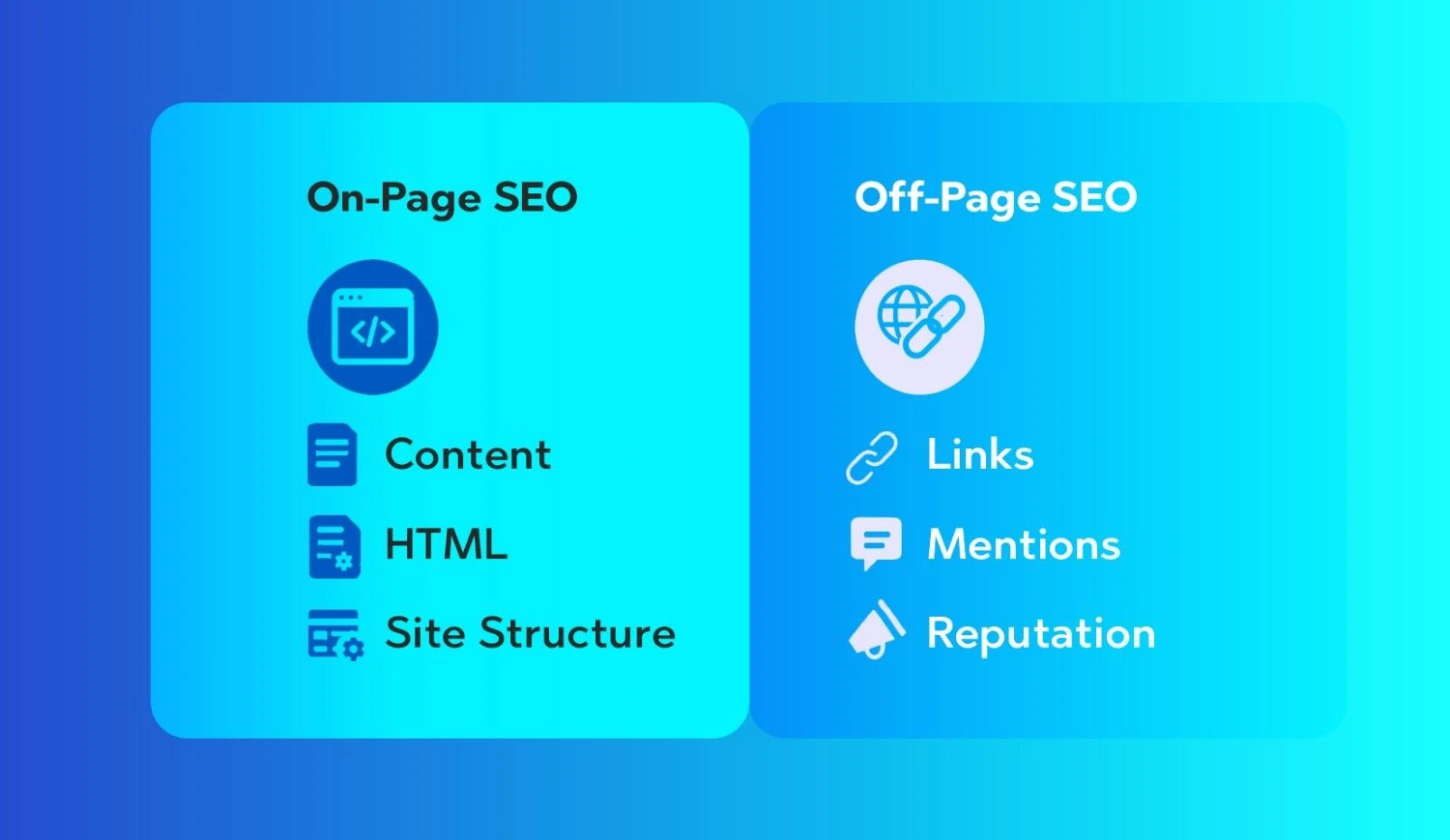
The simplest way to remember it:
On-Page SEO is what you control on your website. Off-Page SEO is what others say about your website.
Both matter. One without the other is like having a beautiful shop in the middle of nowhere or being famous for a store that’s a mess inside.
Let’s look at the difference between On-Page and Off-Page SEO side by side.
Aspect | On-Page SEO | Off-Page SEO |
|---|---|---|
Optimisation area | Inside your website (content, code, structure, UX) | Outside your website (links, mentions, citations, reputation) |
Main techniques | Keyword optimisation, meta tags, headings, internal links, UX, technical fixes | Link building, digital PR, brand building, social media, influencer collaborations, citations |
Primary ranking factors | Relevance, content quality, search intent match, Core Web Vitals, mobile-friendliness | Authority, trust, backlink quality and quantity, brand searches, topical relevance of linking sites |
Typical KPIs | Organic traffic, time on page, bounce rate, click-through rate (CTR), indexed pages | Referring domains, number/quality of backlinks, brand searches, domain authority, referral traffic |
Impact on search visibility | Helps search engines understand and correctly rank individual pages for relevant queries | Boosts your overall domain and page authority, helping you rank higher and for more competitive keywords |
You need both. On-Page SEO sets the foundation. Off-Page SEO builds the authority that pushes you above competitors.
Yes… but with limits.
If you’re in a low-competition niche, have a very unique brand name, or target ultra-specific long-tail keywords, strong On-Page SEO alone might get you decent visibility.
For example:
In these cases:
can be enough to rank for some terms.
However, as soon as you enter competitive markets – think “best digital marketing agency”, “buy running shoes online”, “dentist in Dubai” – you’ll hit a ceiling.
Why?
Because your competitors are:
On-Page SEO helps you enter the race.Off-Page SEO helps you win it.
So yes, you can rank in small or niche spaces with just On-Page SEO, but you’ll almost always cap your full potential for bigger, high-value keywords.
Imagine a famous restaurant that serves terrible food. People may visit once because they heard about it. They don’t come back.
That’s what happens when you push Off-Page SEO (links, PR, hype) without a solid On-Page SEO foundation.
Off-Page SEO amplifies what’s already there. So if the underlying page isn’t optimised, you’re basically amplifying mediocrity.
Let’s dig a little deeper into the building blocks of effective On-Page SEO.
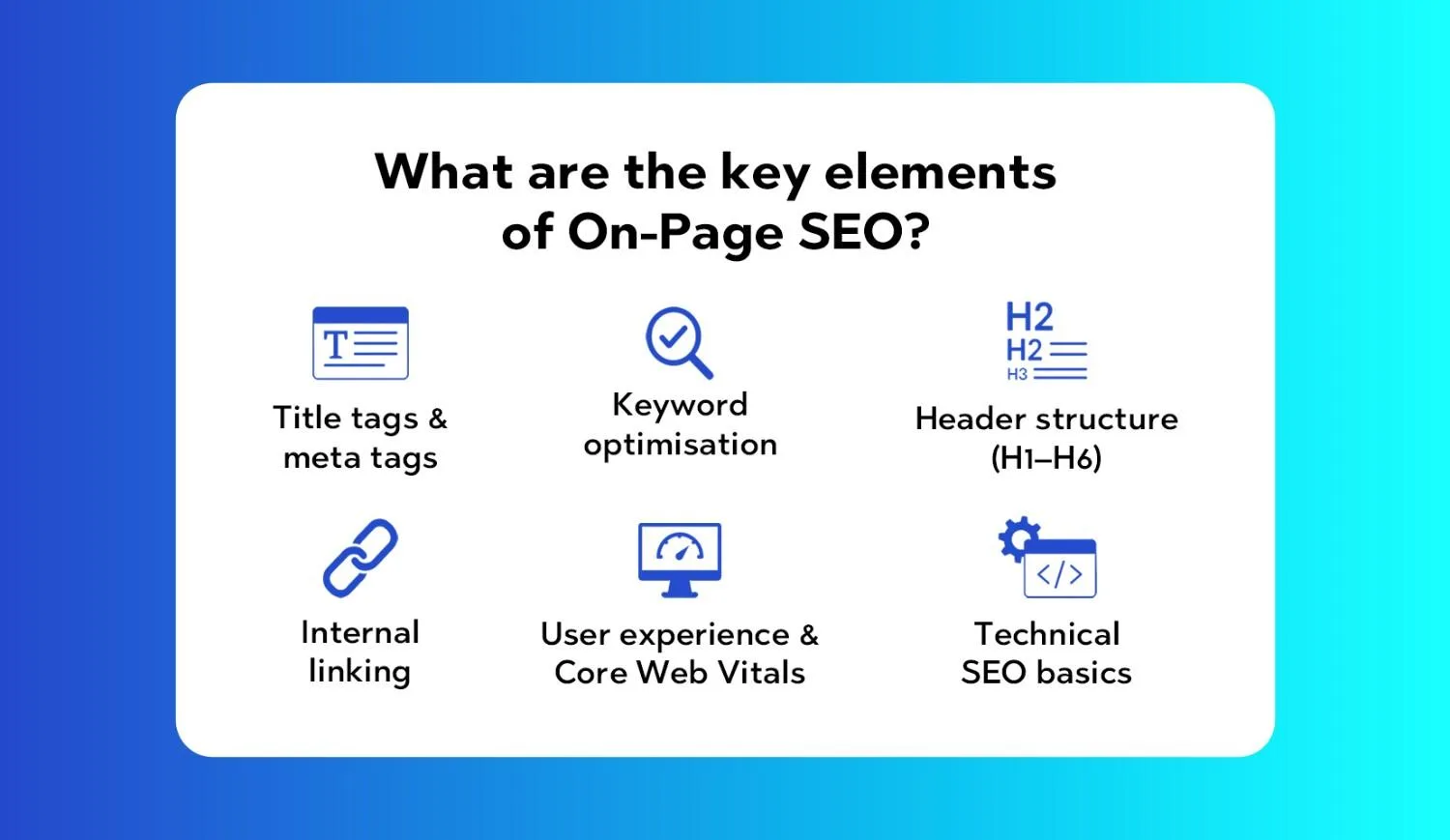
Your title tag is often the first thing a user sees on Google.
Your meta description doesn’t directly impact rankings, but it influences click-through rate (CTR).
Well-crafted titles and descriptions help users choose your result over competitors.
Keyword optimisation today is less about stuffing exact phrases and more about:
Think in terms of topics and entities, not just keywords.
Headers are like signposts for both users and search engines.
A clean header structure improves readability and helps Google understand the hierarchy of your content.
Internal links connect your content and distribute authority around your site.
Good internal linking:
A few tips:
This also supports broader search engine optimisation efforts across your website.
On-Page SEO isn’t just about text. It’s about how it feels to use your site.
Google’s Core Web Vitals focus on:
Optimise by:
If users get frustrated, they leave. High bounce rates and low engagement hurt your ability to rank.
You don’t need to be a developer to handle the basics, but you can’t ignore them.
Key technical foundations include:
With these in place, your On-Page SEO work won’t be held back by hidden technical issues.
Now let’s move outside your website and look at Off-Page SEO in more detail.
Backlinks are still one of the most powerful Off-Page SEO signals.
But not all links are equal.
The best links are:
A few ethical ways to earn them:
As your brand grows, people start mentioning you even without linking.
These brand mentions still matter, because they:
You can grow brand mentions through:
Strictly speaking, likes and shares aren’t direct ranking factors. However, social media still supports Off-Page SEO by:
Useful approaches:
The more visible you are, the easier it becomes to earn natural backlinks and mentions.
For local businesses, Off-Page SEO also includes citations and local PR.
Citations list your:
on directories, maps, and local platforms.
Consistent NAP information helps:
Local PR — such as sponsoring events, supporting social causes, or collaborating with neighbourhood businesses — can lead to:
Together, these off-site signals improve your authority and make your On-Page SEO work even harder.
Here’s the honest answer:
Neither On-Page SEO nor Off-Page SEO works well in isolation. Google values the combination of both.
Think about Google’s goals. It wants to show:
Modern algorithms also look at E-E-A-T:
On-Page SEO plays a bigger role in content quality, clarity, and user satisfaction. Off-Page SEO plays a bigger role in authority, reputation, and external trust signals.
If you want to build a strong presence in search, you need to treat them as partners, not rivals.
If you’re just starting and everything feels overwhelming, here’s a step-by-step beginner SEO roadmap that combines On-Page and Off-Page priorities.
Before chasing rankings:
If search engines can’t crawl and index your site, nothing else matters.
Next, focus on:
This lifts the “technical burden” and improves user experience, which benefits every future SEO effort.
Start with your:
For each page:
This is where you start to see early wins from On-Page optimisation.
Plan content that:
This content becomes the asset you’ll later promote with Off-Page SEO.
You don’t need 1,000 backlinks to begin. Start with:
Even a handful of strong, relevant links can move the needle when paired with solid On-Page work.
As your foundation strengthens, you can expand into:
At this stage, Off-Page SEO acts as a multiplier for the On-Page work you’ve already done.
If you’d like expert help building a roadmap tailored to your business, PulsePlay’s team can support you with full-funnel search engine optimisation and content marketing.
When you compare On-Page SEO vs Off-Page SEO, you’re really looking at two halves of the same strategy:
Instead of asking “Which is more important?”, a better question is:
“How can I get my On-Page and Off-Page SEO working together to grow my business?”
Start with a solid On-Page foundation. Then layer in Off-Page tactics like ethical link building, PR, and brand building. Over time you’ll see more keywords, more traffic, and — most importantly — more leads and sales.
And if you’d like expert help creating a tailored strategy across both sides of SEO, the team at PulsePlay Digital is ready to support your long-term search engine optimisation journey.
On-Page SEO makes your pages highly relevant and user-friendly. Off-Page SEO tells Google that your pages are trusted and recommended.
When both are strong:
That combination is what consistently drives first-page rankings.
They might help a little, but you’ll never get the full benefit.
If the page:
then backlinks are like pouring water into a leaky bucket.
Backlinks work best when you first fix On-Page issues and ensure the content truly deserves to rank.
You’ll typically see faster visible improvements from On-Page SEO.
can all lead to noticeable changes in a matter of weeks (sometimes days), depending on crawl frequency.
Off-Page SEO, especially link building and brand awareness, takes more time — but it’s crucial for long-term growth and competing in tough niches.
Common (and safe) backlink types include:
Avoid automated link schemes, private blog networks (PBNs), and any link sellers promising “1,000 links overnight”. Those can do more harm than good.
Keyword cannibalisation happens when multiple pages on your site compete for the same keyword, confusing search engines about which page to rank.
To avoid it:
A clear content strategy prevents your own pages from fighting each other in the search results.
Yes, social media is considered part of Off-Page SEO, even though it doesn’t directly pass the same kind of link equity as traditional backlinks.
It helps by:
So while social signals alone won’t rank you #1, they strongly support overall Off-Page efforts.
Content quality is absolutely critical.
Google’s algorithms look for:
High-quality content is also much easier to:
In other words, content quality is the engine that powers both sides of SEO.
Local SEO uses both.
On-Page Local SEO includes:
Off-Page Local SEO includes:
To dominate local search, you need both strong On-Page foundations and active Off-Page signals.