If you run a local business today, your next customer is probably searching for you on Google right now.They might type “dentist near me”, “best café in Dharamshala” or “AC repair open now”.
If you don’t show up in those local search results, you’re basically invisible at the exact moment people are ready to buy.
That’s where Local SEO strategies for small businesses come in.
Local SEO helps your business appear in:
The Google Map Pack (those top 3 map results)
Google Maps
Localised organic results (normal blue links with local intent)
When you combine the right Local SEO tips, a well-optimized Google Business Profile, and consistent local branding, you improve local rankings, attract more nearby customers, and grow revenue without always relying on paid ads.
In this guide, you’ll learn:
What Local SEO actually is
How Google decides who ranks where
The best Local SEO strategies for small businesses
How to track performance and avoid common mistakes
Let’s start from the basics.
What is Local SEO and Why is it Important for Small Businesses?
Local SEO (Local Search Engine Optimisation) is the process of optimizing your online presence so your business appears for location-based searches.
Think:
“Pharmacy near me”
“Wedding photographer in Dubai”
“Plumber in Pune open now”
Instead of trying to attract everyone, Local SEO focuses on the people closest to you who are more likely to visit your store, book a service, or call you.
Local customers + proximity-based search results
Search engines want to show users the most relevant and nearby results.
So if someone is standing near your store and searches “coffee shop”, Google won’t show a café 30 km away. It will show options within a practical distance, based on:
Where the user is
How close your business is
How strong your local signals are (reviews, relevance, profile quality)
Local SEO drives in-store visits and service bookings
For small businesses, Local SEO is often the bridge between online discovery and offline sales.
It helps:
Restaurants fill tables
Clinics get more appointments
Salons increase bookings
Home services (plumbers, electricians, cleaners) get more calls
Retail stores increase footfall
If you’re investing in broader search engine optimisation, adding a strong Local SEO layer amplifies your visibility where it matters most: your own neighbourhood.
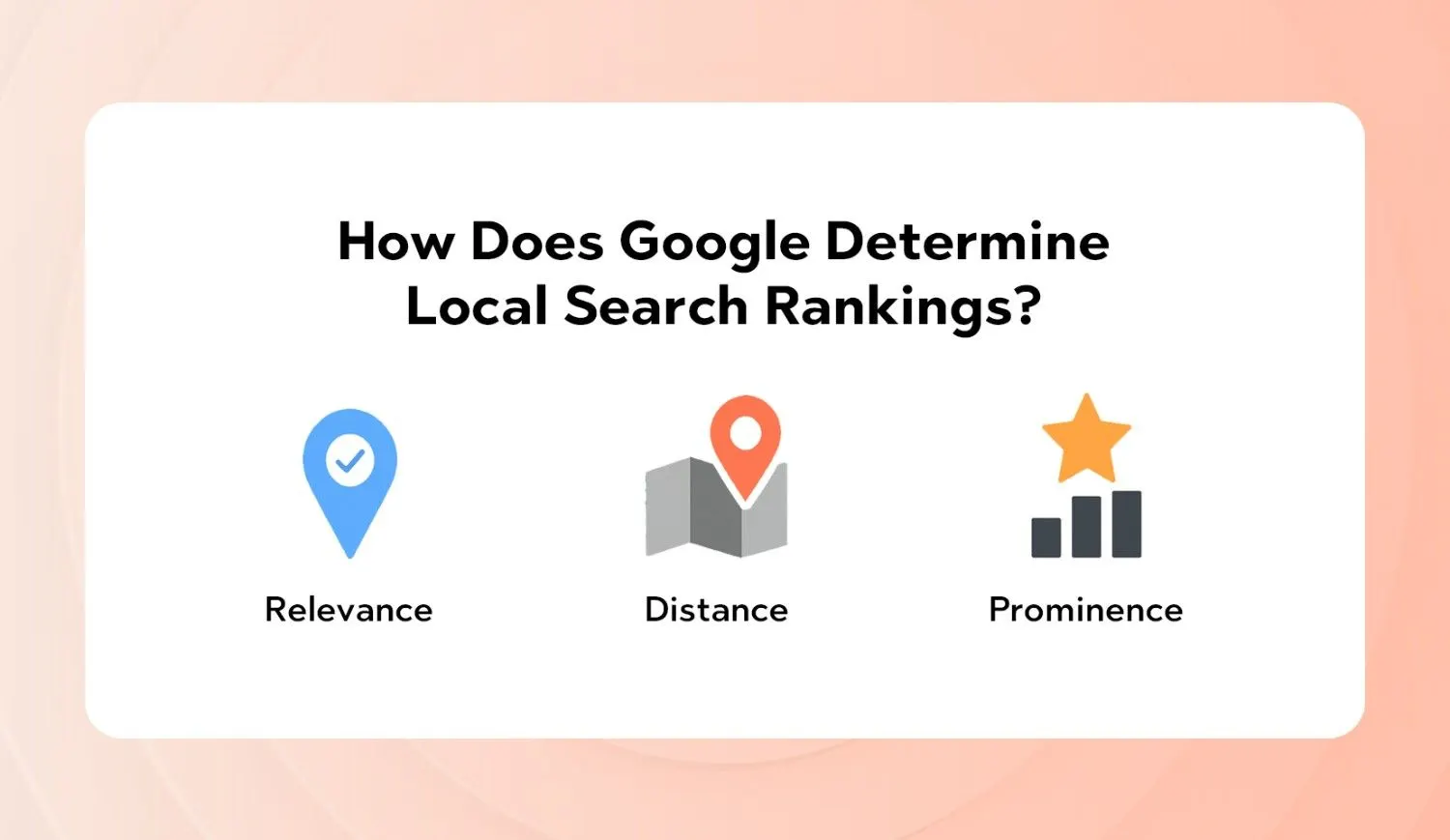
How Does Google Determine Local Search Rankings?
Google has shared three primary factors for local search rankings:
Relevance
Distance
Prominence
Understanding these helps you build smarter Local SEO strategies for small businesses.
1. Relevance
Relevance measures how well your business matches what the user is searching for.
For example:
If someone searches “orthodontist near me” and your profile says “general dental clinic”, Google might show a more specialized orthodontist first.
You increase relevance by:
Using accurate categories
Adding detailed services
Writing descriptive content
Answering common questions on your website & Google Business Profile
2. Distance
Distance is simple: how far your business is from the user or the location mentioned in the search.
If a user types “bakery in Andheri”, Google will prioritise Andheri bakeries over those in Bandra.
You can’t control where users are.
You can make sure your business address and service areas are correct everywhere online.
3. Prominence
Prominence is about how popular and trusted your business appears online.
Google looks at signals like:
Review volume and average rating
Local backlinks and mentions
Citations and directory listings
Website authority
Brand recognition
This is where Local link building, reviews, PR, and content all work together to push your rankings higher over time.
What Are the Best Local SEO Strategies for Small Businesses?
Now let’s get practical.
Here are 8 powerful Local SEO strategies for small businesses you can start using today.
1. How to optimize Google Business Profile for better local ranking?
Your Google Business Profile (GBP) is your most important local asset after your website.
It feeds data to:
Google Search
Google Maps
The Local Pack
If you do nothing else, optimize your GBP properly.
a) Get the basics right: Business name, NAP
Your NAP stands for:
Name
Address
Phone number
Make sure:
Your business name is real (no spammy keyword stuffing like “Riya Salon Best Bridal Makeup Top Hairstyles”).
Address is accurate and matches your website & other listings.
Phone number is correct and reachable during business hours.
Use the same NAP format everywhere – website, directories, social media, listings. Consistency builds trust with Google.
b) Choose the right categories and attributes
Categories help Google understand what you do.
Set your primary category to your main service (e.g. “Dentist”, “Coffee shop”, “Travel agency”).
3. How to keep NAP citations consistent across the web?
Citations are mentions of your business NAP on other sites, such as:
Online directories
Local listings
Industry platforms
Map and review sites
Google compares these to check if your business details are trustworthy.
a) List on key business directories
Start by getting listed on:
Google Business Profile
Apple Maps
Bing Places
Facebook business page
Local business directories in your city/country
Niche directories (e.g., medical listing sites, restaurant platforms, home service apps)
b) Maintain accuracy & consistency
Make sure your:
Name
Address
Phone
Website URL
are identical everywhere.
If you rebrand, change location, or update your phone number, go back and update all major listings. Inconsistent information confuses both users and search engines, which can hurt local rankings.
4. How does local content help improve rankings?
Local content connects your business to the community, location, and needs of people around you.
Search engines love websites that show clear local relevance.
a) Create service pages for each location
If you serve multiple locations, don’t put everything on one generic page.
Instead:
Create separate pages like:
“Pest Control Services in Dubai Marina”
“Dental Clinic in Dharamshala”
“Interior Designer in Pune”
On each page, include:
Local keywords
Specific services offered in that location
Local testimonials or case studies
Directions and nearby landmarks
This helps you rank for location-specific searches.
b) Publish local blogs and community updates
Blog topics might include:
“Top things to know before hiring a wedding planner in [City]”
“Best trekking spots near [City] and what to pack” (for an outdoor gear store)
“How to prepare your home for monsoon in [Region]” (for a home repair service)
You can also write about:
Local events you sponsor
Community initiatives you support
Collaborations with other local businesses
This positions you as a local expert and gives Google more content to index.
5. What role do online reviews and ratings play in Local SEO?
Reviews are a massive ranking and conversion factor.
More genuine reviews = more trust
Higher ratings = better click-through rates
Detailed reviews = richer content for Google to understand your business
a) Use Google + industry-specific platforms
Focus on:
Google Business Profile reviews (top priority)
Platforms like Zomato, TripAdvisor, Justdial, Practo, Houzz, etc. depending on your vertical
Don’t try to be everywhere at once. Pick 2–3 platforms that matter for your industry and build a strong presence.
b) E-E-A-T and customer trust
Local SEO ties closely with E-E-A-T:
Experience – Do reviewers talk about real experiences with your brand?
Expertise – Do they mention how knowledgeable your team is?
Authoritativeness – Do many people recommend and rate you highly?
Trustworthiness – Do you respond transparently and solve issues?
Reviews help search engines and humans see that your business is credible and reliable.
Never buy fake reviews. It’s risky, against guidelines, and usually obvious.
6. What is Local Link Building and how to get quality links?
Local link building is about earning backlinks from local and relevant websites.
These links act like votes of confidence and strengthen your prominence.
a) Sponsorships & local PR
You can earn local links by:
Sponsoring local events, school activities, sports teams
Partnering with NGOs or community initiatives
Supporting festivals or cultural events
Often, these partners will mention you on their website with a link.
b) Collaborations and partnerships
Build real relationships with:
Complementary businesses (e.g. a photographer + event planner)
Local bloggers and influencers
Chambers of commerce or business associations
You can:
Co-create content
Run joint campaigns
Feature each other on blogs and resources pages
c) Local events & content
Host or participate in:
Webinars
Workshops
Meetups or pop-up events
Local media, blogs, or event sites may link to your site to share details. Over time, this builds strong, locally relevant authority.
7. How to use Social Media to support Local SEO?
While social signals aren’t direct ranking factors, social media still supports Local SEO in powerful ways.
It amplifies your:
Brand awareness
Community presence
Opportunities for people to search for your brand on Google
a) Use content with location tags
On Instagram, Facebook, LinkedIn, and other platforms:
Tag your location in posts
Mention your city/neighbourhood in captions
Use local hashtags where relevant (#dharamshala, #punefoodies, etc.)
This familiarises users with where you are. Many will later search your brand name on Google and interact with your profile.
b) Engage with your local community
Don’t just broadcast. Interact.
Reply to comments and DMs
Share user-generated content from local customers
Collaborate with local creators or micro-influencers
Promote local causes or events you care about
The stronger your community presence, the more people search for you by name — and brand searches are a strong signal of trust and relevance.
8. Why should websites be mobile-friendly for Local SEO success?
Most local searches happen on mobile devices.
Think of someone:
Standing outside, searching for “pharmacy near me”
Sitting in a car, searching “best biryani near me”
On the couch, searching “AC repair in [city]”
If your website is slow, broken, or hard to use on mobile, you’ll lose that visitor in seconds.
a) Location-based mobile searches
Make sure your site:
Is responsive on all screen sizes
Displays clear contact information and address
Offers click-to-call buttons
Embeds Google Maps or directions
This makes it easy for people to act in the moment.
b) Faster user experience = better conversions
Speed matters.
Compress images
Avoid heavy, unnecessary scripts
Use caching and performance optimizations
A fast, smooth site keeps users engaged, which indirectly supports better rankings and higher conversion rates.
If you want help improving your overall search engine optimisation foundation, explore PulsePlay’s SEO & Content Marketing services.
How to Track and Measure Local SEO Performance?
Local SEO is not “set it and forget it”.You need to track performance and refine your strategy.
Tools you can use
Google Business Profile Insights
See how many people found you via search vs maps
Track calls, website clicks, and direction requests
View queries people used to find you
Google Search Console (GSC)
Track impressions and clicks for local keywords
Check which pages are driving traffic
Fix indexing and technical issues
Google Analytics 4 (GA4)
See what local visitors do on your site
Track events like form submissions, calls (via click tracking), and bookings
Monitor your rankings in specific cities or neighbourhoods
Track performance in the Local Pack vs organic results
Metrics that matter
Instead of obsessing only over ranking positions, look at:
Calls from Google profile
Direction requests (strong intent to visit)
Website visits from GBP
Local pack visibility (how often you appear in top 3 results)
Review volume and average rating
Conversions (leads, bookings, purchases)
These tell you if Local SEO is actually growing your business, not just your traffic numbers.
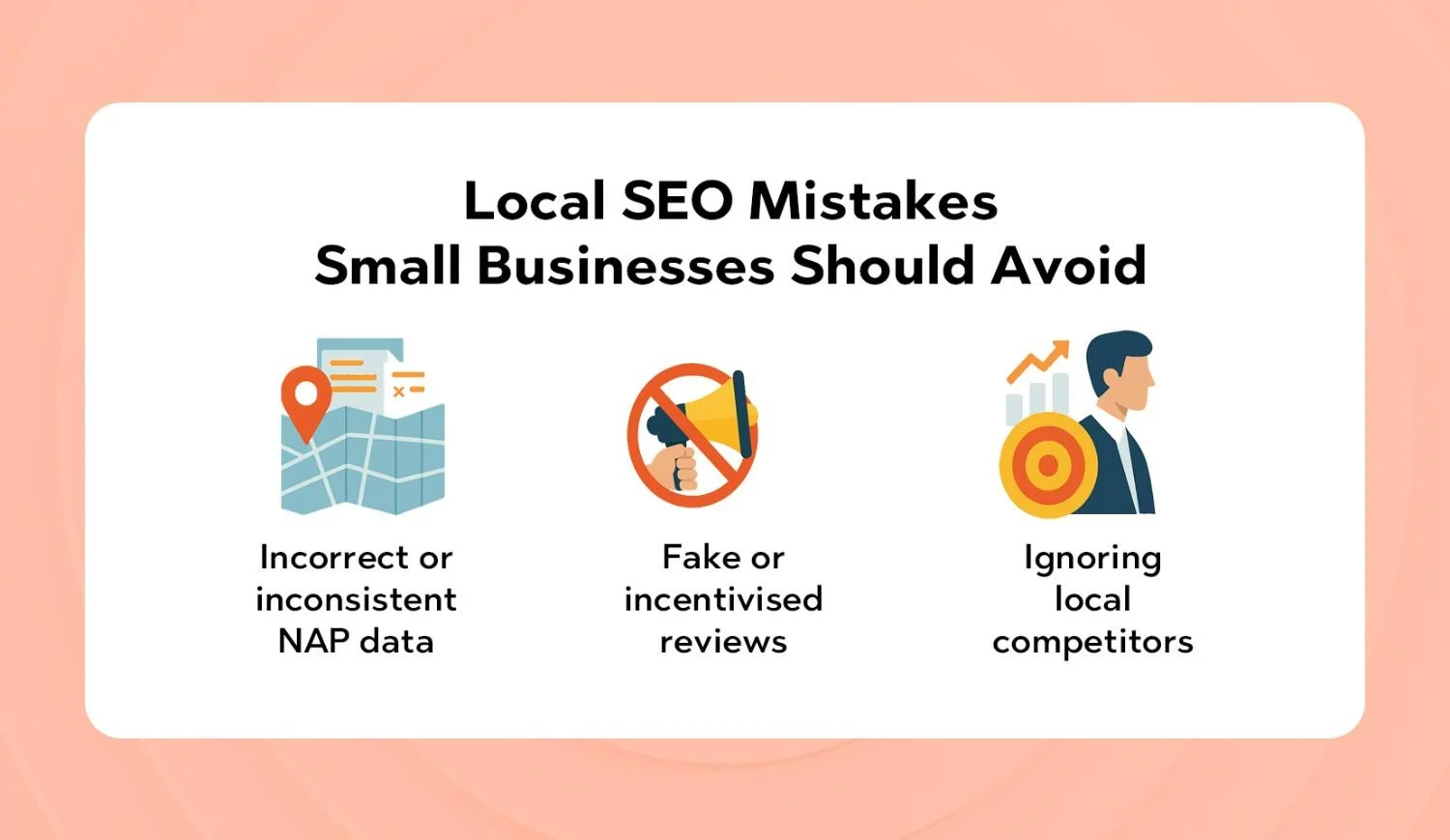
Local SEO Mistakes Small Businesses Should Avoid
Some Local SEO mistakes can quietly hurt your visibility and credibility. Avoid these:
1. Incorrect or inconsistent NAP data
If your Google Business Profile says:
“ABC Dental Clinic, 123 Hill Road”
and a directory says:
“ABC Dental Care, 12 Hill Road”
and your website says:
“ABC Dental Clinic, 123 Hills Rd”
Google (and users) may get confused.
Keep one single source of truth
Use the same NAP everywhere
Update your details promptly whenever something changes
2. Fake or incentivised reviews
Buying fake reviews or offering gifts in exchange for “5-star reviews only” is dangerous.
It violates platform policies
It looks unnatural
It can destroy trust if exposed
Instead, focus on:
Delivering great service
Asking happy customers to share honest feedback
Making review links easy to access (QR code in-store, SMS or WhatsApp after service, follow-up emails, etc.)
3. Ignoring local competitors
Your competitors are not sitting still.
They’re getting more reviews
Creating better content
Investing in their Local SEO strategies
Regularly check:
Who appears above you in the Local Pack
How many reviews tdo hey have
What kind of content do they publish
What offers or USPs do they highlight
Use this as a learning opportunity, not just a threat.
FAQs: Local SEO Strategies for Small Businesses
1. What is the most important Local SEO strategy for small businesses?
If you had to pick just one, it would be a fully optimized Google Business Profile.
It’s the core of your Local SEO presence and directly impacts:
Map rankings
Local Pack visibility
Calls, direction requests, and website clicks
That said, the best results come from combining GBP optimisation with local content, reviews, citations, and local link building.
2. How can I get more positive reviews for local ranking?
Here are a few practical ideas:
Ask at the right time — just after a successful purchase or service.
Train your staff to say: “If you enjoyed our service, it would mean a lot if you could leave us a quick review on Google.”
Send follow-up messages with a direct review link.
Put a QR code at your counter or in your office.
Never pressure customers or try to script their review. You want authentic feedback, not copy-pasted sentences.
3. Can a small business rank without Google Business Profile?
You can still appear in organic results without a GBP, but you’ll likely:
Miss out on the Map Pack
Lose visibility on Google Maps
Get fewer calls and direction requests
For local businesses, not using Google Business Profile is like running a store with the lights off. Technically open, but easy to miss.
4. How long does Local SEO take to show results?
It depends on:
Competition in your area and industry
Current strength of your website and profiles
How aggressively you implement changes
In many cases:
You may see some early movement in a few weeks (especially from a better GBP).
Strong, stable results typically build over 3–6 months and keep improving with consistent effort.
Local SEO is not a one-time campaign. It’s an ongoing part of your digital growth strategy.
5. What types of businesses benefit most from Local SEO?
Any business that serves customers in specific locations, such as:
Restaurants, cafés, bars
Clinics, dentists, spas, salons
Home services (plumbers, electricians, cleaners, pest control)
Real estate agents and property managers
Local retailers and boutiques
Fitness centres, gyms, yoga studios
Education centres, coaching classes
If your customers ask “Where are you located?” then Local SEO is essential for you.
6. Are paid ads required along with Local SEO?
Not required, but often very effective together.
Local SEO brings sustainable, long-term organic visibility
Paid ads bring immediate visibility for selected keywords and locations
Many smart small businesses use:
Local SEO as the foundation
Google Ads or social ads to accelerate growth, especially during promotions, new launches, or seasonal spikes
You don’t have to choose one or the other. A combined approach usually wins.
7. How do I rank in the Google Local Pack?
To increase your chances of appearing in the top 3 map results:
Fully optimize your Google Business Profile
Choose correct categories and add detailed services
Maintain accurate NAP data
Get a steady flow of genuine reviews
Build local content and local backlinks
Make sure your website is mobile-friendly and fast
There’s no guaranteed shortcut, but consistent effort across these areas works.
8. Why are citations important for Local SEO?
Citations help search engines verify your business information.
When your NAP appears consistently across multiple trusted platforms, Google gains confidence that:
You’re a real business
Located where you claim
Serving the audience your content targets
This, combined with links, reviews, and quality content, strengthens your overall local authority.
Final Thoughts
Local SEO is one of the most cost-effective growth levers for small businesses.
You don’t need an enterprise budget. You need:
A strong Google Business Profile
Consistent NAP data
Useful, localised content
Genuine reviews
A mobile-friendly website
Strategic local link building
If you’d like to build a Local SEO roadmap tailored to your business, audience, and location, the team at PulsePlay Digital can help you integrate Local SEO into a broader search engine optimisation and content strategy — so your brand stays visible, trusted, and chosen in your local market.