

Rahul Guleria
SEO Executive
Creative,
Branding
& Growth
in the Global
Digital Ecosystem

Businesses today invest in digital advertising to reach potential customers, generate qualified leads and increase revenue. However, running successful advertising campaigns involves much more than creating advertisements and allocating budgets. It requires audience research, strategic planning, creative development, campaign optimisation and accurate performance measurement.
This is where a performance marketing agency plays an important role. It helps businesses plan, execute and optimise digital advertising campaigns with a focus on measurable outcomes. From managing paid search and social media campaigns to improving conversion rates and tracking customer acquisition, these agencies connect marketing activities with business objectives.
But what exactly does a performance marketing agency do? What services does it offer, which platforms does it use, and how does it contribute to business growth? Understanding these aspects can help businesses determine whether working with a specialised agency is the right approach.
A performance marketing agency is a specialised digital marketing company that plans, manages and optimises advertising campaigns to achieve measurable business outcomes.
Unlike advertising approaches that primarily focus on brand exposure, performance marketing places greater emphasis on actions such as website visits, leads, purchases, app installations and customer acquisition.
These agencies combine media buying, audience intelligence, creative strategy, advertising technology and campaign analytics to develop marketing programmes aligned with business objectives.
A performance marketing agency typically works across multiple digital channels, selecting advertising platforms based on the target audience, campaign requirements and available budget.
Its responsibilities extend throughout the campaign lifecycle, including:
The objective is to make marketing activities more accountable by evaluating how advertising investments contribute to business outcomes.
Although both types of agencies support business marketing activities, their approaches to campaign planning and measurement can differ.
Traditional marketing agencies may focus on brand awareness, market positioning, public relations, creative campaigns and broader communication objectives.
Performance marketing agencies place greater emphasis on measurable actions and the optimisation of advertising investments.
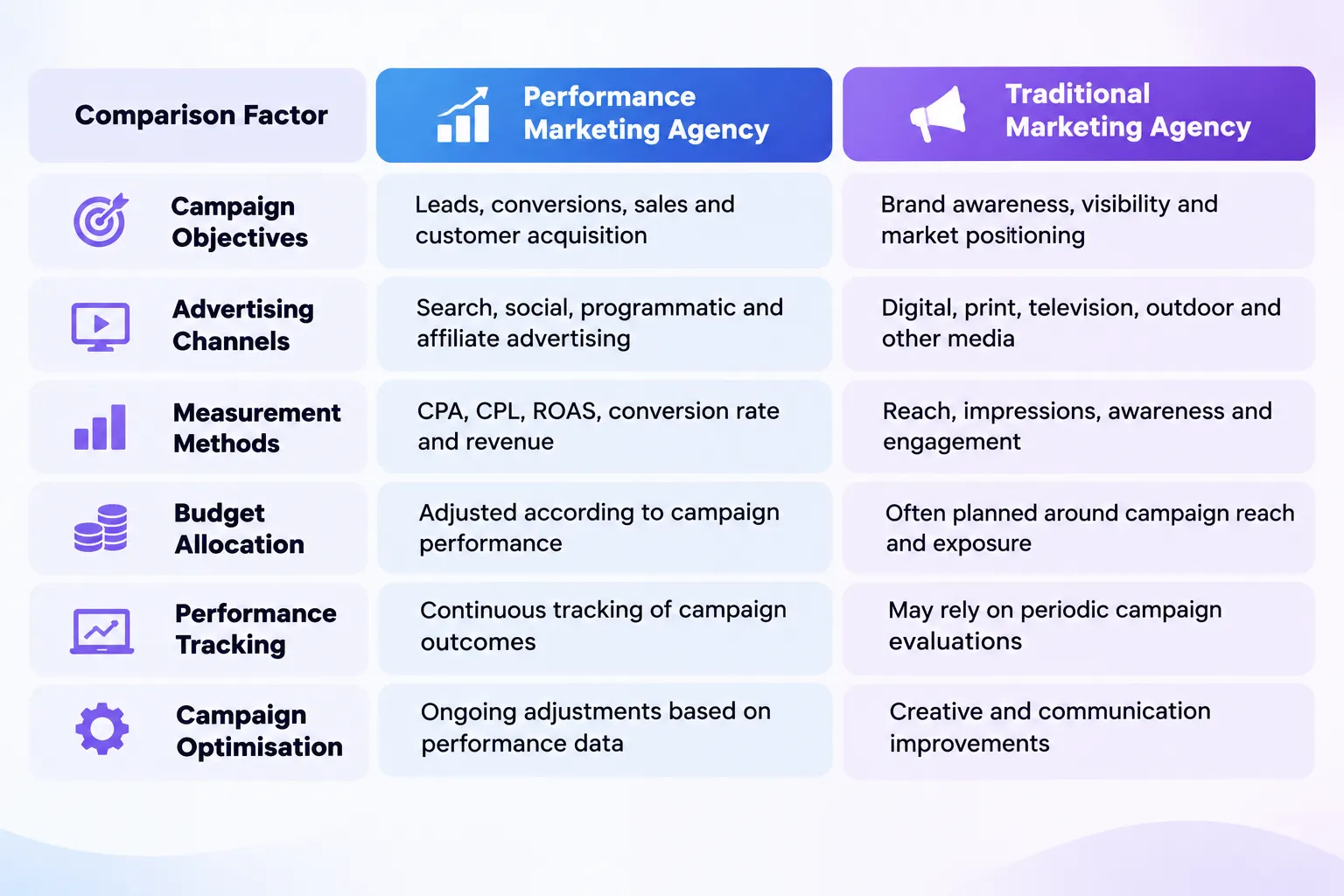
Here are the major differences:
Comparison Factor | Performance Marketing Agency | Traditional Marketing Agency |
|---|---|---|
Campaign Objectives | Leads, conversions, sales and customer acquisition | Brand awareness, visibility and market positioning |
Advertising Channels | Search, social, programmatic and affiliate advertising | Digital, print, television, outdoor and other media |
Measurement Methods | CPA, CPL, ROAS, conversion rate and revenue | Reach, impressions, awareness and engagement |
Budget Allocation | Adjusted according to campaign performance | Often planned around campaign reach and exposure |
Performance Tracking | Continuous tracking of campaign outcomes | May rely on periodic campaign evaluations |
Campaign Optimisation | Ongoing adjustments based on performance data | Creative and communication improvements |
The distinction is not absolute. Many modern marketing agencies offer both traditional and performance-focused services. However, performance marketing places measurable business outcomes at the centre of campaign management.
A performance marketing agency handles several interconnected activities that help businesses attract relevant audiences, generate conversions and improve customer acquisition.
Let's explore its primary responsibilities.
A successful advertising campaign begins with a clear understanding of business objectives and the target audience.
A performance marketing agency studies the organisation's business model, products, customer segments and competitive environment before developing a campaign strategy.
This process generally involves:
For example, a business looking to generate qualified B2B leads may require a different strategy from an e-commerce company focused on increasing online purchases.
By connecting audience insights with campaign objectives, an agency can recommend suitable advertising channels, targeting methods and creative approaches.
Paid search advertising allows businesses to reach users who are actively searching for relevant products, services or information.
A performance marketing agency manages search campaigns by identifying relevant keywords, developing advertising messages and optimising bidding strategies.
Common paid search activities include:
Google Search Ads: Targeting users based on search queries and keyword intent.
Shopping Ads: Promoting products through product-focused advertising placements.
Display Ads: Reaching audiences through visual advertisements across relevant websites and digital properties.
Performance Max Campaigns: Managing campaigns across Google's available advertising inventory through its automated campaign format.
Agencies also work on keyword research, negative keyword management, bidding strategies, ad copy development and landing page alignment.
The objective is to connect relevant search intent with suitable advertising messages and conversion experiences.
Social media advertising helps businesses reach audiences based on demographic information, interests, behaviours and other available targeting signals.
A performance marketing agency develops and manages paid campaigns across relevant social media platforms.
Common activities include:
For instance, a B2B company may use LinkedIn advertising to reach professionals and decision-makers, while a consumer brand may use Meta platforms to promote products to relevant customer segments.
Agencies also experiment with different creative formats, audience groups and advertising messages to identify opportunities for improving campaign performance.
Programmatic advertising uses automated technology to purchase and optimise digital advertising placements.
Instead of relying entirely on manual media buying, programmatic platforms use data and automated processes to help advertisers reach relevant audiences across digital environments.
A performance marketing agency may manage:
Automated Media Buying: Using programmatic platforms to purchase advertising inventory.
Audience-Based Targeting: Reaching audiences based on available demographic, behavioural and contextual signals.
Display and Video Advertising: Delivering visual advertisements across websites, applications and digital video environments.
Native Advertising: Creating advertisements that align with the format and experience of the surrounding content.
Real-Time Campaign Optimisation: Adjusting campaign parameters based on available performance data.
Ad Placement and Inventory Management: Managing advertising placements according to campaign requirements and targeting objectives.
Programmatic advertising can help businesses expand their audience reach while maintaining greater control over targeting and campaign measurement.
Creative development plays an important role in how audiences respond to digital advertisements.
Even when targeting is accurate, advertising campaigns may struggle if the messaging or creative assets do not communicate the intended value effectively.
A performance marketing agency develops creative assets and campaign messaging that align with the target audience and advertising objectives.
This may include:
Agencies may test different headlines, visuals, messaging styles and calls to action to understand which combinations generate better audience responses.
Creative optimisation helps ensure that advertising messages remain relevant throughout the campaign lifecycle.
Generating website traffic is only one part of performance marketing. Businesses also need visitors to complete meaningful actions.
These actions may include submitting a lead form, purchasing a product, requesting a consultation or registering for a service.
Conversion Rate Optimisation (CRO) focuses on improving the percentage of website visitors who complete these desired actions.
A performance marketing agency may work on:
Landing Page Analysis: Reviewing page structure, content and conversion elements.
User Experience Optimisation: Identifying potential usability issues that affect visitor behaviour.
CTA Placement: Improving the visibility and positioning of calls to action.
Form Optimisation: Reviewing form length, required information and submission processes.
A/B Testing: Comparing different page elements or experiences to evaluate their effectiveness.
Conversion Funnel Improvements: Identifying friction points across the customer journey.
By improving landing page experiences, businesses can work towards generating more conversions from their existing advertising traffic.
Accurate measurement is essential for understanding whether advertising campaigns are achieving their objectives.
A performance marketing agency implements tracking systems and analytics processes to monitor campaign activities and evaluate results.
Its responsibilities may include:
For example, an agency may analyse which advertising channels generate the most qualified leads, which campaigns contribute to purchases and where potential customers leave the conversion journey.
This information helps businesses understand campaign effectiveness and identify opportunities for improvement.
Performance marketing does not end when a user clicks an advertisement or completes a purchase.
Businesses also need to understand the customer journey and identify opportunities to encourage repeat interactions and long-term engagement.
A performance marketing agency may support these activities through:
Customer Acquisition Strategy: Developing campaigns to attract relevant potential customers.
Retargeting: Reaching eligible previous website visitors or audiences who have interacted with a brand.
First-Party Data Activation: Using appropriately collected customer information to support relevant audience strategies.
CRM Integration: Connecting marketing activities with customer relationship management systems.
Customer Journey Optimisation: Improving the experience across different marketing touchpoints.
Marketing Automation: Supporting automated communication and engagement workflows.
These activities help businesses connect customer acquisition with broader marketing and retention objectives.
An integrated performance marketing agency offers multiple services that work together to support advertising performance and business growth.
The exact service portfolio varies between agencies, but the following capabilities are commonly associated with performance marketing.
Paid media advertising involves promoting products and services through paid placements across digital advertising channels.
It includes search advertising, social media advertising, display advertising and video campaigns.
Agencies help businesses select relevant platforms, define campaign objectives, manage advertising budgets and optimise campaign performance.
Explore our guide to [paid media advertising] to understand how paid placements support digital marketing strategies.
Conversion Rate Optimisation focuses on improving the percentage of website visitors who complete a desired action.
It involves analysing user behaviour, identifying conversion barriers, improving landing pages and testing different website experiences.
CRO helps businesses make better use of existing advertising traffic by improving the conversion journey.
Audience intelligence involves understanding potential customers through available demographic, behavioural, contextual and transactional insights.
Agencies use audience research and segmentation to develop relevant targeting strategies.
First-party data can also support audience activation, provided that its collection and use follow applicable privacy requirements.
Better audience understanding helps align advertising messages with customer interests and business objectives.
Marketing analytics involves collecting and analysing campaign data to evaluate advertising performance.
Attribution helps businesses understand how different marketing channels and touchpoints contribute to conversions.
These capabilities support:
Together, analytics and attribution provide a clearer view of marketing effectiveness.
Affiliate marketing involves partnerships where affiliates promote a business's products or services under an agreed compensation arrangement.
Programmatic marketing uses automated technology to purchase advertising placements and reach relevant audiences.
Both approaches can contribute to customer acquisition through different advertising and partnership models.
Creative strategy focuses on developing advertising concepts, messages and visual assets that connect with the target audience.
It may include copywriting, graphic design, video production, creative storytelling and advertising format development.
A structured creative approach helps maintain consistency across campaign touchpoints while supporting ongoing creative testing.
A performance marketing agency works across different advertising platforms depending on the business objectives, target audience and campaign requirements.
Some commonly used platforms include:
Platform | Primary Purpose |
|---|---|
Google Ads | Search intent and lead generation |
Meta Ads | Social advertising and retargeting |
LinkedIn Ads | B2B lead generation |
YouTube Ads | Video advertising and awareness |
TikTok Ads | Video-based audience engagement |
Programmatic Platforms | Automated media buying |
Affiliate Networks | Partner-driven customer acquisition |
Each platform serves different marketing purposes.
For example, Google Ads can help businesses connect with users actively searching for relevant products and services. LinkedIn Ads can support B2B audience targeting, while Meta Ads can help brands reach consumer audiences through different social advertising formats.
Programmatic platforms provide additional opportunities for automated media buying and audience-based advertising.
Platform selection should always be based on campaign objectives, audience behaviour, budget and business requirements rather than popularity alone.
A performance marketing agency follows a structured process to plan, execute, monitor and optimise advertising campaigns.
Although workflows vary depending on the agency and campaign requirements, the process generally involves six stages.
The first step involves understanding the business and its marketing objectives.
The agency studies the company's products, services, target customers and competitive environment.
This includes:
This research provides the foundation for developing a relevant campaign strategy.
After understanding the business, the agency develops a campaign plan aligned with its objectives.
This stage includes:
For example, a lead generation campaign may focus on cost per lead and lead quality, while an e-commerce campaign may prioritise purchases, revenue and return on ad spend.
The next stage involves translating the campaign strategy into an executable advertising structure.
The agency develops relevant audience segments, configures targeting parameters and prepares advertising accounts.
It may also implement tracking systems to measure important campaign actions.
Proper campaign setup helps establish the foundation for accurate performance monitoring.
Once the campaign structure is ready, the agency develops the required creative assets and advertising messages.
This may include:
After the necessary approvals, the advertising campaigns are launched.
Campaign management continues after launch.
The agency monitors performance data to understand how audiences interact with advertisements and whether campaigns are meeting their objectives.
Typical optimisation activities include:
Continuous optimisation helps businesses respond to changing campaign performance and audience behaviour.
The final stage involves evaluating campaign results and identifying opportunities for future improvements.
The agency prepares performance reports covering relevant KPIs, advertising expenditure, conversions and campaign outcomes.
These insights help businesses understand what is working, which areas need improvement and where additional investment may be appropriate.
Successful campaign strategies can then be refined and scaled according to business objectives and available resources.
Key Performance Indicators (KPIs) help businesses evaluate whether advertising campaigns are achieving their objectives.
A performance marketing agency selects relevant metrics according to campaign goals rather than treating every advertising metric as equally important.
Here are some commonly used performance marketing KPIs:
KPI | Meaning |
|---|---|
CTR | Click-Through Rate |
CPC | Cost Per Click |
CPM | Cost Per Thousand Impressions |
CPL | Cost Per Acquisition |
CPA | Cost Per Lead |
CAC | Customer Acquisition Cost |
ROAS | Return on Ad Spend |
ROI | Return on Investment |
Conversion Rate | Percentage of users completing a desired action |
CLV | Customer Lifetime Value |
Let's understand what these metrics indicate.
Click-Through Rate (CTR): Measures the percentage of people who click an advertisement after seeing it.
Cost Per Click (CPC): Represents the amount spent for each advertising click.
Cost Per Thousand Impressions (CPM): Measures the cost of generating one thousand advertising impressions.
Cost Per Lead (CPL): Indicates the advertising cost associated with generating a lead.
Cost Per Acquisition (CPA): Measures the cost of acquiring a desired conversion or customer, depending on the defined acquisition event.
Customer Acquisition Cost (CAC): Represents the overall cost of acquiring a new customer across relevant sales and marketing activities.
Return on Ad Spend (ROAS): Measures the revenue attributed to advertising relative to the advertising expenditure.
Return on Investment (ROI): Evaluates the return generated relative to the total investment.
Conversion Rate: Measures the percentage of users who complete a specified action.
Customer Lifetime Value (CLV): Estimates the value a customer generates over the duration of their relationship with a business.
The importance of each KPI depends on the campaign objective. For example, an awareness campaign may prioritise reach and impressions, while a customer acquisition campaign may focus on CPA, CAC and conversion quality.
Explore our detailed guide to [performance marketing KPIs] to understand how businesses can measure and evaluate campaign performance.
Working with a specialised performance marketing agency can provide businesses with additional expertise, structured campaign management and access to multiple advertising capabilities.
Here are six important benefits.
One of the main advantages of performance marketing is its focus on measurable outcomes.
Agencies use analytics and tracking systems to evaluate campaign performance across relevant channels.
Businesses can monitor leads, conversions, advertising expenditure and revenue-related metrics to understand how marketing investments contribute to their objectives.
This makes it easier to assess campaign effectiveness and identify areas that require improvement.
Advertising budgets need to be allocated carefully to avoid inefficient spending.
Performance marketing agencies evaluate campaign data, audience responses and conversion trends to identify opportunities for improving budget allocation.
They can review channel performance, adjust bidding strategies and recommend changes based on campaign objectives.
This supports more informed advertising investment decisions.
Reaching the right audience is essential for generating relevant leads and conversions.
Agencies use audience research, segmentation and available customer data to develop targeting strategies.
They can also test different audience groups and advertising approaches to understand which segments respond more effectively.
Better targeting helps align advertising messages with potential customer needs and interests.
Businesses often use performance marketing to attract potential customers and generate sales opportunities.
Agencies develop campaigns that connect advertising messages with relevant audiences and conversion experiences.
They may also optimise landing pages, forms and customer journeys to support lead generation and customer acquisition.
Campaign performance can then be evaluated using metrics such as CPL, CPA, CAC and conversion rate.
Digital advertising requires ongoing monitoring and adjustments.
An agency evaluates campaign data to identify opportunities for improving targeting, creatives, bidding strategies and landing page experiences.
A/B testing and performance analysis help guide optimisation decisions.
This allows campaigns to evolve based on available data rather than relying entirely on initial assumptions.
As businesses grow, their marketing requirements may change.
They may need to reach new audiences, enter additional markets, introduce new products or expand advertising activities.
A performance marketing agency can support these requirements by adjusting campaign strategies, channels and service scope according to business priorities.
This provides flexibility as marketing needs evolve.
Businesses can manage performance marketing activities through an external agency or an internal marketing department.
Both approaches offer different advantages depending on the organisation's resources, objectives and operational requirements.
Comparison Factor | Performance Marketing Agency | In-House Marketing Team |
|---|---|---|
Expertise | Access to specialised professionals | Depends on internal team skills |
Resources | Multiple marketing capabilities | Internal resources |
Tools | Agency's marketing technology stack | Company-managed tools |
Flexibility | Can support different campaign requirements | Depends on team capacity |
Management | External collaboration | Direct internal management |
Strategy | External strategic perspective | Internal business knowledge |
An agency may be suitable for businesses that need access to multiple marketing specialists without recruiting an entire department.
An in-house team may be preferable for organisations requiring direct operational control, continuous internal coordination and dedicated employees.
Some businesses also combine both approaches through a hybrid marketing model.
The right choice depends on business size, budget, internal expertise and campaign requirements.
Hiring a performance marketing agency can be useful when businesses need additional expertise or resources to improve their advertising activities.
Consider working with an agency in the following situations.
1. Advertising Campaigns Are Not Generating Sufficient Leads
If advertising campaigns generate website traffic but fail to produce enough qualified leads, an agency can review targeting, creative messaging and conversion processes.
2. Customer Acquisition Costs Are Increasing
Rising acquisition costs may indicate opportunities to improve campaign efficiency, audience selection or conversion journeys.
An agency can analyse relevant performance data and recommend optimisation strategies.
3. Your Business Wants to Scale Paid Advertising
Expanding campaigns across multiple channels requires additional planning, execution and measurement capabilities.
An agency can provide support across different advertising platforms.
4. Your Internal Team Lacks Specialised Expertise
Businesses without dedicated paid media, programmatic, analytics or CRO specialists may benefit from external expertise.
5. Campaign Tracking and Attribution Are Unclear
Without reliable tracking, businesses may struggle to understand which campaigns and channels contribute to conversions.
An agency can support measurement systems and attribution processes.
6. Your Business Wants to Enter New Markets
Expanding into new markets requires audience research, channel evaluation and campaign planning.
External specialists can provide additional strategic and execution support.
7. Marketing Activities Need Better Coordination
Businesses managing multiple advertising channels may need a more structured approach to campaign planning, reporting and optimisation.
An agency can help coordinate these activities through an integrated marketing strategy.
Choosing a performance marketing partner requires evaluating more than its ability to manage advertising campaigns.
Businesses need a partner that understands their marketing objectives and can connect different capabilities across the customer journey.
PulsePlay Digital is an integrated performance marketing, creative, branding and technology company that brings together advertising, audience intelligence, creative development and marketing technology capabilities.
Its services cover several areas of performance marketing, including:
Programmatic Guaranteed Advertising: Supporting programmatic advertising requirements through planned media buying and relevant inventory.
Native Advertising: Developing advertising opportunities that align with the format and experience of digital content environments.
Paid Social and Paid Search: Managing advertising campaigns across relevant search and social media platforms.
Conversion Rate Optimisation: Improving website experiences and conversion journeys.
Landing Page Optimisation: Supporting landing page improvements through content, design and conversion-focused enhancements.
Creative Development and Copywriting: Developing advertising creatives and campaign messaging aligned with brand and marketing objectives.
Affiliate Marketing: Supporting partner-driven customer acquisition strategies.
Attribution and Measurement: Evaluating campaign performance and understanding the contribution of different marketing activities.
First-Party Data Activation: Using available customer insights and first-party data to support audience strategies.
Customer Experience, CRM and CDP Integration: Supporting customer data management and marketing technology requirements.
These capabilities work together to support different stages of the customer journey, from audience discovery and engagement to conversion and retention.
Rather than treating advertising, creative and analytics as separate activities, an integrated approach connects them through shared marketing objectives.
Businesses looking for specialised campaign support can explore [PulsePlay Digital's performance marketing solutions] to understand its capabilities.
You can also explore its broader [digital marketing services] and learn more about [PulsePlay Digital] and its approach to integrated marketing.
A performance marketing agency does much more than manage digital advertisements. It combines advertising strategy, audience research, media buying, creative development, conversion optimisation and analytics to support measurable business objectives.
From managing paid search and social media campaigns to implementing programmatic advertising and improving landing page experiences, its responsibilities cover multiple stages of the customer acquisition journey.
The value of working with an agency depends on its ability to understand business requirements, select appropriate channels, maintain transparent reporting and continuously optimise campaigns.
For businesses looking to strengthen their advertising activities, selecting the right performance marketing partner is an important step towards building a more structured and measurable marketing strategy.
Explore PulsePlay Digital's performance marketing capabilities to discover how integrated advertising, creative and technology solutions can support your business objectives.
A performance marketing agency plans, executes, manages and optimises digital advertising campaigns to achieve measurable outcomes such as leads, sales, conversions and customer acquisition. Its responsibilities include audience research, paid media management, creative development, conversion optimisation, analytics and campaign reporting.
A performance marketing agency may provide paid search advertising, paid social media campaigns, programmatic advertising, affiliate marketing, creative development, conversion rate optimisation, audience targeting, marketing analytics and attribution. The exact services depend on the agency's capabilities and the client's requirements.
An agency generates leads by identifying relevant audiences, selecting suitable advertising platforms, developing campaign creatives and directing potential customers towards conversion-focused landing pages. It also monitors campaign performance and optimises targeting, messaging and conversion processes to improve lead generation.
Performance marketing agencies commonly use Google Ads, Meta Ads, LinkedIn Ads, YouTube Ads and TikTok Ads. They may also work with programmatic advertising platforms and affiliate networks. Platform selection depends on the target audience, campaign objectives and available budget.
Agencies measure success using KPIs such as click-through rate, cost per click, cost per lead, cost per acquisition, customer acquisition cost, return on ad spend, conversion rate and customer lifetime value. The selected metrics depend on the campaign's objectives and desired business outcomes.
Digital marketing is a broad term covering online marketing activities such as SEO, content marketing, social media, email marketing and digital advertising. Performance marketing is a more outcome-focused approach that emphasises measurable actions such as leads, conversions, purchases and customer acquisition.
Yes. Performance marketing can be suitable for small businesses because campaigns can be planned around specific objectives and available budgets. Businesses can select relevant advertising channels, monitor campaign expenditure and evaluate measurable outcomes. However, campaign strategy and budget allocation should reflect the business's requirements and resources.
The cost depends on the services required, campaign complexity, advertising budget, number of platforms and level of management support. Some agencies charge fixed monthly management fees, while others use percentage-based or project-based pricing. Businesses should evaluate the service scope and total investment before selecting an agency.
The time required depends on the advertising platform, campaign objectives, budget, competition, audience and conversion process. Some campaigns may generate initial engagement or leads shortly after launch, while meaningful optimisation and consistent performance evaluation generally require sufficient data over time. Businesses should establish realistic expectations and evaluate results against relevant KPIs.