
Rahul Guleria
SEO Executive
Creative,
Branding
& Growth
in the Global
Digital Ecosystem
Social media video marketing blends strategic storytelling with high-impact visuals to reach people where they scroll every day. In a world of shrinking attention spans, brands that invest in professional video production stand out, build trust, and convert. This guide helps marketers and businesses use video marketing and corporate video production the smart way.
Scroll any feed for ten seconds and you’ll notice something right away. Videos dominate. They autoplay, grab attention, and pull viewers into a story faster than any static image or text post.
That’s not an accident. Social platforms have evolved around motion first. When brands treat video as a core part of their digital strategy instead of an add-on, they immediately gain an advantage.
Let’s break down why video marketing on social media matters so much — especially when you work with a professional business video production company or invest in corporate video production in-house.
People process visuals far faster than text. Add movement, human faces, and sound, and you get content that feels alive and relatable.
On social media, that translates into:
● More likes, shares, and comments
● Higher average watch time
● Better recall of your brand and message
● Stronger emotional connection with viewers
When you invest in video marketing, you don’t just “post more content”. You give your audience a format they naturally enjoy consuming. That’s why many brands see their engagement jump when they replace static assets with even simple, well-structured videos.
Social platforms reward content that keeps users on the app. Video typically wins on that front. As a result:
● Instagram pushes Reels more than static posts
● YouTube Shorts get strong reach even from newer channels
● LinkedIn gives preference to native video in the feed
● Facebook Watch and in-feed videos receive more distribution than link posts
If you ignore video, you fight against the algorithm. When you lean into it with strategic corporate video production, you align with how the platforms already behave.
You can show a product photo. Or you can show:
● A founder explaining why they started the brand
● A customer sharing their transformation
● A behind-the-scenes clip of your team solving a real problem
Video lets you mix story, emotion, and proof in one compact format. That makes your brand easier to remember and easier to trust.
Good professional video production helps you:
● Present your brand as reliable and credible
● Show real people behind your logo
● Demonstrate expertise instead of only claiming it
● Make complex ideas simple through visuals and motion graphics
Trust drives conversions. Video builds that trust faster.
Video isn’t just about “views”. When you treat it as a structured video marketing channel, it supports key business goals:
● Lead generation: Use educational videos that lead into downloadable resources or demos.
● Sales and conversions: Product demo videos, explainer videos, and testimonial videos help close deals.
● Brand awareness: Short, thumb-stopping social clips put your name in front of new audiences.
● Customer retention: How-to videos and onboarding content keep customers engaged after purchase.
A strong business video production company will always connect creative ideas with measurable objectives. That’s how you turn social media videos from “nice to have” into a performance channel.
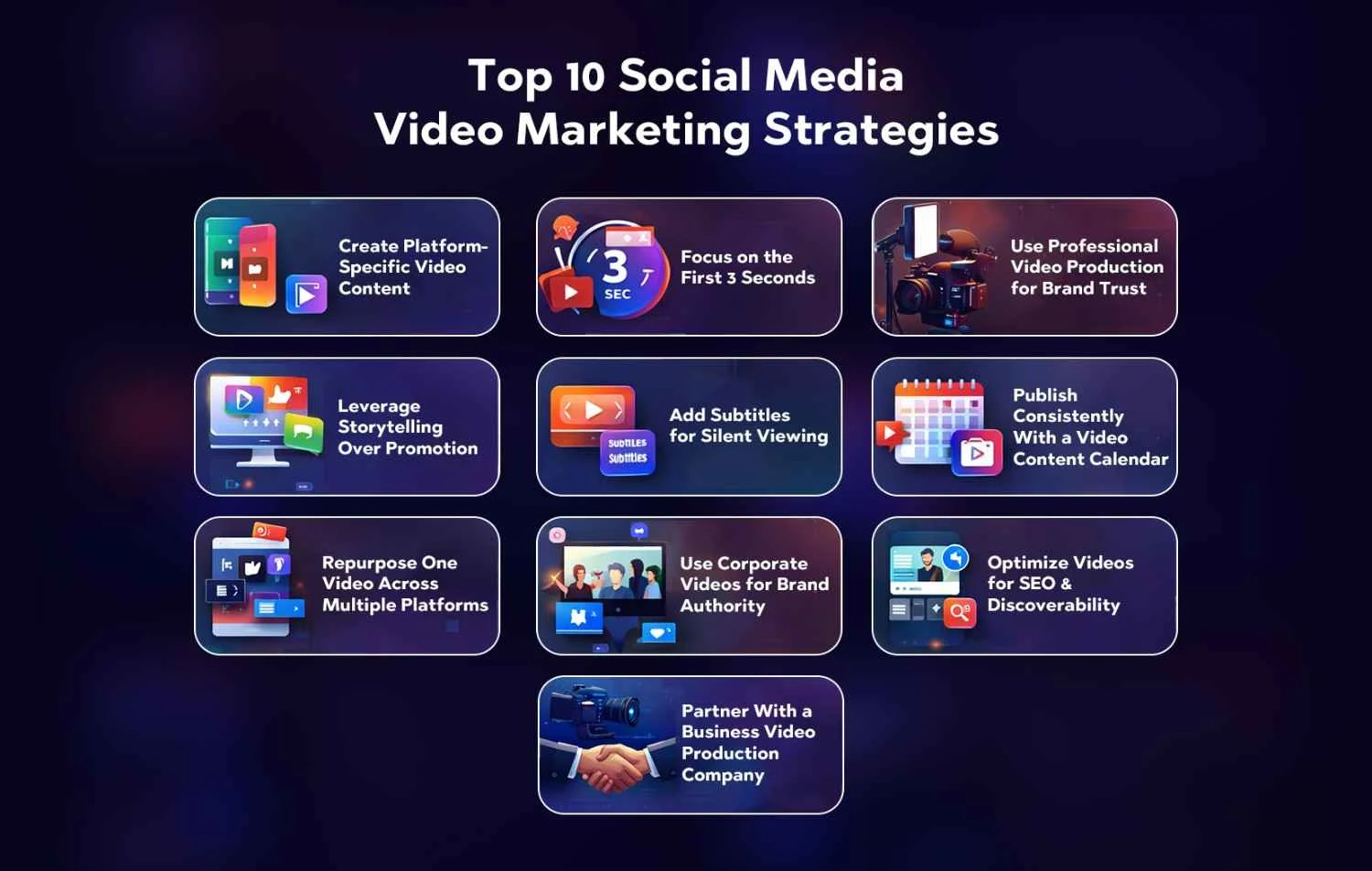
The most successful brands don’t just “post more videos”. They follow clear, repeatable strategies that align with each platform, their audience, and their business goals.
Many of these strategies come straight from how professional video production teams plan, shoot, and distribute content for Instagram, LinkedIn, YouTube, Facebook, and emerging platforms.
To explore how expert teams handle end-to-end production and distribution, check out Professional Video Production & Marketing Services.
Below are the top 10 strategies you can start applying right away.
One of the biggest mistakes brands make is posting the same exact video everywhere without any adaptation. Every platform has its own “native” style, audience behavior, and technical preferences.
You get better results when you design content with each platform in mind.
● Instagram & Facebook Reels, YouTube Shorts, TikTok
○ Short, vertical (9:16) videos
○ Fast-paced, visually rich, often under 30 seconds
○ Works great for hooks, teasers, quick tips, and behind-the-scenes clips
●YouTube (long-form)
○ Horizontal, long-form videos (5–15+ minutes)
○ Ideal for deep dives, tutorials, product walkthroughs, interviews, and storytelling
○ Short to mid-length (30–120 seconds)
○ Professional tone, value-driven, insight-heavy content
○ Great for corporate announcements, thought leadership, and B2B case stories
● Instagram Feed & Stories
○ Polished short content in feed
○ Raw, “in the moment” clips in Stories
When your video looks and feels native to the platform:
● Users are more likely to watch instead of scrolling past
● Algorithms rank your content higher
● Your brand appears more in touch with how people actually use the app
A smart corporate video production plan bakes these adaptations into the process right from pre-production. You plan your shoot so you can capture both vertical and horizontal formats and get enough coverage for multiple cuts.
On social media, the first three seconds decide everything. People either stay or swipe. Algorithms either push your video further or bury it.
You need a strong hook. Think of it as your “open the door” moment.
● A bold statement: “You’re losing 40% of your leads because of this one mistake.”
● A surprising visual: Start mid-action instead of with a logo screen.
● A question: “Ever wondered why your ads get views but no sales?”
● A quick benefit: “Here’s how to double your demo bookings with one simple video tweak.”
● Avoid slow intros and long logo animations.
● Put the most interesting visual in the opening frame.
● Use on-screen text to reinforce the hook, especially for silent viewers.
● Make the viewer feel, “This is about me” as quickly as possible.
A professional video production team will often script and storyboard the hook first, then build the rest of the video around it. That’s how important those opening seconds are.
Anyone can shoot a video with a phone. That’s great for spontaneity. But when it comes to your core brand story, flagship campaigns, or C-suite messaging, production quality matters.
High-quality visuals signal that you take your brand — and your audience — seriously.
● Crisp visuals & lighting make your brand look premium.
● Clear audio ensures people hear your message without strain.
● Stable framing & composition keep viewers focused on the subject.
● Thoughtful art direction aligns visuals with your brand identity.
This is especially crucial for:
● B2B brands presenting to decision-makers
● Enterprise-level companies communicating to large stakeholders
● Financial, healthcare, and tech brands where credibility is critical
By partnering with a business video production company, you ensure your social media videos don’t just “look nice” but also reflect your positioning, pricing, and promise.
People don’t log in to social media to watch ads. They come for stories, entertainment, and insight.
You can still sell, but you need to wrap your message in a narrative that feels human and meaningful.
A simple storytelling framework you can use for almost any brand:
1. Problem
○ Show a relatable challenge.
○ Our sales team spent hours every week updating spreadsheets.”
2. Solution
○ Introduce your product, service, or approach.
○ “We implemented an automated reporting dashboard.”
3. Result
○ Share tangible outcomes.
○ “The team saved 10+ hours a week and closed more deals.”
You can turn this into:
● Customer video testimonials
● Mini case study videos
● Founder stories
● Short narrative ads
● Stories stick in memory far better than product features.
● They make your video feel like content, not an interruption.
● Viewers see themselves in the narrative and emotionally engage.
Strong corporate video production focuses on scripting and story structure, not just camera gear. That’s where the magic happens.
A huge share of social media users watch videos without sound, especially on mobile and in public spaces. If your message only works with audio, you lose a chunk of your audience.
Subtitles and on-screen text solve this.
● Higher completion rates: People can keep watching even in silent mode.
● Better accessibility: Viewers with hearing impairments can still engage.
● Stronger messaging: Key points stay on screen long enough to sink in.
● Multi-language possibilities: You can localize content for different markets.
● Burn subtitles directly into the video for platforms like Reels or Shorts.
● Use large, readable fonts with strong contrast.
● Highlight key words or phrases in a different weight or style.
● Keep sentences short and sync them properly with the visuals.
Professional post-production workflows often include subtitling as a standard step because the impact on video marketing performance is so clear.
One viral video feels good. A consistent stream of strategic videos builds a brand.
Social algorithms reward frequency and consistency. Your audience does too. They start to expect your content, look out for it, and build a habit of engaging with you.
A video content calendar helps you:
● Maintain a steady posting rhythm across platforms
● Mix content types (educational, promotional, storytelling, behind-the-scenes)
● Align video topics with campaigns, launches, and seasons
● Avoid last-minute, low-quality rush jobs
● Publish dates and times for each platform
● Topic or angle (e.g. “Customer success story: retail client”)
● Format (Reel, Short, long-form, Stories, carousel + video)
● Goal (awareness, lead gen, sales, nurture)
● Owner (who scripts, shoots, edits, approves)
A seasoned business video production company will often help you define this editorial calendar so that your investment in corporate video content compounds over months, not just days.
Smart brands squeeze maximum value from every shoot. You don’t need to reinvent the wheel every time you want to post.
Repurposing lets you turn one asset into many pieces of content without diluting quality.
Start with a single flagship video, like a 10-minute product walkthrough or founder interview. From that one shoot, you can create:
● 1 full-length YouTube video
● 3–5 Shorts or Reels with key highlights
● 1 LinkedIn native video with a more formal edit
● 3–4 short quote clips for Stories
● Several GIFs or motion snippets for paid ads
● Screenshot carousels or thumbnails for additional posts
● Cost-effective: You get more from your time and budget.
● Consistent messaging: Multiple touchpoints reinforce the same core idea.
● Platform fit: Each cut can be tailored to the audience and context.
When you plan your shoot the way a professional video production team does, you intentionally capture footage for repurposing: multiple angles, b-roll, close-ups, and modular segments.
Some videos don’t primarily sell. They shape perception. In the long run, these “authority” videos become powerful assets on social media, your website, and in sales decks.
1. Founder and leadership messages
○ Vision, mission, and values
○ Market insights and point of view
○ Strategic updates or major milestones
2. Company culture videos
○ Behind-the-scenes moments
○ Office life and team stories
○ Social responsibility or community projects
3. Product and service explainers
○ Animated or live-action breakdown of how your solution works
○ Clear articulation of benefits and use cases
4. Case study and client success videos
○ Real stories of problems solved and outcomes delivered
These assets make your brand feel bigger, more credible, and more trustworthy. When you share them regularly on social media, you reinforce brand authority every week.
Investing in thoughtful corporate video production for these pieces pays off for years.
Creating great video content is step one. Helping people actually find it is step two.
Social platforms also function like search engines. People search for:
● “How to…”
● “Best way to…”
● “[Industry] trends 2025”
● “[Problem] solution”
You want your videos to surface when they do.
For every video, optimize:
● Title
○ Clear, benefit-driven, keyword-rich
○ Example: “How to Increase B2B Demo Bookings With Social Media Video Marketing.”
● Description
○ Expand on what the video covers
○ Include relevant keywords naturally
○ Add CTAs and links to relevant pages
● Hashtags and tags
○ Use a mix of brand, niche, and topic tags
○ Avoid stuffing; choose what truly fits the content
● Thumbnails (especially on YouTube)
○ High contrast, readable text
○ Strong imagery that teasers the value
● Your content keeps working long after you post
● You tap into search intent, not just passive scrolling
● You attract more targeted, motivated viewers
An experienced business video production company often pairs creative work with keyword research and SEO optimization, especially for YouTube and LinkedIn.
You can absolutely experiment with DIY videos. In fact, you should. But as your brand grows, campaigns scale, and expectations rise, working with a business video production company unlocks a different level of impact.
1. Strategy + execution under one roof
○ Audience research and messaging
○ Content planning and scripting
○ Storyboarding and shot planning
○ Production, direction, and editing
○ Distribution strategy and performance tracking
2. Higher creative quality
○ Access to experienced directors, cinematographers, editors, animators, and copywriters
○ Professional equipment, locations, and lighting setups
3. Consistency and scalability
○ Repeatable production workflows
○ Ability to plan quarterly or annual video roadmaps
4. Measurable ROI
○ Clear KPIs for each campaign
○ Testing different creative variations
○ Data-driven optimization of future videos
With the right partner, your professional video production doesn’t just deliver beautiful footage. It delivers business results across social media, websites, and performance campaigns.
You can’t improve what you don’t measure. That rule applies to video marketing more than almost any other channel because you have so many layers to optimize: hooks, formats, length, messaging, calls to action, and targeting.
Instead of tracking only views, focus on a small set of metrics that actually relate to business outcomes.
Engagement rate tells you whether people simply watched or actively responded.
Measure:
● Likes and reactions
● Comments
● Shares
● Saves (on platforms that support it)
Compare engagement rate across:
● Different video topics
● Formats (Reels vs. long-form)
● Posting times and days
If a video with fewer views has a much higher engagement rate, that content type might be more valuable than a “viral” post that doesn’t drive meaningful actions.
Watch time reveals how long people stay with your video. Retention curves show where they drop off.
Key questions:
● Do viewers leave in the first few seconds?
○ Your hook or opening visuals might need work.
● Do they drop off right after your main benefit statement?
○ Maybe the rest feels repetitive or slow.
● Do they stay almost till the end but drop before the CTA?
○ You might be delaying the value or CTA for too long.
Aim to improve:
● The percentage of viewers who watch at least 25%, 50%, 75%, and 100%
● The average watch time for similar types of videos
Strong watch time sends positive signals to the platform algorithm and increases your reach.
If you include a link or a CTA button with your video (for example, in paid campaigns or certain organic placements), CTR tells you how effectively the video drives traffic or next steps.
Watch for:
● Which hooks drive the highest CTR
● Which CTAs (“Learn more” vs. “Book a demo”) perform best
● How different thumbnails and titles affect CTR on YouTube and similar platforms
CTR sits at the intersection of messaging, visual design, and audience intent. It’s a key metric for performance-oriented video marketing.
At some point, you need to connect your social media videos to revenue.
Track:
● Form fills or sign-ups that come from video-driven campaigns
● Demo or consultation bookings after watching product or explainer videos
● Direct purchases from video-led traffic
● Assisted conversions where video views happen earlier in the customer journey
Use UTM parameters, platform pixels, or CRM tracking to understand the role video plays in your funnel.
A professional approach to corporate video production always includes clear conversion goals for performance campaigns, not just “awareness”.
Each platform offers its own analytics dashboard. Use them to understand:
● Audience demographics (age, location, job roles, interests)
● Best posting times based on your actual audience behavior
● Top-performing content themes and video lengths
● How organic and paid videos complement each other
These insights help you refine your strategy, script more relevant stories, and target the right viewers with the right message.
If you want a broader view of how production, distribution, and optimization fit together, dive into the Professional Video Production & Marketing Services Overview for a deeper strategic context.
Not every brand needs a full studio on day one. However, there are clear moments in a company’s growth where professional video marketing support makes a big difference.
Here’s when it usually makes sense to step up from DIY to expert-led professional video production.
You’ve proven your offer. Customers love your product or service. Now you want to:
● Expand into new markets
● Raise brand awareness at scale
● Ramp up paid campaigns on social and search
At this stage, your visuals must reflect your ambition. Polished brand videos, product explainers, and social campaigns help you stand out from competitors and communicate your value crisply and consistently.
If you sell to other businesses, especially in tech, finance, SaaS, or enterprise services, you often face:
● Long sales cycles
● Multiple decision-makers
● Complex products or solutions
Professional corporate video production simplifies what you do into clear, compelling stories. It equips your sales and marketing teams with assets like:
● Product demo videos
● Solution overviews
● Industry-specific case studies
● Thought leadership content from your leadership team
These videos can then live on social media, your website, landing pages, and sales decks.
Launching something new or refreshing your brand is a prime moment to invest in strong visual storytelling.
For example:
● A launch film that introduces your new product to the world
● Short teaser clips and countdown videos for social media
● Explainer videos that show how the new product fits into your ecosystem
● Behind-the-scenes stories about the making of the product or the rationale behind the rebrand
These assets create excitement, answer questions, and help your audience emotionally connect with what’s new.
When you invest real money into advertising, the creative must pull its weight.
Video is now a core part of performance marketing on platforms like Meta, YouTube, and LinkedIn. Strong professional video production helps you:
● Test multiple hooks, angles, and formats
● Align message, targeting, and creative strategy
● Produce high-impact short-form assets specifically designed for paid campaigns
● Track and optimize based on data
The difference between a basic ad and a strategically crafted video ad can be dramatic in terms of cost per lead, cost per acquisition, and return on ad spend.
Even if you have an in-house marketer or a small creative team, there comes a point where:
● You can’t keep up with demand for new video content
● Quality starts to slip because of tight timelines
● Strategy gets neglected while everyone rushes production
At that stage, partnering with a business video production company gives you:
● Extra bandwidth for bigger projects
● Specialist skills your team might not have (animation, motion graphics, advanced editing, etc.)
● A structured process from concept to final delivery
You keep control over brand direction while unlocking external expertise to speed things up and raise the bar.
Video marketing matters on social media because it matches how people naturally consume content today. Videos:
● Capture attention faster than text or images
● Convey emotion, story, and proof in one format
● Perform better in most platform algorithms
● Build trust through human faces, voices, and real stories
When you use social media video strategically, you don’t just chase views. You move people from awareness to interest to action.
Professional video production helps businesses in several ways:
● Stronger brand perception: High-quality visuals, clear audio, and thoughtful design make your brand appear more credible and premium.
● Better storytelling: Experienced writers, directors, and editors know how to shape your message into a story that resonates.
● Consistent quality: You get repeatable production standards across campaigns and platforms.
● Higher ROI: When your videos convert better, every rupee or dollar you spend on media and production goes further.
Whether you’re creating corporate films, product explainers, or performance ads, professional production turns ideas into assets that actually drive results.
There’s no single “best” platform. The right one depends on your audience and goals:
● Instagram & Facebook: Great for B2C brands, lifestyle products, and visually rich storytelling through Reels and Stories.
● YouTube: Ideal for long-form educational content, product tutorials, and search-driven discovery.
● LinkedIn: Perfect for B2B brands, thought leadership, corporate announcements, and industry insights.
● YouTube Shorts and Reels: Strong for reach, quick hooks, and top-of-funnel awareness.
Most brands get the best results by using a combination of platforms and tailoring their video marketing strategy to each.
There’s no magic number, but consistency beats intensity. A practical approach:
● Start with 2–3 videos per week across your primary platforms.
● Maintain that rhythm for at least 60–90 days.
● Watch performance and scale up once you have a repeatable process.
Use a content calendar to plan ahead and balance:
● Educational content
● Story-driven or authority-building videos
● Product and offer-focused videos
● Community and behind-the-scenes clips
The key is to post often enough that your audience remembers you, but not so often that quality drops.
Hiring a business video production company makes sense when:
● You want to elevate your brand image and creative quality
● You’re planning major campaigns, launches, or corporate announcements
● You need a structured strategy for ongoing social media video content
● Your internal team doesn’t have the bandwidth or specialist skills
A good production partner will act like an extension of your marketing team. They’ll help you clarify goals, craft a coherent content roadmap, and create assets designed to perform across social media, web, and paid channels — not just look impressive on a showreel.
By combining these top 10 social media video marketing strategies with thoughtful planning and the right production support, your brand can turn every video into a strategic asset. Whether you’re just getting started or ready to scale with full-funnel professional video production, the next move is simple: pick one strategy from this guide, apply it to your next video, and build from there.