
Rahul Guleria
SEO Executive
Creative,
Branding
& Growth
in the Global
Digital Ecosystem
Marketing automation helps businesses scale by automating repetitive marketing and customer-engagement tasks. It enables teams to manage more leads, personalize communication, nurture prospects, and improve customer retention without increasing manual effort at the same rate. The result is a more consistent, measurable, and scalable approach to growth.
As businesses grow, marketing rarely becomes simpler. More customers create more leads, more communication, more data, and ultimately more operational complexity. Marketing automation helps businesses manage that complexity by turning repeatable processes into structured workflows.
Rather than simply adding more people to handle more work, businesses can use automation to scale processes, improve responsiveness, and create better customer experiences.
Growth creates a predictable operational challenge:
More customers → more leads → more communication → more data → more operational complexity.
A marketing team that manages every interaction manually can quickly become overwhelmed. Lead follow-ups may be delayed, customer communication may become inconsistent, and reporting can consume valuable time.
Marketing automation helps businesses address these challenges by automating repeatable activities while allowing teams to focus on strategy, creativity, customer relationships, and higher-value work.
Key benefits include:
The goal isn't to automate everything. The goal is to identify processes where automation can make growth more efficient without compromising the human side of marketing.
Marketing automation can support customers throughout the entire growth journey:
Awareness → Lead Capture → Nurturing → Conversion → Retention → Advocacy
Each stage presents opportunities to automate repetitive actions and deliver more relevant experiences.
At the awareness stage, automation can help businesses reach and organize audiences more efficiently.
Common applications include:
For example, audiences can be segmented according to where they came from, what content they interacted with, or which campaign introduced them to the business.
Once someone shows interest, automation can help capture and organize that information.
Businesses can automate:
When a prospect submits a form, for example, the information can automatically enter a CRM while relevant team members receive a notification.
This reduces manual data entry and creates a faster transition from marketing activity to sales follow-up.
Not every lead is ready to buy immediately. Marketing automation allows businesses to continue communicating with prospects over time.
Lead-nurturing workflows can include:
A prospect who downloads a guide may receive educational content, while someone who repeatedly visits a pricing page may enter a more conversion-focused workflow.
When buying intent increases, automation can help businesses respond quickly.
Examples include:
The objective is to reduce delays between customer intent and business response.
Growth doesn't end when a customer converts. Retention is an important part of sustainable growth.
Automation can support:
A well-designed onboarding workflow, for example, can help customers understand the product or service and take the next steps without requiring a team member to manually send every message.
Satisfied customers can become an important source of future growth.
Businesses can automate:
These workflows can help turn successful customer experiences into reviews, referrals, and repeat business.
Many marketing activities follow predictable patterns. These are often strong candidates for automation.
Examples include:
Automating these tasks can reduce the amount of time teams spend managing routine processes.
Without automation, nurturing every prospect individually can become difficult as lead volume increases.
Automated sequences allow businesses to maintain consistent communication without requiring a salesperson to manually contact every lead.
This doesn't eliminate human sales interaction. Instead, it helps sales teams focus their attention on prospects who are more likely to need direct engagement.
Automation becomes significantly more valuable when workflows use customer data and behavior.
Different experiences can be triggered based on:
This allows businesses to move beyond one-size-fits-all communication and create journeys that reflect where customers are in their relationship with the brand.
Marketing automation doesn't necessarily replace marketing teams.
Its value is that it allows teams to manage a larger volume of work more efficiently.
A team can use automation to handle predictable activities while spending more time on:
This makes automation an operational scaling tool rather than simply a cost-cutting mechanism.
Timing matters when a potential customer takes a high-intent action.
For example:
Automation can trigger an appropriate response immediately, helping businesses reduce the gap between customer action and business follow-up.
Automation can support customers after conversion through:
These processes help businesses maintain communication throughout the customer lifecycle instead of focusing only on acquisition.
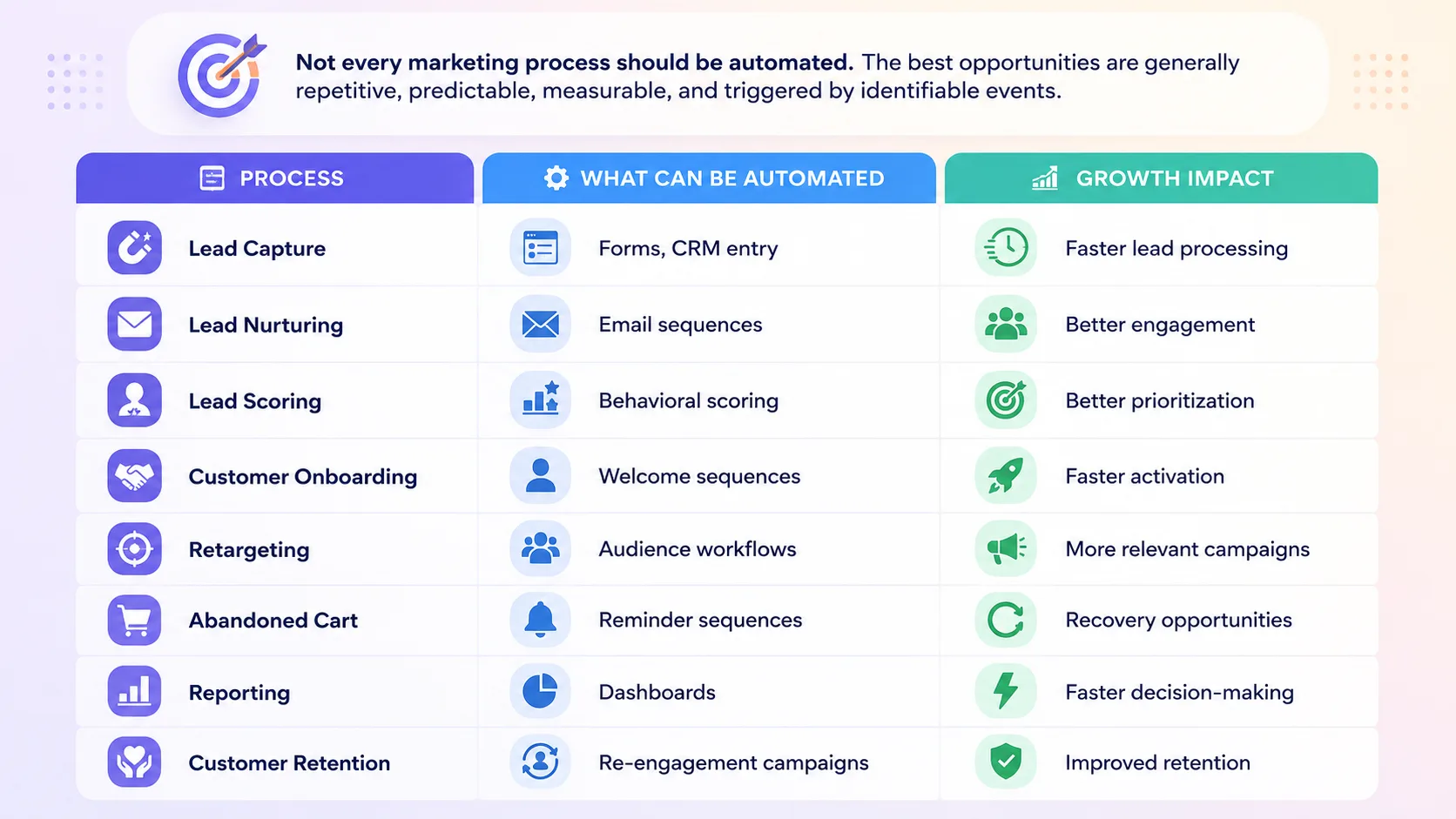
Not every marketing process should be automated. The best opportunities are generally repetitive, predictable, measurable, and triggered by identifiable events.
Process | What Can Be Automated | Growth Impact |
|---|---|---|
Lead Capture | Forms, CRM entry | Faster lead processing |
Lead Nurturing | Email sequences | Better engagement |
Lead Scoring | Behavioral scoring | Better prioritization |
Customer Onboarding | Welcome sequences | Faster activation |
Retargeting | Audience workflows | More relevant campaigns |
Abandoned Cart | Reminder sequences | Recovery opportunities |
Reporting | Dashboards | Faster decision-making |
Customer Retention | Re-engagement campaign | Improved retention |
The key is to automate processes where consistency and speed provide meaningful value.
Factor | Manual Marketing | Marketing Automation |
|---|---|---|
Repetitive Tasks | High manual effor | Automated |
Personalization | Often limited by scale | Behavior-based |
Lead Follow-Up | Manual | Trigger-based |
Scalability | Resource-intensive | More scalable |
Reporting | Time-consuming | Centralized |
Customer Journeys | Harder to manage | Workflow-based |
However, automation is not a replacement for strategy, creativity, or human interaction.
A poorly designed automated campaign can still produce poor results. Automation works best when it supports a clear strategy and a well-understood customer journey.
Modern customers expect relevant communication. Automation makes personalization more scalable by combining customer data with predefined rules and behavioral triggers.
Businesses can create meaningful groups such as:
Each group can receive communication appropriate to its lifecycle stage and relationship with the business.
Automation can respond to actions such as:
These actions provide signals about customer intent.
Instead of sending every customer through the same workflow, businesses can create branching journeys.
For example, someone who engages heavily with product content may receive a different sequence from someone who has not interacted with the brand for several weeks.
This creates a more relevant experience while keeping the underlying process scalable.
A successful automation program should begin with business objectives rather than technology.
Start by deciding what the automation strategy needs to achieve.
Potential goals include:
A clear goal makes it easier to decide which processes should be automated and which metrics matter.
Map the key stages:
Awareness → Consideration → Conversion → Retention
Identify the interactions customers have at each stage and where delays, repetitive tasks, or gaps occur.
Look for tasks that:
These are often the strongest candidates for automation.
Create meaningful audience groups based on factors such as behavior, customer status, and lifecycle stage.
Segmentation helps prevent automation from turning into generic mass communication.
A useful framework is:
Trigger → Condition → Action → Goal
For example:
Lead submits form → Lead enters CRM → Welcome email → Sales notification → Nurturing sequence
Each workflow should have a defined purpose and measurable outcome.
Marketing automation becomes more effective when the systems involved can share relevant customer information.
This may include:
Businesses looking to design and connect these workflows can explore PulsePlay Digital's marketing automation services.
Automation should not be treated as a set-it-and-forget-it system.
Test:
Analyze the results and continuously improve the workflows.
Measure business outcomes rather than simply counting how many workflows or emails were launched.
The important question is whether automation is contributing to better acquisition, conversion, retention, efficiency, or revenue.
Marketing automation is not just about choosing a software platform. Businesses need a technology stack that supports their customer journey and data requirements.
Category | Purpose |
|---|---|
CRM | Customer and lead managemen |
Email Automation | Nurturing and communication |
Analytics | Measuring customer behavior |
CDP | Customer data management |
Advertising Platforms | Audience activation |
E-commerce Platforms | Purchase workflows |
Integration Tools | Connecting systems |
Reporting Platforms | Performance monitoring |
The exact combination depends on the business model, customer journey, existing technology, data structure, and growth objectives.
Marketing automation can contribute to ROI in several ways.
Automating repetitive activities can reduce the amount of manual work required for routine marketing processes.
Consistent nurturing and faster follow-up can help businesses engage prospects throughout longer buying journeys.
Retention, cross-selling, upselling, and re-engagement workflows can help businesses continue creating value after the initial purchase.
When repetitive processes are automated, teams can dedicate more time to strategy, creative work, optimization, and customer relationships.
Connected marketing systems can provide greater visibility into customer actions and campaign performance, helping businesses make more informed decisions.
For businesses connecting automation with acquisition and conversion, performance marketing can complement automated customer journeys by linking campaign activity with measurable outcomes.
Email open rates and clicks can provide useful signals, but they should not be the only measures of success.
For deeper measurement and performance visibility, data analytics can help businesses evaluate customer behavior and marketing outcomes more effectively.
Automation cannot fix a poor customer journey.
Before building workflows, businesses should understand the customer journey, define objectives, and identify where automation can provide genuine value.
More automation does not automatically mean better marketing.
Excessive messaging can overwhelm customers and reduce engagement.
Generic messaging can become less relevant as audiences become more diverse.
Segmentation should reflect meaningful differences in customer behavior and lifecycle stage.
Poor customer data can lead to poor automation.
Incomplete, outdated, or inconsistent information can cause the wrong messages to be delivered at the wrong time.
Disconnected systems can create data gaps and make it harder to understand the customer journey.
Automated workflows should be monitored, tested, and optimized continuously.
A large number of automated emails or workflows doesn't necessarily indicate business success.
Focus on metrics connected to leads, conversions, retention, efficiency, and revenue.
Automation becomes increasingly valuable when a business has:
However, business size alone shouldn't determine whether automation is appropriate.
A smaller business with repetitive workflows may benefit significantly from automation, while a larger business may still need to improve its strategy and processes before adding more automation.
The better question is:
Are there repeatable customer and marketing processes where automation can improve speed, consistency, scalability, or measurement?
B2B organizations can use automation to support longer and more complex buying journeys.
Common applications include:
E-commerce businesses can use automation throughout the purchase and post-purchase lifecycle.
Common applications include:
SaaS companies can use automation to support activation and customer success.
Examples include:
Smaller businesses often have limited team resources, making efficient automation particularly useful.
Potential applications include:
Marketing automation is becoming increasingly connected to customer data, artificial intelligence, and real-time behavior.
Areas to watch include:
The underlying principle remains the same: technology should help businesses deliver more relevant customer experiences while making their operations more scalable.
Marketing automation is most effective when it is connected to the broader customer journey and business strategy.
PulsePlay Digital approaches automation across areas including:
Automation can be particularly powerful when customer data, marketing activity, technology platforms, and performance measurement work together.
Businesses also need to optimize the experiences that automated campaigns lead customers toward. This makes conversion rate optimization an important complement to marketing automation.
The objective isn't simply to create more automated campaigns. It is to build connected systems that help businesses acquire, convert, retain, and grow customers more effectively.
Marketing automation helps businesses scale repeatable marketing and customer-engagement processes. It can improve lead follow-up, nurture prospects, personalize communication, support retention, and reduce manual workload.
It allows teams to manage higher volumes of leads, customers, campaigns, and communication without increasing manual effort at the same rate.
Common candidates include lead capture, lead assignment, email sequences, follow-ups, segmentation, lead scoring, onboarding, retargeting, abandoned-cart reminders, reporting, and re-engagement.
It can reduce the operational effort associated with repetitive processes. However, the primary value should be evaluated through business outcomes such as efficiency, conversion, retention, and revenue.
Automation allows businesses to maintain consistent communication with prospects through email sequences, educational content, behavioral triggers, personalized follow-ups, and lead scoring.
Yes. Automated onboarding, education, check-ins, renewal reminders, re-engagement, cross-selling, and upselling can support customers throughout the lifecycle.
A CRM primarily helps businesses manage customer and lead information and relationships. Marketing automation focuses on automating marketing workflows and customer communication. The two can work together as part of an integrated technology stack.
Marketing automation can involve CRM systems, email automation platforms, analytics tools, customer data platforms, advertising platforms, e-commerce systems, integration tools, and reporting platforms.
A business should consider automation when it has repeatable processes, growing lead or customer volumes, multiple segments, long buying journeys, multiple channels, or increasing requirements for retention and follow-up.
Measure outcomes such as cost per lead, qualified leads, conversion rates, revenue, customer acquisition cost, retention, customer lifetime value, time saved, and manual work reduced.
Yes. Business size alone should not determine whether automation is appropriate. Small businesses can benefit when they have repetitive workflows and limited team resources.
Yes. Marketing automation can work alongside advertising platforms by using customer data, audience segmentation, behavioral signals, and conversion information to create more connected acquisition and nurturing journeys.
Marketing automation is ultimately a way to make growth more scalable.
As businesses generate more leads, acquire more customers, and operate across more channels, manual processes can become increasingly difficult to manage. Automation provides a way to handle repeatable activities more efficiently while maintaining consistent customer communication.
The strongest automation strategies don't attempt to replace people. They combine technology, customer data, strategy, and human expertise to create better experiences and more efficient operations.
By identifying repetitive processes, mapping the customer journey, connecting the right technology, creating behavior-based workflows, and measuring business outcomes, companies can use marketing automation to support sustainable growth rather than simply automate activity.