
Rahul Guleria
SEO Executive
Creative,
Branding
& Growth
in the Global
Digital Ecosystem
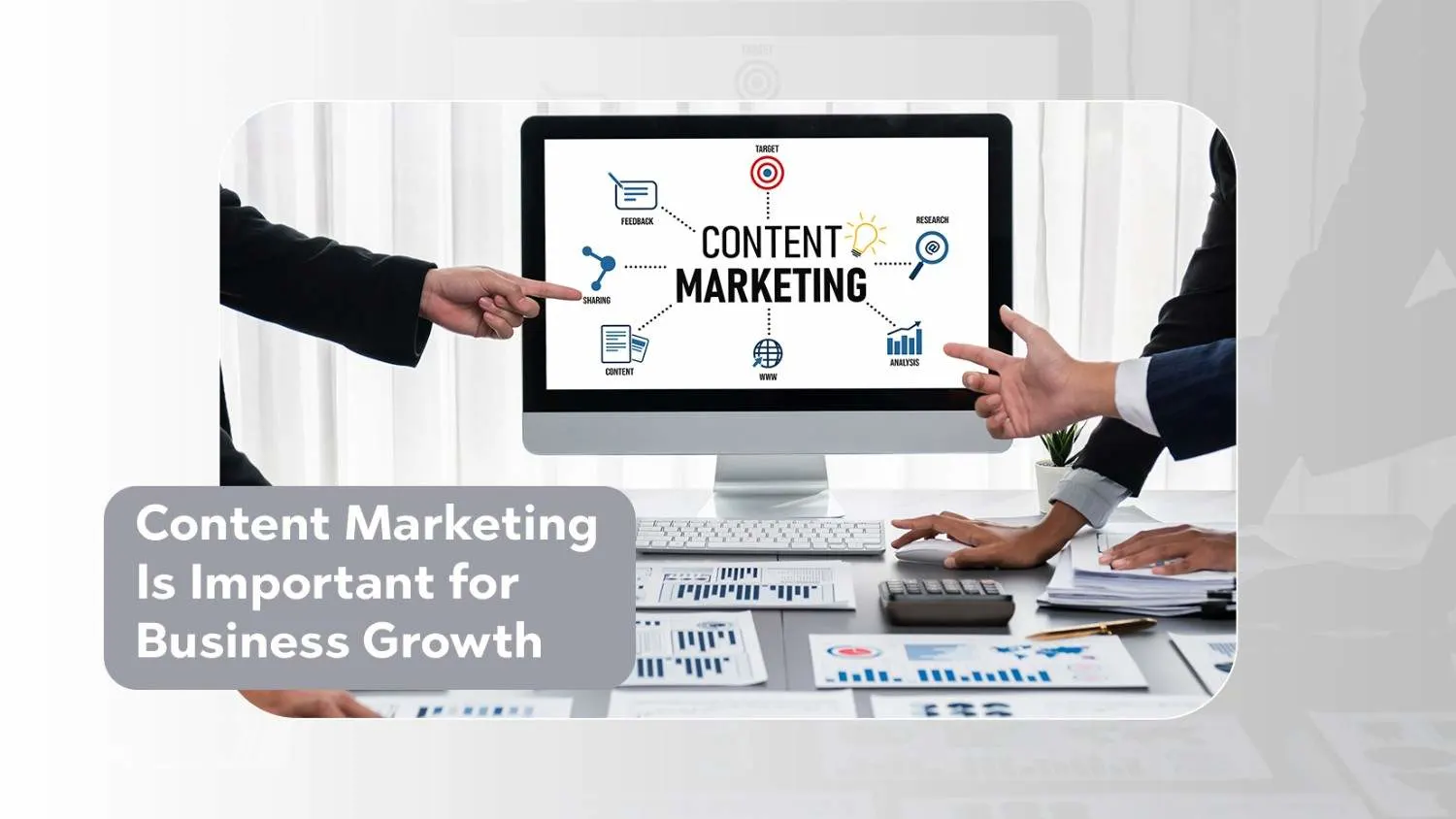
Content marketing is the strategic process of planning, creating, and distributing useful content—like blogs, videos, guides, emails, podcasts, and social posts—to attract, engage, and convert your ideal customers.
Instead of pushing hard sales messages all the time, you:
● Answer real questions
● Solve problems
● Share expertise
● Tell stories that resonate
When you do this consistently, people begin to see your brand as a trusted advisor rather than just another company trying to sell something.
Good content marketing:
● Educates your audience
● Builds authority and trust
● Drives organic traffic from search and social
● Supports your sales team with better-qualified leads
If you are still getting comfortable with the basics of SEO, it is worth reading What Is SEO & Why It Matters for Businesses first. SEO and content marketing work hand in hand, so understanding both gives your business a serious edge.
You can run a business without content marketing. You just make life much harder and more expensive than it needs to be.
Here is why the role of content marketing in business growth is so critical in 2025.
With content marketing, you don’t shout at everyone. You speak directly to people who care.
● Blog posts rank for the exact keywords your audience searches● Social content reaches the communities where they hang out
● Emails hit the inboxes of people who already opted in
Instead of cold outreach, you attract people who are actively looking for what you offer.
Anyone can claim to be an expert. Only a few consistently show it.
When you publish detailed guides, case studies, and expert insights, prospects think:
“If their free content is this helpful, their product or service must be even better.”
That perception is priceless. It shortens sales cycles, reduces objections, and increases close rates.
Ads are powerful but expensive. And once you turn them off, traffic vanishes.
Content, in contrast, keeps working:
● An article ranking on page one can bring traffic for years
● A high-performing video continues to attract views and leads
● Evergreen guides become assets, not one-off expenses
You still might use paid campaigns, but you’re no longer forced to outbid competitors every single day.
High-quality content optimised for search engine optimisation (SEO) makes it easier for Google and other search engines to find and rank your pages.
You show up exactly when people search for:
● “best CRM for small businesses”
● “How to choose a digital marketing agency”
● “Benefits of content marketing for B2B”
That means:
● More website traffic
● Better quality leads
● Higher conversion potential
For deeper SEO support, you can always explore PulsePlay Digital’s search engine optimisation services to align content and SEO into one strategy.
Content is not only for acquisition. It is just as important after someone becomes a customer.
● Onboarding tutorials help people get value faster
● How-to articles prevent frustration and support tickets
● Newsletters keep your brand top-of-mind
When you keep educating and supporting customers, they renew, upgrade, and advocate for you.
People rarely buy complex products after seeing just one post.
Content marketing nurtures them from:
Each piece of content becomes a stepping stone that moves them a little closer to “yes”.
Think of this as your content marketing for business growth roadmap.
Everything starts with understanding your audience.
● What keeps them up at night?
● What questions do they ask sales and support?
● What topics do they discuss in forums and communities?
Use interviews, surveys, search data, and social listening to build a clear picture of their world.
Once you know what they care about, map content ideas to your funnel:
●Top of funnel (Awareness):
○ Educational blogs
○ How-to videos
○ Social posts about trends and problems
● Middle of funnel (Consideration):
○ Comparison guides
○ Webinars
○ Product-focused blogs
● Bottom of funnel (Decision):
○ Case studies
○ Testimonials
○ ROI calculators
○ Free trials and demos
This structure ensures you always have something helpful to offer, no matter where someone is in their journey.
You don’t publish content and hope for the best. You optimise it so people actually find it.
● Do keyword research to understand search demand
● Use on-page SEO best practices (titles, headings, internal links)
● Add compelling visuals for higher engagement on social
● Write click-worthy meta descriptions and post captions
This is where content meets SEO. When done well, it becomes a powerful growth loop: better content → better rankings → more traffic → more data → even better content.
Publishing is step one. Distribution is where the magic happens.
Share your content via:
● Social platforms (LinkedIn, Instagram, X, YouTube, etc.)
● Email newsletters
● Communities and groups
● Partner websites or industry portals
Repurpose a single core piece into multiple formats—threads, clips, carousels, infographics—so it reaches people in the way they prefer to consume information.
Content without a next step is a missed opportunity.
Use:
● Lead magnets (guides, templates, checklists)
● Content upgrades (bonus resources for subscribers)
● Simple forms and landing pages
● Email sequences that educate and nurture
For visitors who don’t convert immediately, use remarketing ads or follow-up content to stay visible.
Finally, you measure what works.
Track:
● Organic traffic
● Time on page and scroll depth
● Conversion rate (sign-ups, demo requests, purchases)
● Assisted conversions in analytics
● Engagement metrics on social and email
Double down on formats and topics that perform well, and either improve or retire those that don’t. Content marketing is iterative, not one-and-done.
Let’s zoom in on the main benefits of content marketing and what they mean for your bottom line.
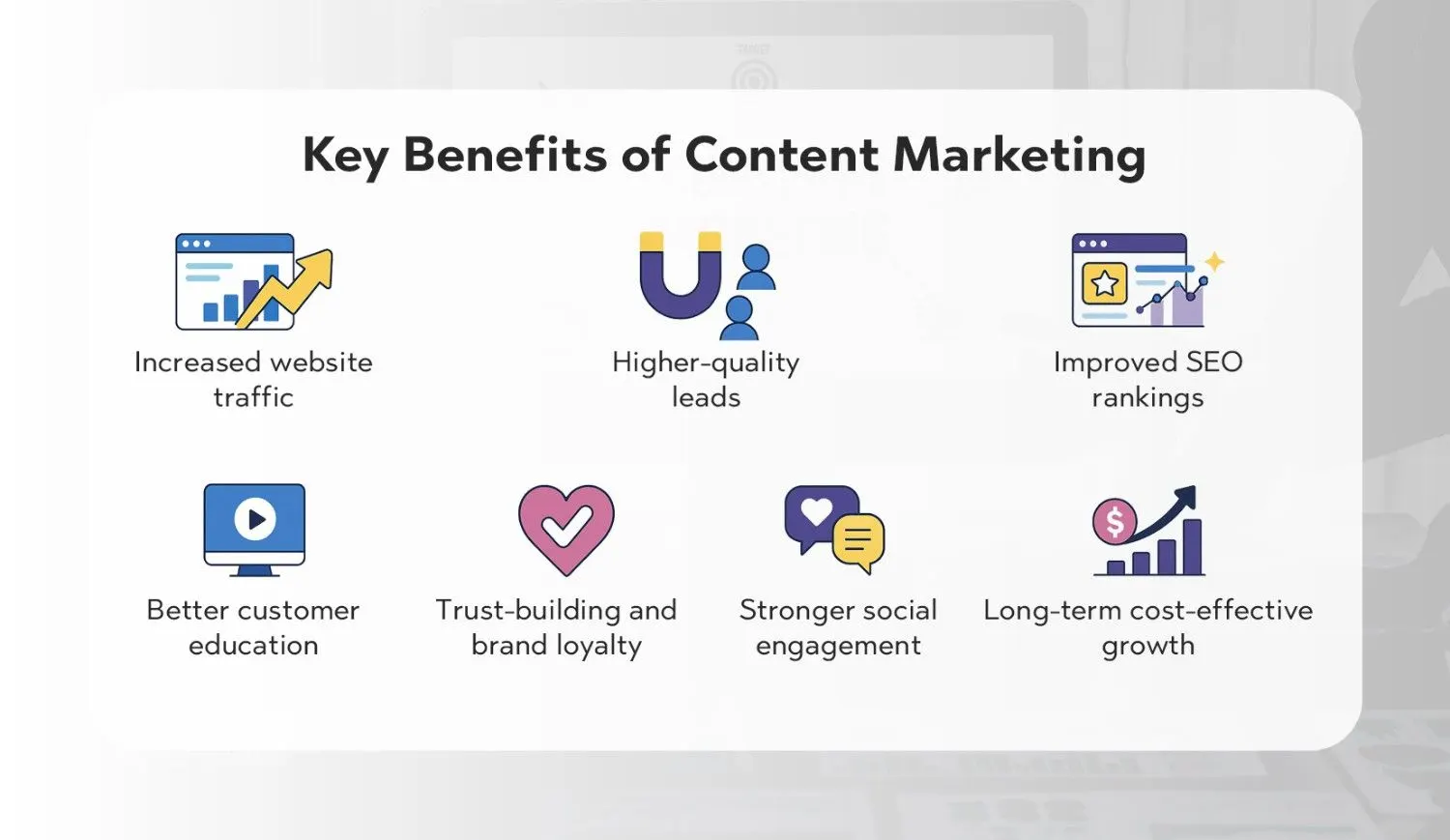
High-quality, SEO-optimised content naturally attracts more visitors via search and social.
Over time, your website becomes a hub of helpful information, and people return not just for your products but also for your insights.
When you create content around specific pain points and use cases, you attract people who are already thinking about solutions.
They arrive with context, trust your expertise, and are more likely to convert because they self-qualify through your content.
Google loves fresh, authoritative, well-structured content.
By creating in-depth articles and guides around strategic keywords, you:
● Increase your topical authority
● Earn backlinks naturally
● Improve internal linking between pages
All of these influence rankings, which in turn boost visibility and traffic.
Content acts as a 24/7 educator.
● Help documents and knowledge bases reduce support load
● Tutorials show how to use features customers might miss
● Explainer videos simplify complex topics
Educated customers use your product properly and get better results. That leads to happier clients and stronger retention.
Consistently valuable content creates a relationship.
Even if people aren’t ready to buy today, they remember the brand that:
● Helped them solve an issue
● Shared practical tips
● Didn’t gatekeep knowledge
When the time comes to choose a vendor, that trust pays off.
Social media feeds on content.
When you have a steady stream of articles, clips, and visuals to share, you:
● Stay active without feeling forced or repetitive
● Spark conversations and feedback
● Reach new audiences through shares and mentions
Good content gives your social channels substance, not just surface-level promotion.
Content marketing has compounding returns.
A single high-performing piece of content can bring:
● Thousands of visitors
● Hundreds of leads
● Dozens of sales
…for years, with minimal ongoing costs. That’s the kind of marketing asset every business wants.
The role of content marketing in business growth gets even clearer when you break down the most effective content types.
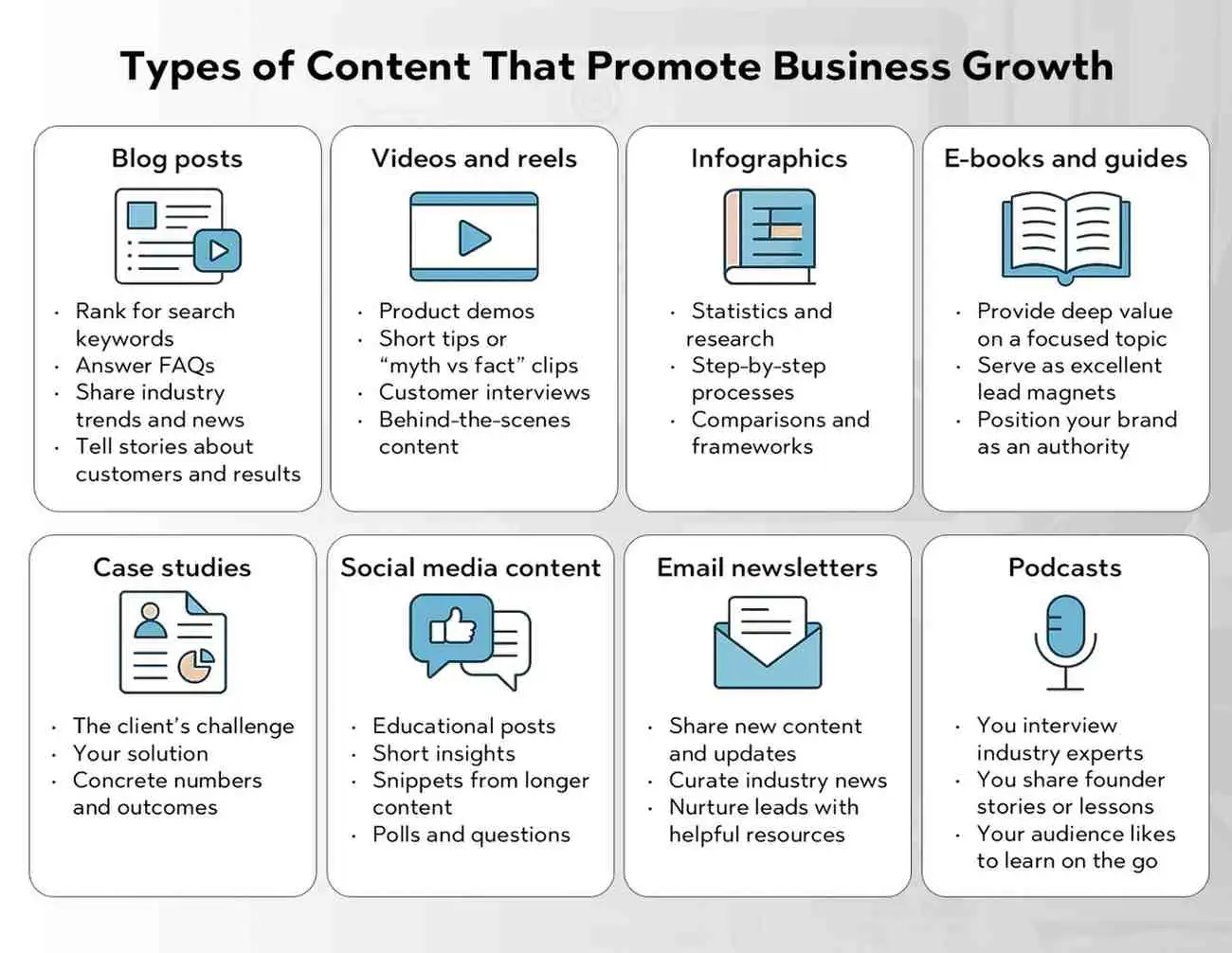
The backbone of many strategies.
Use blogs to:
● Rank for search keywords
● Answer FAQs
● Share industry trends and news
● Tell stories about customers and results
Long-form blogs (like this one) can also act as pillar content that you repurpose into many smaller assets.
Attention spans are short, and video cuts through the noise.
Ideas:
● Product demos
● Short tips or “myth vs fact” clips
● Customer interview
● Behind-the-scenes content
You can embed video on your site for SEO benefits and publish it on YouTube, Instagram, and LinkedIn for reach.
Infographics simplify complex ideas into visual, shareable pieces.
They work especially well for:
● Statistics and research
● Step-by-step processes
● Comparisons and frameworks
They also perform well on social and often earn backlinks when others reference your visuals.
These longer resources:
● Provide deep value on a focused topic
● Serve as excellent lead magnets
● Position your brand as an authority
For example: “The 2025 Guide to Content Marketing for SaaS Startups.”
Case studies show proof, not just promises.
A strong case study covers:
● The client’s challenge
● Your solution
● Concrete numbers and outcomes
They are powerful bottom-of-funnel assets for sales teams who need credible success stories.
Social content keeps your brand in daily conversations.
Mix:
● Educational posts
● Short insights
● Snippets from longer content
● Polls and questions
● User-generated content and testimonials
This keeps your audience engaged between bigger launches or campaigns.
Email is still one of the highest-ROI marketing channels.
Use newsletters to:
● Share new content and updates
● Curate industry news
● Nurture leads with helpful resources
Because subscribers already opted in, engagement and conversion rates are usually higher than on social.
Podcasts allow for deeper, more personal connection.
They work well when:
● You interview industry experts
● You share founder stories or lessons
● Your audience likes to learn on the go
Podcast episodes can be transcribed and turned into blogs, social snippets, and quotes—perfect for repurposing.
Here’s how businesses actually use content marketing day-to-day.
An accounting firm might publish content like:
● “How to choose the right GST filing software”
● “Tax-saving tips for freelancers in India”
Each post brings in people who might later become clients.
A B2B SaaS product can create:
● Feature walkthroughs
● Webinars explaining use cases
● ROI calculators
These assets help potential buyers understand value before they jump on a sales call.
A strong knowledge base and FAQ section:
● Answer common “how do I…?” questions
● Reduce support tickets
● Shorten resolution time
Support and marketing teams both win.
When prospects see others succeed with your product, their risk perception drops.
Sharing detailed case studies on landing pages, proposals, and follow-up emails often increases conversion rates significantly.
Thought leadership pieces—“opinion” blogs backed by data and experience—position your brand as a leader, not a follower.
This is especially important in crowded markets where features look similar and trust becomes the differentiator.
High-value downloads like templates, checklists, and ebooks encourage visitors to share their email addresses.
From there, your nurturing sequences can educate them gradually until they’re ready to buy.
Of course, it’s not all smooth sailing. Let’s talk about the tricky parts.
Coming up with topics, writing, editing, and publishing—week after week—can overwhelm small teams.
Without a content calendar and process, you quickly fall into the “random posting” trap.
If you compete in a saturated market, it may take time to rank for your dream keywords.
You’ll often start by targeting long-tail phrases and niche topics before moving into highly competitive spaces.
Content marketing’s impact stretches across multiple touchpoints, so ROI isn’t always obvious.
You need clear goals, proper analytics setup, and patience to see patterns in:
● Assisted conversions
● Lifetime value
● Organic traffic trends
Content ages.
Statistics change, screenshots become outdated, and new competitors appear. Regularly refreshing high-performing articles helps you maintain rankings and relevance.
Different platforms like different content styles.
Turning a single idea into a blog, video, carousel, and email takes planning and workflow, not just inspiration.
Content marketing compounds, but the early phase can feel slow.
You might publish for months before big traffic or lead spikes appear. This is where many businesses give up—right before momentum kicks in.
Good news: you can avoid a lot of pain by following some proven guidelines.
Don’t guess what to write.
Use tools to discover:
● Questions people actually ask
● Phrases with solid search volume and feasible competition
● Gaps in your competitors’ content
Then build a content calendar around those insights.
You don’t have to post daily, but you do need to be consistent.
Whether it’s one strong blog per week or two per month, pick a cadence your team can maintain and stick to it.
Behind every keyword is an intention:
● To learn
● To compare
● To buy
Make sure the content you create actually matches that intent. If someone searches “how to start a podcast”, they want a step-by-step guide, not a hard sales pitch for recording software.
Treat your best-performing content like a valuable asset.
● Refresh stats and examples
● Improve visuals
● Add internal links to new articles
● Expand sections based on user questions
Often, updating an old post gives bigger returns than publishing a brand-new one.
Every piece of content should answer: “What should readers do next?”
Include clear, relevant calls to action:
● Subscribe to the newsletter
● Download a related guide
● Book a consultation
● Start a free trial
Soft CTAs build relationships. Hard CTAs drive conversions. Use both strategically.
Don’t fly blind.
Track metrics like:
● Sessions and unique visitors
● Bounce rate and time on page
● Scroll depth
● Leads and sales generated
● Assisted conversions
Then use those insights to tweak topics, formats, and distribution.
Squeeze every drop of value.
From one in-depth guide, you can create:
● Multiple blog posts
● A webinar or live session
● LinkedIn and Instagram posts
● Email sequences
● Short clips or reels
You work smarter, not harder.
You don’t need every tool, but a smart stack helps.
● Google Search Console – Understand how your content performs in search
● Ahrefs / SEMrush – Keyword research, competitor analysis, backlink tracking
● HubSpot (or similar CRM) – Manage leads and measure content-driven revenue
● Canva – Design social posts, infographics, and visuals without a full design team
● Grammarly – Catch grammar mistakes and polish tone
● SurferSEO / Clearscope – Optimise content for search intent and topical depth
● Notion / Trello – Plan content calendars, workflows, and collaboration
Choose tools that match your team size and maturity. It’s better to use a few properly than to sign up for ten and open none.
A mid-sized SaaS company selling workflow automation tools struggled with high CAC from paid ads and low awareness in a crowded market.
They launched a focused content marketing for business growth strategy:
● Published one in-depth blog per week on automation use cases
● Created short tutorial videos and embedded them into articles
● Offered a “Workflow Automation Playbook” as a gated lead magnet
Within four months:
● Organic traffic increased by 60%
● Lead generation improved by 35%
● Customer onboarding time dropped because prospects already understood core features before signing up
The combination of education and trust turned content into their most profitable channel.
Content marketing is important because it helps you attract the right audience, build trust, and nurture prospects until they are ready to buy. Instead of relying only on ads, you create assets that consistently bring traffic, leads, and sales while strengthening your brand over time.
Content generates leads by:
● Attracting visitors with useful information
● Offering gated resources like ebooks or templates
● Encouraging sign-ups for newsletters and demos
Once you capture contact details, you can nurture those leads with more targeted content until they convert.
For most small businesses, the best starting mix is:
● SEO-focused blog posts answering common questions
● Short, value-packed social posts
● Simple email newsletters
As you grow, you can add videos, guides, and case studies. Start with what you can create consistently and what your audience prefers.
It depends on your niche, competition, and current authority, but most businesses start seeing clear traction within 3–6 months if they publish consistently. Content marketing is a long-term strategy that compounds, so the biggest gains often appear after the first year.
SEO ensures your content is discoverable in search engines.
It involves:
● Keyword research
● On-page optimisation
● Technical health of your site
● Internal linking
When you combine strong content with solid SEO, you maximise visibility and traffic from people actively searching for solutions.
You measure ROI by tracking:
● Leads and sales generated from content-driven channels
● Assisted conversions where content influenced the decision
● Customer lifetime value from content-originated leads
● Reduction in paid ad spend as organic channels grow
Use analytics tools and UTM parameters to connect content efforts to revenue.
There is no one-size-fits-all answer, although consistency matters more than volume. Many businesses do well with:
● 2–4 blog posts per month
● Weekly newsletters
● Several social posts per week
If you can publish more without sacrificing quality, great. Just avoid burning out your team.
Content marketing can significantly reduce your reliance on paid ads but doesn’t have to replace them entirely. The best approach often combines both:
● Content drives long-term organic growth
● Ads amplify high-performing content and campaigns
Together they create a balanced, resilient marketing engine.
Popular options include:
● Notion – flexible content calendars and docs
● Trello – visual board for workflow stages
● Asana / ClickUp – project management with content pipelines
Choose whatever your team will actually use daily.
A content marketing funnel maps content to each stage of the buyer journey:
●Top of funnel: Awareness content (blogs, social posts, videos)
● Middle of funnel: Consideration content (guides, webinars, comparisons)
● Bottom of funnel: Decision content (case studies, demos, offers)
When every stage has the right content, you move people smoothly from stranger to customer—and beyond.