
Rahul Guleria
SEO Executive
Creative,
Branding
& Growth
in the Global
Digital Ecosystem
Customer acquisition cost (CAC) has become one of the most important metrics for growth-focused businesses in 2026. As competition increases across search, social and other digital channels, simply spending more on advertising does not guarantee more customers. The goal is to acquire better customers more efficiently—without sacrificing lead quality or long-term revenue.
This guide explains what CAC means, why it increases, and the performance marketing tactics businesses can use to bring it down sustainably.
Customer Acquisition Cost is the average amount a business spends to acquire one new customer.
CAC = Total Sales and Marketing Costs ÷ Number of New Customers Acquired
Depending on the business model, total costs may include advertising spend, marketing technology, creative production, agency or freelancer fees, and relevant sales costs.
CAC is different from CPL (cost per lead) and CPA (cost per acquisition/action). CPL measures what you pay to generate a lead, while CPA can measure the cost of a specific conversion. CAC goes further by measuring the cost of acquiring an actual customer.
Businesses should also measure CAC by channel—such as Google, Meta, LinkedIn, organic or other sources—instead of relying only on an overall average.
Rising PPC and social advertising costs are only part of the problem. CAC can increase because of poor audience targeting, declining creative performance, low landing-page conversion rates, weak positioning, poor lead quality, complicated conversion journeys and increasing competition.
Over-reliance on one acquisition channel and poor attribution can make the problem worse by directing budget toward campaigns that generate activity but not profitable customers.
The most common reason CAC increases is that businesses continue spending on campaigns without identifying which audiences, creatives, keywords, and conversion stages are actually profitable.
Start by separating audiences according to intent. Keep prospecting campaigns distinct from retargeting and use first-party customer data wherever appropriate. Exclude existing customers when the objective is new-customer acquisition, and build similar audiences from your highest-value customers.
Better audience intelligence can reduce wasted impressions and improve the probability of conversion. Explore Audience Intelligence to strengthen your targeting strategy.
A campaign generating hundreds of inexpensive leads may be less valuable than one generating fewer but highly qualified prospects. Connect CRM data with advertising platforms and track qualified leads, customers and revenue.
Your optimization goal should ultimately be profitable customer acquisition, not the lowest possible CPL.
A strong advertisement cannot compensate for a weak landing page. Maintain message match between the ad and page, communicate the value proposition above the fold, use a clear CTA, shorten forms where possible and add relevant trust signals.
Mobile performance and page speed matter too. If a landing page improves from a 2% conversion rate to 3%, the same traffic can generate 50% more conversions. That can significantly lower CAC without increasing media spend.
Explore Conversion Rate Optimisation for more CRO strategies.
Creative fatigue can quietly increase CAC. Test hooks, headlines, visuals, CTAs, offers, UGC, branded creative, video and static formats.
Monitor CTR, conversion rate and frequency to identify when creative performance begins declining. Instead of running one advertisement indefinitely, create a continuous testing process. Creative Storytelling & Production can help build a stronger creative pipeline.
Separate branded and non-branded search campaigns. Prioritize high-intent keywords, use negative keywords and build landing pages around specific search intent.
Paying for traffic with little commercial intent can inflate spend without improving customer acquisition.
Retarget website visitors, product viewers, cart abandoners, lead-form abandoners and engaged social users with relevant messages.
Retargeting often costs less than cold acquisition because these users have already demonstrated some level of interest. The key is to tailor the message to where the prospect is in the buying journey.
Repeatedly showing the same advertisement can reduce engagement. Monitor frequency alongside CTR and conversion rates, refresh creatives regularly and rotate audiences where appropriate.
Do not automatically increase spending on campaigns with the lowest CPL. Compare CAC, conversion rate, revenue and customer lifetime value.
Budget should increasingly move toward audiences, campaigns and channels that produce valuable customers at sustainable acquisition costs. Performance Marketing can support this data-driven approach.
Automated bidding, budget rules, lead scoring, audience segmentation, CRM-based optimization and automated reporting can improve efficiency.
However, automation is only as good as the data behind it. Accurate conversion tracking and customer data are essential before handing more decisions to automated systems. Marketing Automation can help streamline these processes.
CAC should never be evaluated in isolation. Upselling, cross-selling, repeat purchases, subscriptions and retention initiatives can increase customer lifetime value (LTV).
A higher CAC may still be sustainable when customers generate significantly more revenue over time. This is why the LTV:CAC ratio is often more informative than CAC alone.
Reducing CAC does not necessarily mean reducing your advertising budget.
Consider a business spending ₹5 lakh on advertising. If conversion improvements generate more customers from that same budget, CAC falls. Similarly, better lead qualification can reduce the effective cost of acquiring customers even when the number of leads stays the same.
The equation is straightforward:
Higher conversion rate + better lead quality + stronger retention + smarter budget allocation = better acquisition economics.
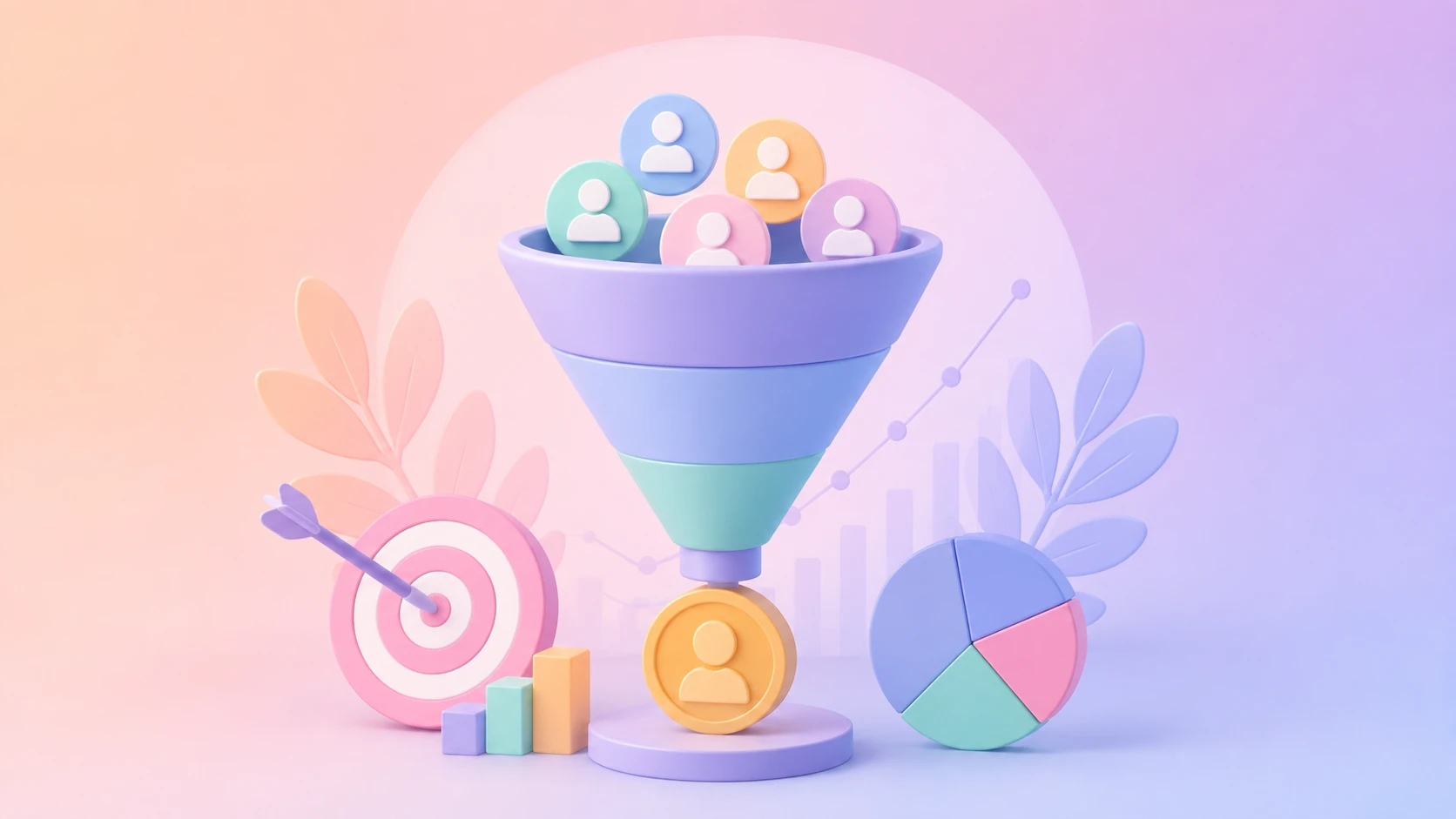
Think of acquisition as a funnel:
Ad → Landing Page → Lead → Qualified Lead → Customer
Improving any stage can improve overall efficiency. Test CTAs, form length, landing-page copy, pricing presentation, testimonials, trust signals and the signup or checkout experience.
CRO is particularly valuable because it can increase output from traffic you are already paying for.
Track CAC alongside CPL, CPA, conversion rate, MQL-to-customer rate, ROAS, LTV, LTV:CAC ratio, payback period and incremental CAC.
Importantly, a lower CPL does not necessarily mean a lower CAC. Cheap leads are valuable only when they have a reasonable probability of becoming customers.
Avoid optimizing only for cheap leads, cutting campaigns too early, ignoring customer quality, using outdated audiences or running the same creative for too long. Businesses should also avoid relying exclusively on last-click attribution, ignoring returning users and organic conversions, scaling before validating unit economics, or making decisions from insufficient data.
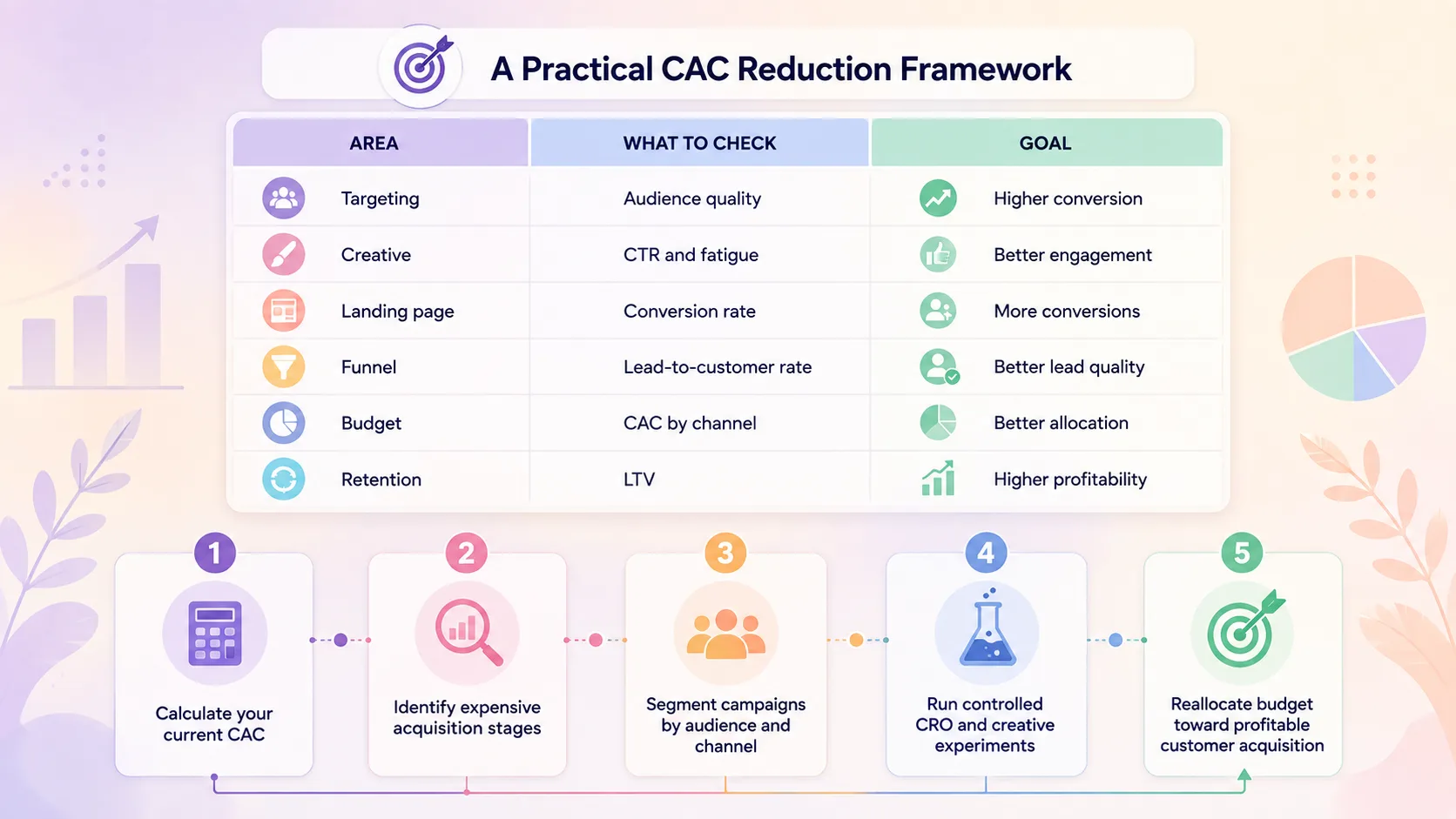
Area | What to Check | Goal |
|---|---|---|
Targeting | Audience quality | Higher conversion |
Creative | CTR and fatigue | Better engagement |
Landing page | Conversion rate | More conversions |
Funnel | Lead-to-customer rate | Better lead quality |
Budget | CAC by channel | Better allocation |
Retention | LTV | Higher profitability |
Follow five steps: calculate your current CAC, identify expensive acquisition stages, segment campaigns by audience and channel, run controlled CRO and creative experiments, and reallocate budget toward profitable customer acquisition.
A low CAC does not automatically mean a profitable business. Customers acquired cheaply may purchase once and generate little revenue. Conversely, a higher CAC can be acceptable when customers have strong retention and high lifetime value.
For subscription and SaaS businesses, payback period is particularly important because it shows how long it takes to recover acquisition costs.
There is no universal benchmark. A good CAC depends on your margins, average order value, customer lifetime value and business model.
By improving targeting, creative performance, conversion rates, lead quality, retargeting and budget allocation.
Start by identifying the biggest conversion or efficiency bottleneck. Improving a high-impact stage can produce faster results than simply cutting spend.
Yes. More customers from the same amount of traffic and spend generally means a lower CAC.
Not necessarily. Cutting spend can reduce total customers without improving unit economics. Optimization is usually more sustainable.
Because CPL measures leads, while CAC measures actual customers. Not every lead becomes a customer.
Divide relevant sales and marketing costs by the number of new customers acquired during the same period.
CPA measures the cost of a defined acquisition or conversion action. CAC specifically measures the cost of acquiring a new customer.
Monitor it regularly, but evaluate trends over a meaningful period rather than reacting to short-term fluctuations.
AI can support audience segmentation, creative testing, lead scoring, forecasting, bidding and reporting—but reliable data and conversion tracking must come first.
Reducing CAC is not simply about spending less. It is about spending more intelligently.
Businesses that combine better targeting, stronger creative testing, conversion rate optimization, quality-based campaign optimization, retargeting and smarter budget allocation can improve acquisition efficiency without sacrificing customer quality.
The most effective approach is continuous: connect advertising data with CRM, revenue and customer lifetime value, identify where the funnel is leaking, test improvements and shift investment toward what consistently produces profitable customers.