

Rahul Guleria
SEO Executive
Creative,
Branding
& Growth
in the Global
Digital Ecosystem

Performance marketing has become an important part of business growth, helping organisations generate leads, acquire customers and improve revenue through measurable digital campaigns. However, achieving consistent results requires the right combination of expertise, technology, resources and campaign management.
Businesses generally choose between two approaches: hiring an external performance marketing agency or building an in-house marketing team. While both models offer distinct advantages, they also come with challenges involving recruitment costs, specialist expertise, campaign execution and operational flexibility.
So, which approach makes more sense for your business?
The answer depends on your marketing objectives, available budget, business size and internal capabilities. Some organisations benefit from outsourcing their marketing activities, while others prefer managing campaigns internally. A third option is a hybrid model that combines internal marketing leadership with external agency expertise.
Let's explore the differences to help you make an informed decision.
A performance marketing agency is an external marketing partner that plans, manages and optimises digital advertising campaigns to achieve measurable business objectives.
Unlike traditional advertising approaches that primarily focus on brand visibility, performance marketing places greater emphasis on measurable outcomes such as leads, website conversions, sales, customer acquisition and return on advertising spend.
A performance marketing agency brings together specialists across different digital marketing disciplines to manage campaigns throughout their lifecycle.
These professionals work on audience research, advertising strategy, creative development, campaign execution, conversion optimisation and performance measurement.
Businesses can access specialised expertise without recruiting and managing every marketing professional internally.
A performance marketing agency typically handles several activities, depending on the agreed scope of services.
1. Paid Search Advertising
Managing search advertising campaigns across platforms such as Google Ads to reach users actively searching for relevant products and services.
2. Paid Social Media Campaigns
Planning and executing advertising campaigns across social platforms to generate awareness, engagement, leads and conversions.
3. Programmatic Advertising
Using automated advertising technology to purchase and optimise digital media placements across relevant websites and applications.
4. Audience Research and Targeting
Identifying potential customers through demographic, behavioural, contextual and interest-based targeting.
5. Creative Development and Copywriting
Developing advertising creatives, messaging, headlines, landing page content and other campaign assets.
6. Conversion Rate Optimisation
Improving landing pages, website experiences and conversion journeys to increase the percentage of visitors who complete desired actions.
7. Campaign Analytics and Attribution
Monitoring campaign performance, analysing conversion data and understanding how different marketing channels contribute to business outcomes.
8. Performance Reporting
Preparing regular reports covering campaign performance, spending, conversions, acquisition costs and other relevant KPIs.
By combining these capabilities, agencies help businesses manage advertising campaigns while maintaining a focus on measurable growth.
Explore PulsePlay Digital's performance marketing services to understand how specialised campaign management can support business objectives.
An in-house performance marketing team consists of employees who manage advertising campaigns and digital marketing activities directly within an organisation.
Instead of outsourcing marketing operations to an external agency, the business recruits professionals with the required skills and assigns them responsibility for planning, executing and optimising campaigns.
An in-house team works closely with internal departments such as sales, product development, customer support and leadership.
This structure allows marketing professionals to develop a deeper understanding of the company's products, customers, brand positioning and commercial objectives.
The team is generally responsible for managing marketing strategy, advertising accounts, campaign execution, reporting and optimisation.
The structure of an internal marketing department depends on the organisation's size, budget and marketing requirements.
Common roles include:
Smaller businesses may combine several responsibilities under fewer employees, while larger organisations may maintain dedicated specialists for individual marketing functions.
An in-house team generally follows a structured process:
The primary advantage of this structure is direct involvement in the organisation's marketing operations and decision-making processes.
However, maintaining the necessary expertise, technology and workforce requires continuous investment.
Both approaches aim to improve marketing performance, but they differ in how resources, responsibilities and campaign activities are managed.
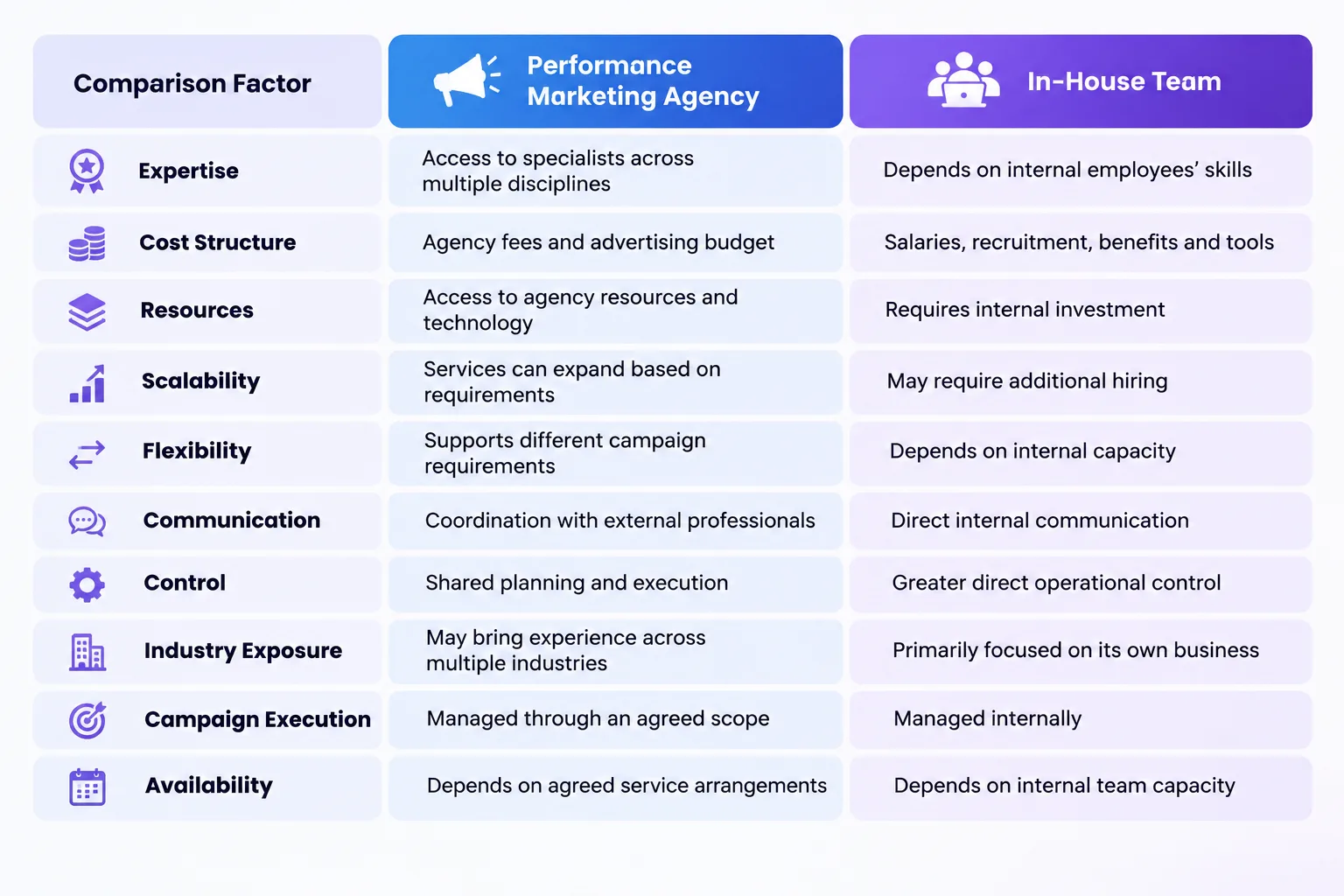
The following table highlights their major differences.
Comparison Factor | Performance Marketing Agency | In-House Team |
|---|---|---|
Expertise | Access to specialists across multiple disciplines | Depends on internal employees' skills |
Cost Structure | Agency fees and advertising budget | Salaries, recruitment, benefits and tools |
Scalability | Services can expand based on requirements | May require additional hiring |
Flexibility | Supports different campaign requirements | Depends on internal capacity |
Communication | Coordination with external professionals | Direct internal communication |
Control | Shared planning and execution | Greater direct operational control |
Industry Exposure | May bring experience across multiple industries | Primarily focused on its own business |
Campaign Execution | Managed through an agreed scope | Managed internally |
Availability | Depends on agreed service arrangements | Depends on internal team capacity |
Neither approach is automatically better. The right choice depends on the level of control, expertise, flexibility and investment your organisation requires.
Before deciding between an external agency and an internal marketing department, evaluate the following seven factors.
Cost is often one of the first considerations when choosing a marketing model.
Building an in-house team involves several expenses beyond employee salaries. Businesses must account for recruitment, employee benefits, training, software subscriptions, advertising technology and ongoing operational costs.
Hiring a performance marketing agency generally involves an agreed management fee, alongside the advertising budget and any additional service charges.
However, comparing only the monthly agency fee with an employee's salary does not provide an accurate picture.
For a meaningful comparison, consider:
For businesses requiring multiple marketing specialists, outsourcing may provide access to broader capabilities without recruiting an entire department.
On the other hand, organisations with consistent marketing requirements and sufficient internal resources may find an in-house structure more suitable over time.
What matters most: Compare the total cost of delivering the required marketing activities, rather than looking at individual expenses in isolation.
Performance marketing requires expertise across multiple disciplines.
Managing paid search campaigns involves different skills from running programmatic advertising, optimising landing pages or analysing attribution data.
A performance marketing agency may provide access to specialists across these areas through a single partnership.
This can be particularly useful for businesses that need expertise across several advertising platforms but do not have the resources to recruit dedicated professionals.
In-house teams, meanwhile, develop detailed knowledge of the company's products, customers and internal processes.
However, smaller teams may have limited exposure to specialised marketing functions.
Businesses should evaluate whether their existing employees have the technical capabilities required to manage campaign complexity and achieve their performance objectives.
Marketing technology plays an important role in campaign execution, measurement and optimisation.
Depending on their requirements, businesses may need access to:
Building an in-house marketing department means investing in the tools required to support its operations.
Agencies may already have established workflows and access to relevant technology, although the tools available will vary between providers and service agreements.
The decision should consider not only software costs but also implementation, integration, training and ongoing management.
Control over marketing activities is another important difference.
An in-house team works directly within the organisation, making it easier to coordinate with leadership, sales and product departments.
Internal employees can access business information and communicate directly with decision-makers.
Agencies operate externally and coordinate through agreed communication processes, meetings, reporting arrangements and approval workflows.
Although this structure may introduce additional coordination requirements, it also provides an independent perspective on campaign strategy and execution.
Before hiring an agency, businesses should establish:
Clear expectations help both parties maintain transparency and work towards shared objectives.
Marketing requirements can change as businesses expand into new markets, launch products or increase advertising budgets.
A performance marketing agency can often support changing requirements by adjusting the scope of services and allocating additional specialists, subject to capacity and contractual arrangements.
Expanding an in-house team generally requires recruitment, onboarding and additional operational investment.
This can take time, particularly when businesses need specialised professionals.
However, an established internal team may provide greater continuity for organisations with ongoing, predictable marketing requirements.
Consider your expected growth trajectory, campaign complexity and resource requirements before selecting a structure.
An in-house team develops a detailed understanding of the company's products, customers, brand positioning and internal operations.
This knowledge can help marketing professionals create campaigns that align closely with business priorities.
Agencies, meanwhile, may bring experience from working across different industries, advertising channels and campaign types.
This broader exposure can introduce new strategies, creative approaches and optimisation opportunities.
The strongest results often come when both perspectives work together.
Internal employees provide business-specific insights, while external specialists contribute technical knowledge and an independent strategic perspective.
Performance marketing should be evaluated through measurable business outcomes.
Whether campaigns are managed internally or externally, businesses need clear KPIs and accountability structures.
Common performance indicators include:
Businesses should also establish reporting frequency, conversion tracking requirements and attribution methodologies.
For agencies, performance expectations should be defined within the scope of work and reporting agreements.
For in-house teams, responsibilities should be incorporated into internal performance reviews and marketing objectives.
Most importantly, campaign success should be evaluated against business goals rather than individual advertising metrics alone.
Working with an external agency can provide access to specialised expertise and additional resources. However, businesses should also understand the potential limitations.
1. Access to Specialised Professionals
Agencies can provide access to professionals across paid media, analytics, creative development, conversion optimisation and other marketing disciplines.
2. Multiple Marketing Capabilities
Businesses can access different marketing services through a single partnership instead of recruiting specialists for every function.
3. Flexible Resource Allocation
Services can be adjusted according to changing campaign requirements and business priorities.
4. Established Processes and Tools
Experienced agencies may bring existing campaign management workflows, reporting systems and optimisation processes.
5. External Strategic Perspective
Agencies can identify opportunities and challenges that internal teams may overlook because of their familiarity with existing business practices.
6. Support Across Multiple Advertising Channels
Businesses can coordinate campaigns across search, social, programmatic and other digital advertising channels.
1. Less Direct Control Over Daily Execution
Businesses may not have the same level of direct involvement in everyday campaign activities as they would with an internal team.
2. Dependence on Communication Processes
External partnerships require structured communication, approvals and reporting.
3. Agency Onboarding Requirements
Agencies need time to understand the business, target audience, products, brand guidelines and campaign objectives.
4. Variation in Service Quality
The expertise, processes and service standards of agencies can differ significantly.
5. Need for Clear Expectations
Businesses must establish responsibilities, deliverables, KPIs and reporting arrangements to maintain accountability.
An internal marketing department provides greater operational involvement and direct access to company resources. However, it also requires ongoing investment.
1. Direct Control Over Marketing Activities
Businesses can manage campaign planning, execution and optimisation through their internal employees.
2. Better Access to Business Information
Internal marketers can access company knowledge, customer insights and product information directly.
3. Closer Departmental Collaboration
Marketing professionals can coordinate with sales, product development and leadership teams more easily.
4. Dedicated Focus on Business Objectives
An internal team works exclusively on the organisation's marketing requirements rather than managing multiple external clients.
5. Faster Internal Coordination
When approval processes are efficient, internal employees can respond quickly to changing business requirements.
1. Recruitment and Employee Retention Costs
Hiring experienced professionals requires investment in recruitment, salaries, benefits and retention.
2. Continuous Training Requirements
Digital advertising platforms, technologies and marketing practices evolve. Internal employees need ongoing training to maintain their expertise.
3. Limited Expertise in Smaller Teams
A small department may not have specialists across every marketing discipline.
4. Additional Technology Investment
Businesses must purchase, maintain and manage the tools required for campaign execution and measurement.
5. Difficulty Scaling Specialised Capabilities
Expanding internal operations can involve lengthy recruitment and onboarding processes.
Hiring an external agency can be a practical option when your organisation needs specialised marketing expertise without building a large internal department.
Consider working with a performance marketing agency in the following situations.
1. Your Business Lacks Specialised Marketing Expertise
If your existing team does not have the technical skills required to manage paid advertising, programmatic campaigns or conversion optimisation, an agency can provide additional capabilities.
2. You Want to Launch Paid Advertising Campaigns
Businesses entering paid digital advertising may benefit from external guidance on campaign structure, audience targeting, creative development and budget allocation.
3. Your Existing Campaigns Are Underperforming
If campaigns are generating traffic but not delivering sufficient leads, conversions or revenue, external specialists can review campaign performance and identify potential improvements.
4. You Need Multiple Marketing Capabilities
An agency can provide access to different specialists across advertising, analytics, creative production and optimisation.
5. You Want to Scale Without Expanding Your Workforce
Outsourcing selected marketing activities can help businesses increase campaign capacity without recruiting employees for every specialised function.
6. You Need External Strategic Guidance
An experienced agency can bring an independent perspective to marketing strategy, channel selection and campaign optimisation.
An internal marketing department may be more suitable when marketing operations require consistent involvement in everyday business activities.
Consider building an in-house team when:
1. Marketing Requires Daily Internal Coordination
Businesses with frequent product launches, sales initiatives and changing internal priorities may benefit from having dedicated marketing employees.
2. You Have Consistent, Long-Term Marketing Requirements
Organisations with ongoing campaign requirements and predictable workloads may benefit from developing internal marketing capabilities.
3. You Have Sufficient Budget and Resources
Building a capable department requires investment in recruitment, employee development, technology and management.
4. Company-Specific Product Knowledge Is Essential
Businesses operating in complex industries may require marketers with detailed knowledge of their products, customers and internal processes.
5. Marketing Requires Close Integration With Other Departments
If marketing activities are closely connected to sales operations, product development and customer management, an internal team may provide better operational alignment.
Yes. Businesses do not necessarily have to choose between an agency and an in-house marketing team.
A hybrid marketing model combines internal business knowledge with external marketing expertise.
Under this structure, the organisation retains control over its overall marketing direction while outsourcing selected activities to an external agency.
For example, an internal marketing team may manage brand strategy, customer insights and communication with leadership, while an agency handles paid advertising, creative production, campaign optimisation and analytics.
This approach allows businesses to access specialised capabilities without transferring complete responsibility for marketing operations to an external partner.
A typical hybrid marketing structure involves four interconnected stages.
1. Business Leadership
Leadership defines business objectives, marketing budgets, growth targets and overall strategic priorities.
2. In-House Marketing Team
The internal team manages brand strategy, business insights, customer understanding and coordination with internal departments.
3. Performance Marketing Agency
The agency supports paid media, creative development, audience targeting, analytics and campaign optimisation.
4. Shared Performance Outcomes
Both teams collaborate to evaluate campaign results and improve measurable outcomes, including leads, conversions, revenue and customer growth.
Hybrid Marketing Workflow:
Business Leadership → In-House Marketing Team + Agency Team → Shared Performance Outcomes
Combines Business Knowledge With External Expertise
Internal employees understand the organisation, while agency specialists contribute additional technical and marketing capabilities.
Provides Access to More Specialists
Businesses can access expertise across different advertising platforms and marketing disciplines without recruiting every specialist internally.
Reduces Recruitment Requirements
Outsourcing selected functions can reduce the need to expand the internal department for every new marketing requirement.
Supports Flexible Resource Allocation
Businesses can adjust the level of external support as marketing priorities and campaign requirements change.
Encourages Collaboration and Knowledge Sharing
Working together allows internal employees to learn from external specialists while providing agencies with deeper business insights.
For many growing organisations, the hybrid approach offers a practical balance between operational control and specialised campaign execution.
The right marketing structure depends on your current resources, business objectives and operational requirements.
The following table provides a general guide.
Business Situation | Recommended Approach |
|---|---|
Startup with a limited marketing team | Agency |
Business needing specialised paid media expertise | Agency |
Large company with established marketing operations | In-house |
Business with continuous internal marketing requirements | In-house |
Business expanding into new markets | Agency or hybrid |
Business needing multiple specialist capabilities | Agency or hybrid |
Business with an experienced internal marketing department | In-house or hybrid |
These recommendations are not fixed rules. A startup may eventually develop an internal department, while an established organisation may continue outsourcing specialised marketing functions.
The most suitable structure is the one that supports your business objectives while making efficient use of available resources.
Choosing a performance marketing partner involves more than finding an agency that can manage advertising campaigns.
Businesses need a partner that understands their objectives, works effectively with internal stakeholders and focuses on measurable marketing outcomes.
PulsePlay Digital is a digital performance marketing and creative partner that collaborates with businesses and internal marketing teams to support campaign execution and growth.
Its capabilities cover multiple areas of digital marketing, allowing businesses to access specialised support across different stages of the customer acquisition journey.
These capabilities include:
Paid Search and Paid Social: Campaign planning, audience targeting and advertising optimisation across relevant digital platforms.
Programmatic Guaranteed Advertising: Access to programmatic advertising solutions for planned media placements and audience reach.
Native Advertising: Advertising formats designed to align with the content and experience of relevant digital environments.
Conversion Rate Optimisation: Improving website experiences and conversion journeys to support better campaign outcomes.
Landing Page Optimisation: Enhancing landing page structure, messaging and user experience to improve conversion opportunities.
Creative Development and Copywriting: Developing advertising creatives and campaign messaging aligned with business objectives.
Affiliate Marketing: Supporting performance-driven partnerships and customer acquisition initiatives.
Audience Research and First-Party Data Activation: Using available audience insights and first-party data to support relevant targeting strategies.
Attribution and Measurement: Evaluating campaign performance and understanding the contribution of different marketing channels.
CRM and CDP Integration: Supporting customer data integration and marketing technology requirements.
Importantly, PulsePlay Digital can work as an extension of an existing internal marketing department rather than replacing it.
This collaborative approach allows businesses to retain internal ownership of their brand and marketing strategy while accessing additional expertise for campaign execution and optimisation.
Businesses can explore PulsePlay Digital's performance marketing solutions and broader digital marketing capabilities to understand how external expertise can complement internal marketing operations.
You can also meet the PulsePlay Digital team or learn more about PulsePlay Digital.
For practical examples of campaign collaboration and execution, explore the Buyceps case study.
Choosing between a performance marketing agency and an in-house team is not simply a question of outsourcing versus hiring.
Both approaches offer advantages, and the right decision depends on your business requirements.
An agency may be more suitable when you need specialised expertise, access to multiple marketing capabilities and flexibility without expanding your internal workforce.
An in-house team may be a better fit when you require dedicated marketing employees, direct operational control and close coordination with other departments.
However, businesses that need both internal ownership and specialist support should consider a hybrid marketing model.
By combining internal business knowledge with external agency expertise, organisations can build a marketing structure that adapts to changing requirements while maintaining a focus on measurable growth.
If your business is looking for additional expertise to support its advertising campaigns, explore PulsePlay Digital's performance marketing capabilities and discover how an external marketing partner can complement your existing team.
Neither option is universally better. A marketing agency may be suitable for businesses needing specialised expertise, flexible resources and support across multiple channels. An in-house team may be more appropriate for organisations requiring dedicated employees, direct operational control and continuous internal coordination. The decision depends on budget, business objectives and available resources.
A marketing agency is an external service provider that manages agreed marketing activities for a business. An in-house marketing team consists of employees who work directly within the organisation. Agencies may offer access to multiple specialists, while internal teams provide closer integration with company operations and business objectives.
Hiring an agency can be cost-effective when a business needs access to multiple marketing specialists without recruiting a complete internal department. However, cost-effectiveness depends on the agency's fees, service scope, advertising budget and business outcomes. Businesses should compare the total cost of both models before making a decision.
An in-house marketing team offers direct control over marketing operations, better access to internal business information, closer collaboration with other departments and dedicated attention to company objectives. It can also provide continuity for organisations with ongoing marketing requirements.
Yes. Many agencies work alongside internal marketing departments through a hybrid model. The internal team can manage brand strategy, business priorities and stakeholder coordination, while the agency provides specialised support for paid media, creative development, analytics and optimisation.
The cost depends on the number of employees, their experience, salaries, benefits, recruitment expenses, technology requirements and training costs. A small team may combine several marketing responsibilities, while larger organisations may require dedicated specialists for individual functions. Businesses should calculate the total operational cost rather than considering salaries alone.
A business should consider outsourcing when it lacks specialised marketing expertise, wants to launch or improve advertising campaigns, requires support across multiple channels or needs additional resources without expanding its internal workforce. Outsourcing can also provide access to external strategic guidance.
A hybrid marketing team combines internal marketing employees with external agency professionals. The internal team generally manages business objectives, brand direction and stakeholder communication, while the agency supports specialised activities such as paid advertising, creative development, analytics and campaign optimisation.
No. A performance marketing agency does not necessarily replace an internal marketing team. It can work as an extension of the existing department, providing additional expertise and resources where required. Businesses can retain control over their marketing strategy while outsourcing selected campaign activities.