
Rahul Guleria
SEO Executive
Creative,
Branding
& Growth
in the Global
Digital Ecosystem

Google Ads is one of the most effective channels for performance marketing because it allows businesses to reach users actively searching for products, services, and solutions. A successful Google Ads strategy combines the right campaign objectives, keyword and audience targeting, compelling ad messaging, conversion tracking, bidding, and continuous optimization.
However, simply running Google Ads is not the same as running performance marketing. Performance marketing focuses on measurable business outcomes rather than vanity metrics. Campaigns should ultimately be connected to goals such as qualified leads, sales, revenue, CPA, ROAS, and ROI.
Businesses using performance marketing can use Google Ads as part of a broader strategy designed to turn advertising spend into measurable business results.
The key is to build a system in which targeting, advertising, landing pages, conversion tracking, and optimization work together.
Google Ads is Google's paid advertising platform, allowing businesses to promote products and services across Google's advertising ecosystem.
Google Ads becomes a performance marketing channel when campaigns are planned, measured, and optimized against specific business outcomes such as leads, sales, revenue, CPA, or ROAS.
Instead of simply asking how many people clicked an ad, performance marketers ask:
Google Ads can be particularly valuable for performance marketing because it offers:
Google Ads can also work alongside other paid channels. A broader paid media advertising strategy can help businesses determine how different channels, campaigns, audiences, and budgets contribute to overall performance.
Google Ads should not operate as an isolated advertising activity. It works best as part of a connected performance marketing system.
A typical process looks like this:
Business Goal
↓
Audience Research
↓
Keyword / Intent Research
↓
Campaign Structure
↓
Ad Creative
↓
Landing Page
↓
Conversion Tracking
↓
Optimization
↓
Revenue / Leads / ROAS
Every stage influences the next.
For example, poor audience targeting can reduce conversion quality. Weak ad messaging can reduce CTR. A poorly designed landing page can waste otherwise valuable paid traffic. Inaccurate conversion tracking can make optimization decisions unreliable.
Funnel Stage | Google Ads Tactics |
|---|---|
Awareness | Display, YouTube |
Consideration | Search, Display Remarketing |
Conversion | Search, Shopping, Performance Max |
Retention | Remarketing / customer-focused campaigns |
The right combination depends on the business model, audience, campaign objective, and stage of the customer journey.
Google Ads provides multiple campaign formats, each suited to different marketing objectives.
Search campaigns are designed to reach users actively searching for relevant products, services, or solutions.
They can be particularly effective for:
Because search advertising captures existing demand, it can be especially useful when customers already know what they need.
Performance Max campaigns are designed to access multiple Google advertising properties through a unified campaign approach.
They can support:
The appropriate use of automation depends on the campaign's objective, available conversion data, tracking quality, and business economics.
Shopping campaigns are particularly relevant to e-commerce businesses.
They can help with:
Product information, pricing, images, categories, and conversion data all influence how effectively an e-commerce campaign can perform.
Display advertising can support both awareness and performance objectives.
Common applications include:
Display can complement search campaigns by keeping a brand visible to users throughout their consideration journey.
YouTube provides a video-focused advertising environment that can support:
Video can be particularly useful for communicating a product's value proposition when visual storytelling is important.
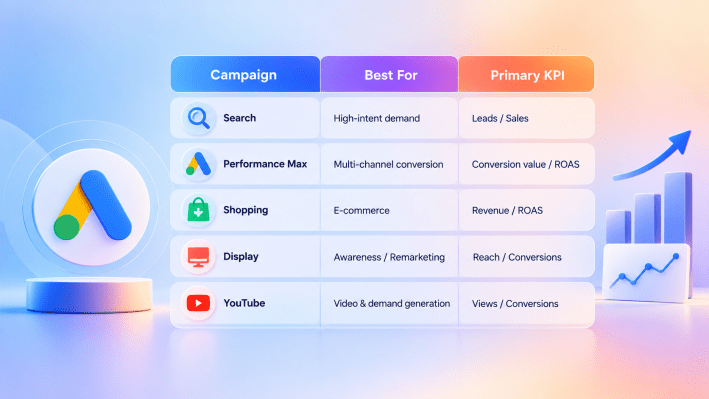
Campaign | Best For | Primary KPI |
|---|---|---|
Search | High-intent demand | Leads / Sales |
Performance Max | Multi-channel conversion | Conversion value / ROAS |
Shopping | E-commerce | Revenue / ROAS |
Display | Awareness / Remarketing | Reach / Conversions |
YouTube | Video & demand generation | Views / Conversions |
A strong strategy begins with business objectives rather than keywords.
Start by determining what the campaign needs to achieve.
Possible objectives include:
The objective determines how campaigns should be structured, measured, and optimized.
For example, a lead-generation campaign should not be evaluated in exactly the same way as an e-commerce campaign focused on revenue.
Understanding the audience helps determine what to target, what to communicate, and where users are in the buying journey.
Consider:
Better audience intelligence can help marketers identify valuable customer segments and make more informed targeting decisions.
Keyword research helps connect advertising with user intent.
Important keyword categories include:
Keyword Intent | Example | Funnel Stage |
|---|---|---|
Informational | how to choose CRM | Awareness |
Commercial | best CRM software | Consideration |
Transactional | buy CRM software | Conversion |
Branded | PulsePlay Digital | Conversion / Navigation |
The objective is not simply to collect as many keywords as possible. The goal is to understand the intent behind searches and align that intent with the appropriate campaign and landing page.
Effective Google Ads targeting requires more than selecting a few keywords.
Keyword targeting should account for:
Search-term analysis is particularly important because it helps marketers understand the actual queries generating traffic.
Negative keywords can also prevent advertising spend from being directed toward irrelevant searches.
Businesses can refine campaigns according to:
For location-dependent businesses, geographic targeting can help align advertising spend with areas where the business can actually serve customers.
Depending on campaign type and available data, audience strategies can include:
Audience signals can complement keyword and contextual targeting and help marketers understand different customer segments.
Performance can vary across:
Reviewing device-level performance can help identify differences in engagement, conversion rate, CPA, and revenue.
Demographic signals can support campaign segmentation and analysis.
Rather than assuming every demographic performs equally, marketers can use performance data to understand which audience groups generate valuable outcomes.
A practical Google Ads structure can be visualized as:
Account
↓
Campaign
↓
Ad Group / Theme
↓
Keywords
↓
Ads
↓
Landing Page
Campaign structure matters because it influences relevance, reporting, budget allocation, and optimization.
Campaigns can be separated based on:
The ideal structure depends on how different the business offerings and objectives are.
Ad groups should contain closely related keywords and messaging.
For example, keywords around one specific service can be grouped together so the ad copy and landing page can directly reflect the user's search intent.
One of the most important principles is:
Keyword → Ad → Landing Page
The message should remain consistent throughout the journey.
If a user searches for a specific service, sees an advertisement about that service, and then lands on a generic homepage, the experience may be less relevant.
Strong conversion rate optimization can help businesses improve the experience users have after clicking an advertisement.
Bidding determines how Google Ads participates in the auction and how advertising budgets are allocated toward the campaign objective.
Manual bidding can provide greater direct control over bids when that level of control is appropriate for the campaign.
Maximize Clicks is designed around generating traffic and can be considered when the primary objective is obtaining clicks.
Maximize Conversions focuses on generating conversions and can be relevant to conversion-focused campaigns with appropriate tracking.
Target CPA is designed around an acquisition-cost goal.
It can be considered when businesses have a defined target cost per acquisition and sufficient conversion information to support optimization.
Target ROAS is designed around a return-on-ad-spend objective.
It can be relevant to campaigns where conversion values are being tracked and revenue efficiency is an important goal.
Objective | Potential Approach |
|---|---|
Traffic | Maximize Clicks |
Leads | Maximize Conversions |
CPA control | Target CPA |
Revenue | Conversion Value |
ROAS | Target ROAS |
There is no single bidding strategy that is automatically best for every campaign. The appropriate approach depends on the campaign objective, conversion data, tracking quality, and business economics.
Conversion tracking is one of the most important components of performance marketing.
Businesses may need to track:
Without reliable tracking, marketers cannot accurately determine:
Which keyword → which ad → which campaign → which conversion → which revenue
A campaign can generate hundreds of clicks without producing meaningful business value.
Tracking helps marketers distinguish between:
Clicks → Traffic
and
Qualified Leads → Sales → Revenue
That distinction is fundamental to performance marketing.
A low-cost click is not necessarily a valuable click.
For lead-generation businesses, the objective should move beyond lead volume toward lead quality and revenue.
For e-commerce businesses, purchases and conversion value may be more meaningful than traffic alone.
Reliable data analytics can help businesses connect campaign activity with conversion and business-performance data.
Google Ads optimization should be continuous rather than a one-time activity.
Review:
The goal is to continually improve the relationship between search intent and advertising spend.
Test different:
Creative testing can reveal which value propositions resonate most strongly with the intended audience.
Test:
A campaign can have excellent targeting and strong ad performance but still underperform if the landing page fails to convert.
Review:
Budget should increasingly reflect evidence about where valuable outcomes are being generated.
Use campaign performance data to identify high-value users and audience segments.
This can help marketers distinguish between audiences that generate traffic and audiences that generate meaningful business results.
Reducing CPC should not be about getting the cheapest possible traffic at any cost. The objective is to improve advertising efficiency while maintaining traffic quality and conversion potential.
Businesses looking to reduce cost per click can improve keyword relevance, ad quality, landing-page experience, campaign targeting, and ongoing optimization.
Key areas include:
Lower CPC can be valuable, but it should always be considered alongside conversion rate, CPA, revenue, and customer quality.
Clicks alone do not tell the full story.
Metric | What It Tells You |
|---|---|
Impressions | Ad visibility |
CTR | Traffic-to-conversion efficiency |
CPC | Cost per acquisition |
Conversion Rate | Revenue / value generated |
ROAS | Revenue relative to ad spend |
ROI | Overall profitability |
ROAS measures advertising revenue efficiency, while ROI measures broader profitability.
A campaign can have a strong ROAS while generating weaker-than-expected profit if other business costs are high.
This is why Google Ads performance should ultimately be connected to the economics of the business.
Google Ads and Meta Ads can both play important roles in performance marketing, but they often interact with customers at different stages of the buying journey.
Google Ads is particularly suited to:
Meta Ads can be particularly valuable for:
Neither platform is universally better.
The right choice depends on the audience, product, buying journey, campaign objective, creative strategy, and measurement framework.
For a deeper comparison, see Google Ads vs Meta Ads.
Google Ads can be an effective lead-generation channel for service businesses and B2B companies because users can be reached when they are actively searching for relevant solutions.
A lead-generation strategy can include:
However, success should not be defined simply by the number of leads.
A stronger measurement framework is:
Lead Volume → Lead Quality → Qualified Opportunity → Customer → Revenue
This helps businesses optimize campaigns around valuable customers rather than inexpensive leads.
Google Ads can be particularly important for e-commerce businesses because shoppers often use search to find products and compare options.
E-commerce strategies can include:
Businesses should evaluate advertising performance alongside product margins, repeat purchases, discounts, returns, and other costs.
PulsePlay's e-commerce and websites capabilities are relevant for businesses looking to connect their digital presence with e-commerce growth.
Even well-funded campaigns can underperform when the fundamentals are overlooked.
Clicks indicate traffic, not necessarily business value.
Broad reach can increase traffic without necessarily improving customer quality.
Irrelevant search terms can consume budget and reduce campaign efficiency.
A dedicated landing page can often provide a more relevant experience for users searching for specific products or services.
Without reliable conversion data, campaign optimization becomes much harder.
Low CPC or high traffic does not necessarily equal high-quality customers.
Frequent changes without sufficient evidence can make it difficult to determine what actually improved or damaged performance.
Without a defined objective, it becomes difficult to select the right campaign structure, bidding approach, KPIs, and optimization strategy.
A repeatable optimization framework helps teams maintain campaign discipline.
Review:
Review:
Review:
This creates a structured cycle of measurement, learning, and optimization rather than relying on occasional campaign changes.
Successful Google Ads performance marketing requires more than campaign setup. It requires a connected approach to strategy, media buying, audience targeting, conversion optimization, measurement, and ongoing optimization.
PulsePlay Digital brings together these capabilities to help businesses build campaigns around measurable business outcomes. Its performance marketing services provide the strategic foundation, while paid media advertising services support media planning, buying, allocation, and optimization.
The customer journey also matters. Strong conversion rate optimization services can help businesses improve what happens after a user clicks an advertisement.
When these capabilities work together with reliable measurement, businesses can move beyond optimizing individual campaign metrics and focus on generating qualified leads, sales, revenue, and sustainable growth.
Google Ads is a paid advertising channel used in performance marketing to reach potential customers and optimize campaigns toward measurable outcomes such as leads, sales, revenue, CPA, or ROAS.
Google Ads can capture existing search demand, provide measurable campaign data, and allow marketers to optimize advertising spend based on business outcomes.
Start with business objectives, define the target audience, research search intent and keywords, structure campaigns, create relevant ads, build aligned landing pages, implement conversion tracking, and continuously optimize based on performance data.
Depending on campaign type, marketers can use signals and targeting related to keywords, search intent, location, audiences, demographics, devices, and remarketing.
There is no single metric that works for every campaign. Lead-generation campaigns may prioritize qualified leads and CPA, while e-commerce campaigns may focus on conversion value and ROAS.
Improve keyword relevance, ad messaging, landing-page experience, conversion tracking, audience targeting, bidding, budget allocation, and ongoing testing.
There is no universal good ROAS. The appropriate target depends on margins, customer acquisition cost, average order value, customer lifetime value, and business objectives.
Neither platform is universally better. Google Ads is particularly strong for capturing existing search intent, while Meta can be valuable for discovery, visual advertising, audience targeting, and demand generation.
Successful Google Ads performance marketing is not about getting the most clicks. It is about connecting the right audience, intent, message, landing page, and conversion strategy to measurable business outcomes.
The framework is simple:
Strategy → Targeting → Tracking → Optimization → Revenue
When these components work together, Google Ads can become more than a traffic-generation channel. It can become a measurable growth engine that helps businesses generate qualified leads, sales, revenue, and stronger returns from advertising investment.
For businesses looking to build a more effective Google Ads and paid media strategy, PulsePlay Digital's paid media services can support a performance-focused approach from strategy through optimization.