
Rahul Guleria
SEO Executive
Creative,
Branding
& Growth
in the Global
Digital Ecosystem
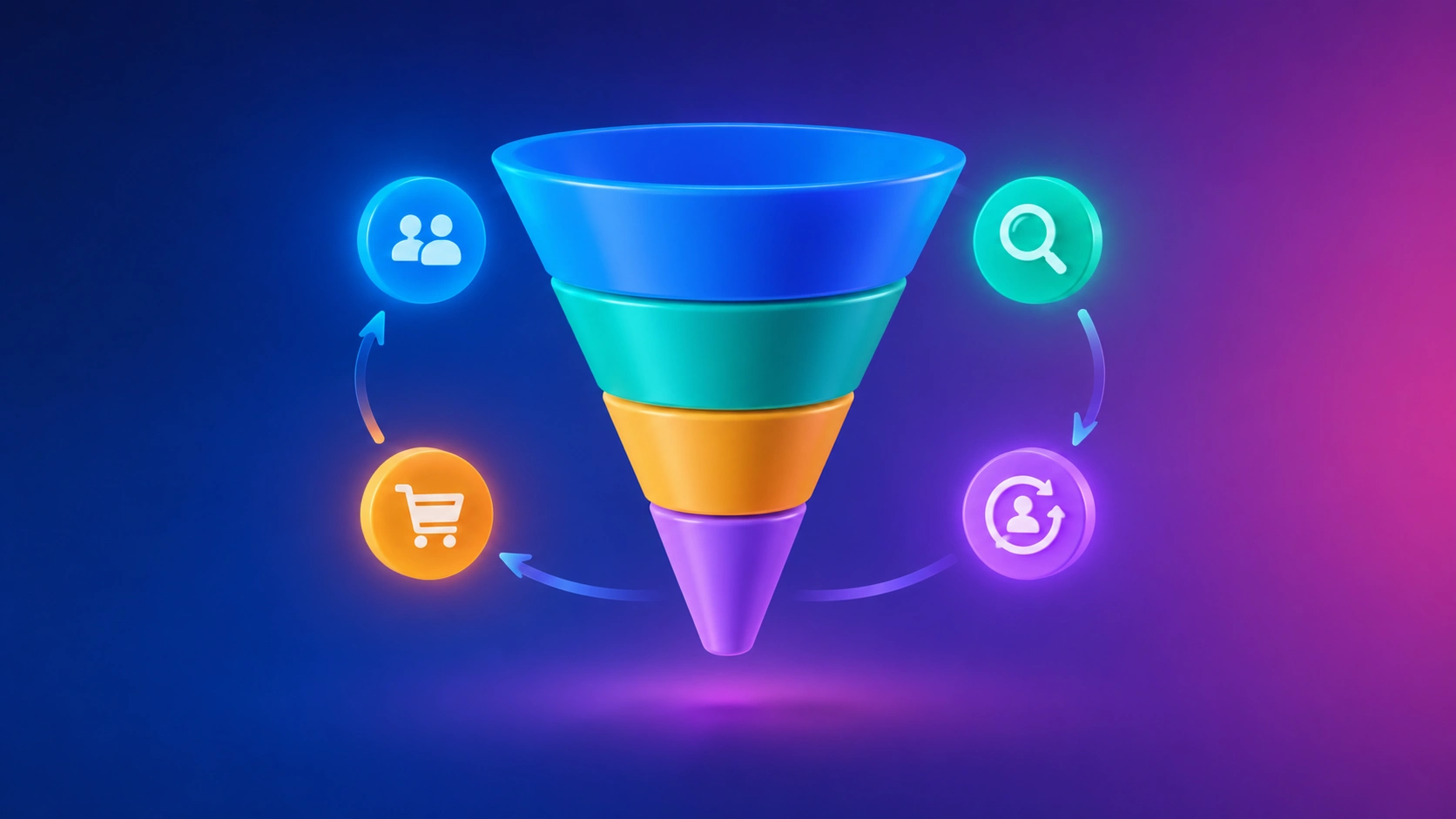
A typical funnel includes:
Funnel Stage | Objective | Typical Channels | Main KPI |
|---|---|---|---|
Awareness | Reach new audiences | Video, Display, Social | Reach, CPM, Video View |
Consideration | Generate interest | Search, Social, Content | CTR, CPC, Engagement |
Conversion | Generate leads or sales | Search, Shopping, Retargeting | CPA, ROAS, Revenue |
Retention | Increase customer value | Email, CRM, Remarketing | Repeat Purchase, LTV |
A full-funnel campaign connects audience, funnel stage, channel, creative, landing page, conversion, measurement and retargeting into one system.
Paid media is particularly valuable because it can introduce a brand to new audiences, capture existing demand and bring back people who have already interacted with the business. Learn more about paid media advertising.
A full-funnel approach prevents businesses from becoming overly dependent on bottom-funnel campaigns.
When marketers focus only on people who are ready to buy, they may capture existing demand but struggle to create new demand. A full-funnel strategy builds awareness, develops interest, encourages conversion and creates opportunities for repeat business.
The goal is not to maximise every individual campaign metric. It is to create a connected customer journey that produces sustainable business growth.
Start with the business outcome, not the advertising platform.
Your goal might be brand awareness, lead generation, e-commerce sales, app installs, customer acquisition, revenue growth or retention.
For example, a business focused on customer acquisition may use lead-generation campaigns at the conversion stage, while an established e-commerce brand may prioritise revenue and repeat purchases.
Effective targeting goes beyond demographics. Consider geography, interests, behaviour, purchase intent, existing customers and high-value customer segments.
First-party data can be particularly useful for understanding existing customers and creating meaningful segments. Audience intelligence can also help marketers make better-informed decisions about customer behaviour and preferences. Explore audience intelligence for more context.
Next, map what customers need at each stage:
Problem Awareness → Research → Evaluation → Purchase → Retention
Someone discovering a problem does not necessarily need a sales offer immediately. They may first need educational content, product information, comparisons, reviews or proof that the solution works.
Your campaigns and creative should reflect these changing needs.
Different channels can play different roles throughout the journey.
Stage | Channels |
|---|---|
Awareness | YouTube, Meta, Display, Video |
Consideration | Google Search, Meta, Content, Remarketing |
Conversion | Google Search, Shopping, Paid Social, Retargeting |
Retention | CRM, Email, Remarketing, Loyalty Campaigns |
Channel selection should also consider user intent. For example, Google Ads vs Meta Ads can serve different purposes because search advertising often captures existing intent, while social advertising can support discovery, awareness and retargeting.
One creative should not be expected to work equally well at every stage.
The closer a prospect gets to purchase, the more specific and action-oriented the messaging can become.
The landing page should continue the message established in the advertisement.
Strong landing pages typically include:
Once users click an advertisement, the landing page becomes critical to turning paid traffic into customers. See how to improve landing page conversions for practical optimisation ideas.
Landing page improvements should also form part of a broader conversion rate optimization process.
A full-funnel strategy cannot work effectively without reliable measurement.
Use tools such as Google Analytics, advertising platform tracking, UTM parameters, and CRM integrations to understand not only where conversions occur but also whether those conversions generate business value.
This means looking beyond clicks and impressions toward lead quality, acquisition costs, revenue and customer value. Strong data analytics capabilities can help connect marketing activity with business outcomes.
Different stages require different KPIs.
Funnel Stage | Key KPIs |
|---|---|
Awareness | Reach, Impressions, CPM, Video Views |
Consideration | CTR, CPC, Engagement |
Conversion | CVR, CPA, CPL, ROAS |
Retention | Repeat Purchase Rate, LTV, Retention Rate |
Do not optimise every campaign against the same metric. Awareness campaigns may need to maximise qualified reach, while conversion campaigns may need to focus on CPA or ROAS.
Understanding PPC, CPM and CPA can also help marketers evaluate different advertising models according to their objectives.
There is no universal budget split that works for every business.
The right allocation depends on brand maturity, existing demand, sales cycle, industry, customer acquisition cost, average order value, retention and historical campaign performance.
A new brand may need to invest more heavily in awareness and consideration, while an established brand with strong existing demand may allocate more budget toward conversion and retention.
Use historical performance as a starting point, then shift investment based on marginal returns rather than following a fixed percentage rule.
Consider a hypothetical D2C brand launching a new product.
Awareness: Meta and YouTube campaigns introduce the product through educational and problem-focused videos.
↓
Consideration: Google Search campaigns and remarketing reach people researching solutions.
↓
Conversion: Product-focused campaigns direct high-intent users to an optimised product page with a clear offer and CTA.
↓
The important part is that data and audiences move between stages. Someone who watches an awareness video can later become a remarketing audience, visit the website, purchase and eventually enter a retention campaign.
Businesses often make the following mistakes:
Avoiding these issues can make campaign optimisation more effective and reduce wasted advertising spend.
Optimisation should be continuous rather than a one-time exercise.
Test:
A simple optimisation loop is:
Launch → Measure → Analyse → Test → Optimise → Scale
The objective is to learn from performance data and progressively improve the entire customer journey.
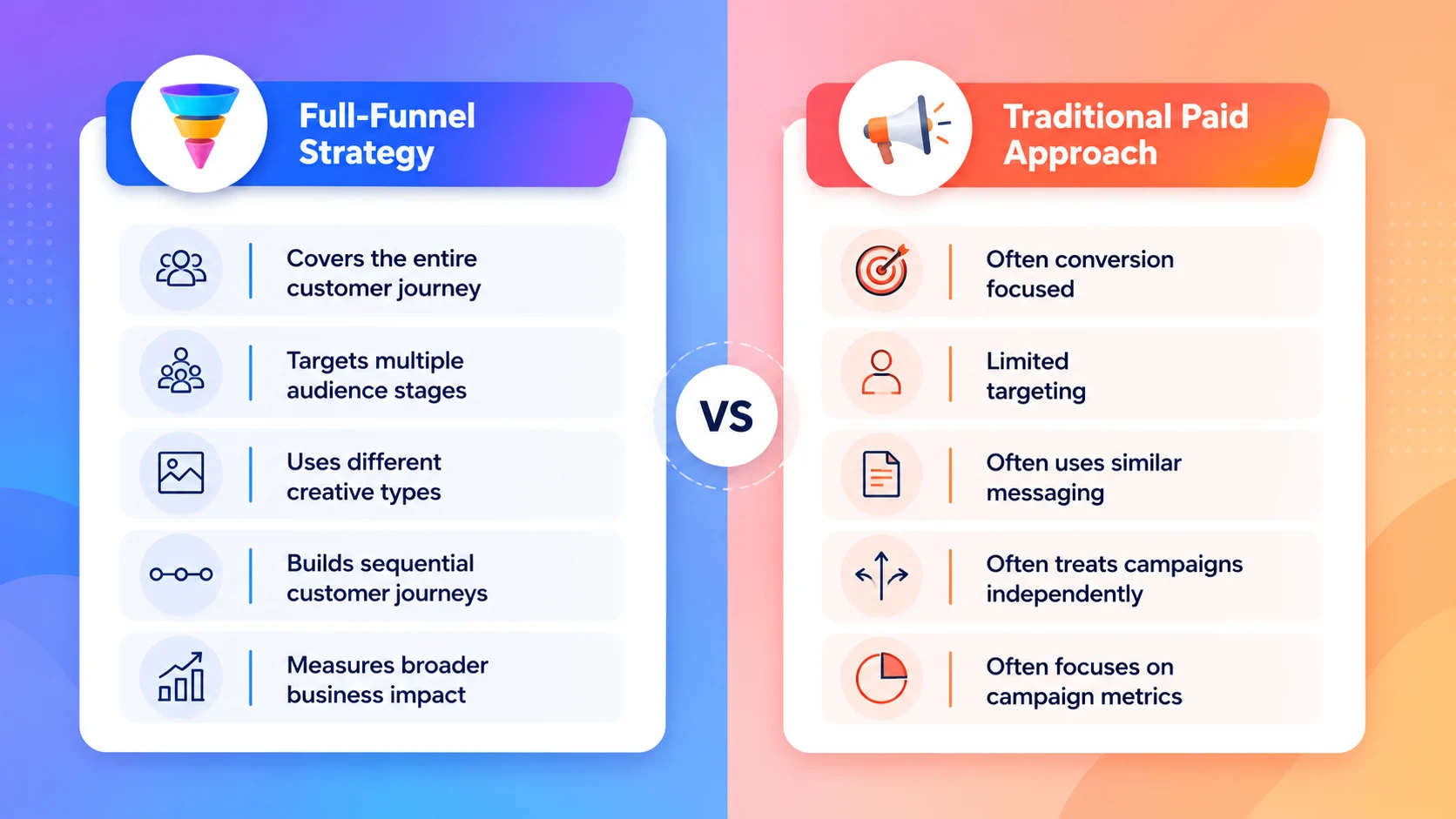
Full-Funnel Strategy | Traditional Paid Approach |
|---|---|
Covers the entire customer journey | Often conversion-focused |
Targets multiple audience stages | Limited targeting |
Uses different creative types | Often uses similar messaging |
Builds sequential customer journeys | Often treats campaigns independently |
Measures broader business impact | Often focuses on campaign metrics |
Traditional advertising can still have an important role, but a full-funnel approach provides a more connected framework for understanding how marketing contributes to growth.
A successful full-funnel performance marketing strategy is not simply about running more campaigns. It is about connecting audiences, channels, creative, landing pages, measurement and customer journeys into one system.
By defining clear business goals, understanding the customer journey, assigning the right channels to each stage and measuring outcomes from click through to revenue, businesses can make better decisions about where to invest.
In 2026, the strongest performance marketing strategies will increasingly focus on the complete customer journey—not just the final click.
Performance marketing focuses on measurable actions such as clicks, leads, sales, or conversions, with campaigns optimized based on real-time data. Traditional advertising includes channels such as TV, radio, newspapers, billboards, and print media, where measuring direct conversions can be more difficult.
Performance marketing can be better when the goal is measurable ROI, precise targeting, and budget control. Traditional advertising can still be valuable for building broad brand awareness and reaching large offline audiences. The better option depends on the business objective, audience, and budget.
In 2026, performance marketing often provides more measurable and trackable ROI because businesses can monitor conversions, customer acquisition costs, and campaign performance. However, ROI varies by industry, audience, offer, channel, and campaign execution. Combining performance marketing with brand-building activities can deliver stronger long-term results.
Yes. Traditional advertising remains effective for businesses that need broad awareness, local visibility, or mass-market reach. Television, outdoor advertising, radio, and print can work particularly well when combined with digital campaigns that allow businesses to track and convert interested audiences.
Yes. Businesses can use both strategies as part of an integrated marketing approach. Traditional advertising can generate awareness and reach, while performance marketing can capture demand, retarget audiences, generate leads, and drive measurable conversions.
Performance marketing is often more suitable for startups because it allows businesses to start with smaller budgets, target specific audiences, and measure results quickly. Startups can gradually add traditional advertising once they have established their target market, messaging, and customer acquisition model.
AI helps performance marketing by improving audience targeting, campaign optimization, predictive analytics, creative testing, personalization, and automated bidding. It can analyze large amounts of customer and campaign data to identify patterns and help marketers make faster, data-driven decisions.
The main performance marketing channels include paid search, paid social media, display advertising, affiliate marketing, influencer marketing, retargeting, email marketing, and native advertising. The right mix depends on the target audience, business model, conversion goal, and customer journey.