

Rahul Guleria
SEO Executive
Creative,
Branding
& Growth
in the Global
Digital Ecosystem

Ecommerce SEO (ecommerce search engine optimization) is the process of optimizing an online store to improve its rankings on search engines like Google. It involves enhancing product pages, category pages, technical website performance, content strategy, and overall user experience to increase organic traffic.
Unlike paid advertising, SEO provides long-term visibility and helps potential customers discover products naturally through search results. With effective ecommerce website SEO, businesses can attract shoppers who are actively looking for products and solutions.
While traditional SEO often focuses on informational content and lead generation, ecommerce SEO prioritizes product discovery, category rankings, shopping intent, and conversion optimization. Ecommerce websites also face unique challenges such as duplicate content, faceted navigation, and large product inventories.
For businesses planning a new online store, reviewing our ecommerce website development guide can help build a strong foundation for SEO success.
One of the biggest benefits of ecommerce search engine optimization is the ability to generate consistent traffic without relying entirely on paid campaigns. Organic traffic compounds over time and often delivers a higher return on investment.
Optimized product and category pages help search engines understand your offerings, increasing the likelihood of appearing for relevant searches and shopping-related keywords.
SEO attracts users with strong purchase intent. When customers find exactly what they're searching for, they are more likely to convert into paying customers.
Unlike paid advertising that stops generating traffic once the budget ends, SEO continues to provide value and visibility over time.
Businesses seeking professional assistance can explore our ecommerce website development services to build SEO-friendly online stores.
Product pages are often the primary entry points for ecommerce websites. Optimizing them correctly can significantly improve rankings and conversions.
Include primary and secondary keywords naturally within product titles while keeping them descriptive and user-friendly.
Example:
Avoid using manufacturer descriptions that appear on multiple websites. Create unique descriptions that highlight features, benefits, specifications, and use cases.
Search engines cannot fully understand images without context. Use descriptive ALT text that includes relevant keywords when appropriate.
Example:"Black leather office chair with ergonomic lumbar support"
Customer reviews build trust and provide fresh content. Implement review schema markup to enhance search result visibility with star ratings.
Category pages often have the highest ranking potential because they target broader commercial keywords.
Create a logical hierarchy that helps users and search engines navigate products efficiently.
Example Structure:
Connect related products and categories through contextual internal links to distribute authority and improve crawlability.
Target groups of related keywords rather than focusing on a single phrase. This approach improves topical relevance and ranking opportunities.
Many ecommerce websites struggle with duplicate content caused by filters, sorting parameters, and product variations. Use canonical tags and proper URL management to prevent indexing problems.
Technical optimization forms the foundation of successful ecommerce website SEO.
Fast-loading pages improve user experience and support higher search rankings.
Best practices include:
Google primarily evaluates mobile versions of websites. Ensure your ecommerce store provides a seamless mobile shopping experience.
Regularly audit your website to identify:
XML sitemaps help search engines discover important pages, while robots.txt guides crawler access and prevents indexing of low-value URLs.
Schema markup helps search engines better understand website content and can improve visibility through rich results.
Provides details such as:
Displays customer ratings directly within search results, improving click-through rates.
Enhances navigation understanding and improves search result presentation.
Adding FAQ schema can increase SERP visibility and help capture more search real estate.
Quality backlinks remain an important ranking factor in ecommerce SEO.
Publish valuable content on industry-relevant websites to earn authoritative backlinks and increase brand exposure.
Acquire links directly to important category pages to improve rankings for competitive commercial keywords.
Use blog content to support product and category pages through strategic internal linking.
Identify broken links on relevant websites and offer your content as a replacement resource.
Many online stores struggle because of avoidable SEO issues.
Overusing keywords can harm readability and search performance. Focus on natural optimization.
Short or duplicate product descriptions provide little value to users and search engines.
Duplicate URLs caused by filters, variants, or session parameters can dilute ranking signals.
Confusing navigation structures make it harder for users and search engines to find important pages.
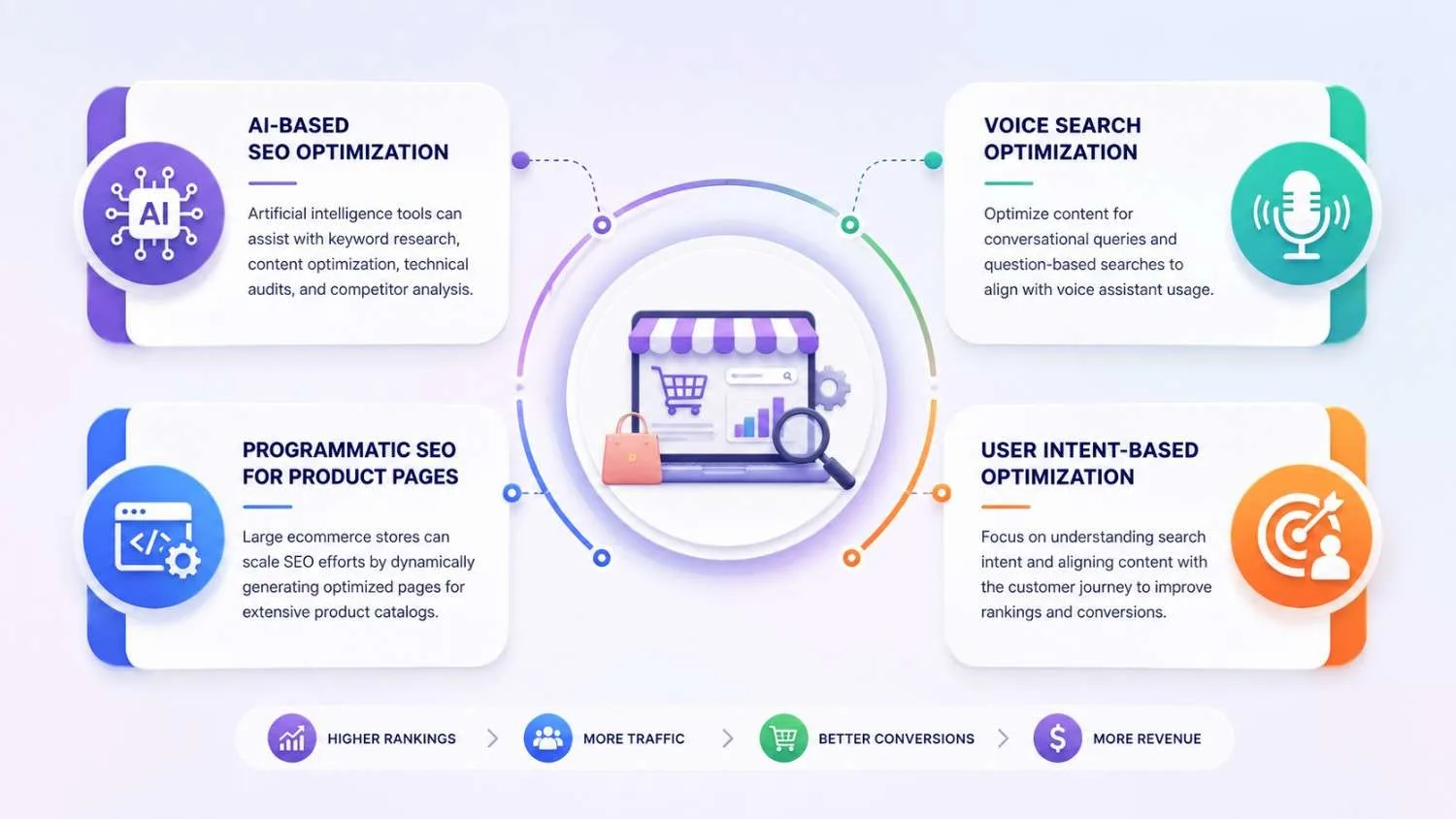
SEO continues to evolve, and ecommerce businesses must adapt to stay competitive.
Artificial intelligence tools can assist with keyword research, content optimization, technical audits, and competitor analysis.
Optimize content for conversational queries and question-based searches to align with voice assistant usage.
Large ecommerce stores can scale SEO efforts by dynamically generating optimized pages for extensive product catalogs.
Focus on understanding search intent and aligning content with the customer journey to improve rankings and conversions.
While some businesses manage SEO internally, expert guidance can accelerate growth and prevent costly mistakes.
If organic traffic has plateaued despite ongoing efforts, professional SEO analysis can identify opportunities.
High traffic with low sales often indicates issues with user experience, targeting, or page optimization.
Poor rankings may result from technical issues, weak content, or insufficient authority.
Large ecommerce websites often face indexing, crawl budget, and performance challenges that require advanced expertise.
Ecommerce SEO remains one of the most effective long-term growth strategies for online businesses in 2026. By optimizing product pages, category structures, technical performance, schema markup, and backlink profiles, businesses can significantly improve visibility, attract qualified traffic, and increase sales.
Success with ecommerce search engine optimization requires continuous monitoring, regular updates, and adaptation to evolving search engine algorithms. Companies that invest in SEO consistently will be better positioned to achieve sustainable growth and maintain a competitive advantage in the online marketplace.