

Rahul Guleria
SEO Executive
Creative,
Branding
& Growth
in the Global
Digital Ecosystem

E-commerce websites have transformed how businesses sell products and services in today’s digital economy. In 2026, companies of all sizes are moving online to reach more customers, improve operational efficiency, and increase revenue.
An e-commerce website is a digital storefront where customers can browse products, make purchases, and complete transactions online. From startups to large enterprises, businesses are adopting e-commerce to stay competitive in a rapidly evolving marketplace.
Digital transformation has played a major role in this shift. Consumers now prefer convenient online shopping experiences, mobile purchasing, and fast delivery services. Businesses that invest in e-commerce platforms can streamline operations, automate sales processes, and scale faster than traditional retail models.
If you are planning your online business strategy, this detailed guide on ecommerce website development can help you understand the essentials of building a successful online store.
For businesses exploring digital expansion, read our guide on ecommerce website development guide
Unlike physical stores with fixed operating hours, e-commerce websites allow businesses to sell products 24/7. Customers can shop anytime, increasing opportunities for sales and revenue generation.
One of the biggest benefits of e-commerce websites is the ability to reach customers worldwide. Businesses are no longer restricted by geographical boundaries and can target international audiences with ease.
E-commerce platforms make it easier to scale operations. Businesses can quickly add new products, expand categories, and increase inventory without opening additional physical locations.
Online stores simplify the buying process through streamlined checkout systems, promotional offers, and personalized shopping experiences, resulting in higher conversion rates and increased sales.
Operating an e-commerce website typically costs less than maintaining a physical retail store. Businesses can reduce expenses related to rent, utilities, and in-store operations.
Online businesses often require smaller teams and less infrastructure. Automation tools can manage inventory, customer communication, and payment processing efficiently.
With e-commerce, businesses can operate from virtually anywhere. This flexibility lowers startup costs and reduces the financial risks associated with physical retail expansion.
Digital marketing channels such as SEO, email campaigns, and social media advertising offer better targeting and measurable ROI compared to many traditional marketing methods.
If you are planning to start your online store, professional e-commerce website development services can help you build a scalable, high-converting platform tailored to your business goals.
Explore our professional ecommerce website development services
Modern e-commerce websites provide intuitive navigation, category structures, and advanced filtering systems that help users quickly find products.
AI-driven recommendation engines analyze customer behavior and suggest relevant products, improving engagement and increasing sales opportunities.
Optimized checkout experiences reduce cart abandonment rates and improve customer satisfaction by making purchases simple and secure.
With mobile commerce growing rapidly, responsive e-commerce websites ensure seamless shopping experiences across smartphones, tablets, and desktops.
An SEO-optimized e-commerce website can rank for valuable search terms, helping businesses attract organic traffic from search engines.
Businesses can create product pages, category pages, and blog content targeting specific keywords relevant to customer searches.
E-commerce websites integrate easily with social media platforms, allowing businesses to run promotions, share products, and drive traffic directly from social channels.
Businesses can monitor user behavior, conversion rates, traffic sources, and customer journeys using analytics tools to make data-driven decisions.
Adding new products or services to an online store is faster and more cost-effective compared to expanding a physical store.
E-commerce websites support multiple currencies, languages, and shipping options, making international expansion easier.
Modern platforms are built to handle traffic spikes during sales events, seasonal campaigns, and marketing promotions.
Businesses can integrate payment gateways, CRM systems, inventory management software, and marketing tools to improve efficiency.
An online presence helps businesses compete with larger brands and reach customers outside their immediate local area.
A professionally designed e-commerce website builds trust, credibility, and brand recognition among customers.
Automation tools can manage emails, inventory updates, customer support, and abandoned cart recovery, improving operational efficiency.
E-commerce businesses can quickly respond to market trends, customer preferences, and changing consumer behavior.
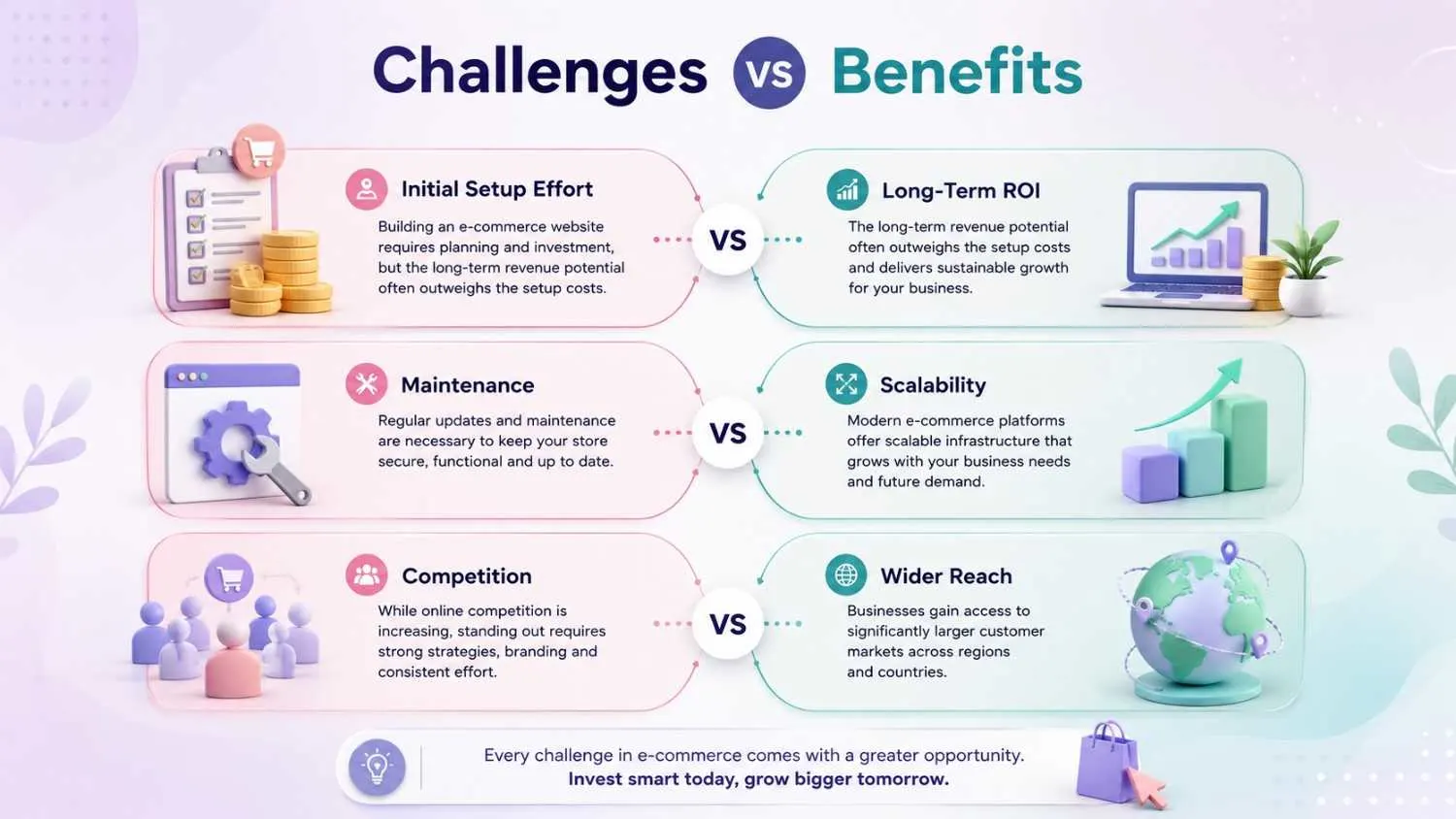
Building an e-commerce website requires planning and investment, but the long-term revenue potential often outweighs the setup costs.
Regular updates and maintenance are necessary, but modern e-commerce platforms offer scalable infrastructure for future growth.
While online competition is increasing, businesses also gain access to significantly larger customer markets.
Artificial intelligence is transforming e-commerce through smart recommendations, chatbots, predictive search, and automated customer support.
More consumers are shopping through mobile devices than ever before, making mobile-optimized e-commerce essential.
Modern consumers expect convenience, speed, and personalized experiences, all of which e-commerce platforms can provide.
Businesses are increasingly prioritizing digital channels as online commerce becomes a dominant part of the global economy.
Looking for a professional solution to launch or scale your online business?
Our team specializes in creating modern, scalable, and conversion-focused e-commerce platforms tailored to your business needs.
Get started with expert ecommerce website development services
The benefits of e-commerce websites extend far beyond online sales. From global reach and reduced operational costs to enhanced customer experiences and business scalability, e-commerce has become essential for modern businesses in 2026.
As digital shopping continues to grow, businesses that invest in professional e-commerce solutions will gain stronger market positioning, better customer engagement, and long-term growth opportunities.
Whether you are a startup or an established brand, building a scalable e-commerce website can help future-proof your business in the digital economy.
The main benefits include global customer reach, 24/7 availability, lower operational costs, improved customer experience, and higher scalability.
E-commerce websites help businesses expand into new markets, increase online sales, automate operations, and improve marketing performance.
Yes, e-commerce websites usually require lower overhead costs because businesses save on rent, utilities, staffing, and infrastructure expenses.
E-commerce websites offer faster checkout, personalized recommendations, easy navigation, and mobile-friendly shopping experiences.
Businesses should invest in e-commerce because consumer behavior is increasingly digital-first, mobile commerce is growing rapidly, and online platforms provide scalable growth opportunities.